Will Rate Hikes Lead to Recession?

Although trading last week was limited to four trading days due to a holiday weekend gold had a deep and severe price decline.

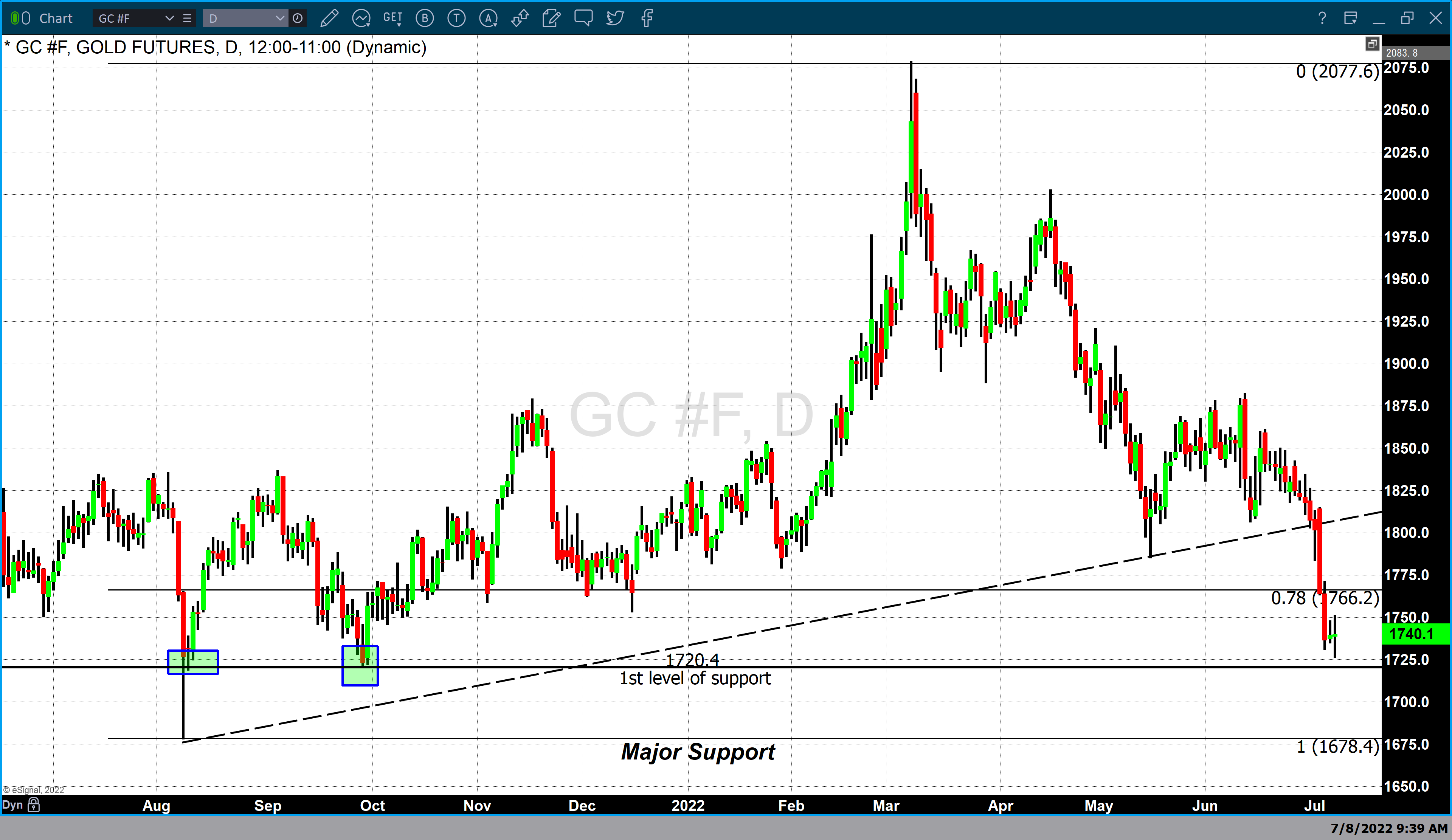
Gold lost approximately $74 in trading this week opening at approximately $1814 on Tuesday and settling at $1741 Wednesday. Last week’s price decline resulted in gold devaluing by 4%.

The Friday before last, gold opened above and closed below a support trendline that was created from two higher lows. The first low occurs at $1679 the intraday low of the flash crash that occurred in mid-August 2021. The second low used for this trendline occurred in the middle of May when gold bottomed at $1787.
Daily Gold Futures Chart

Gold closed just below that trendline one week ago, however it was Tuesday's exceedingly strong price decline of $50 that accounted for two-thirds of last week’s price decline and resulted in major technical chart damage.
Daily DX Futures Chart

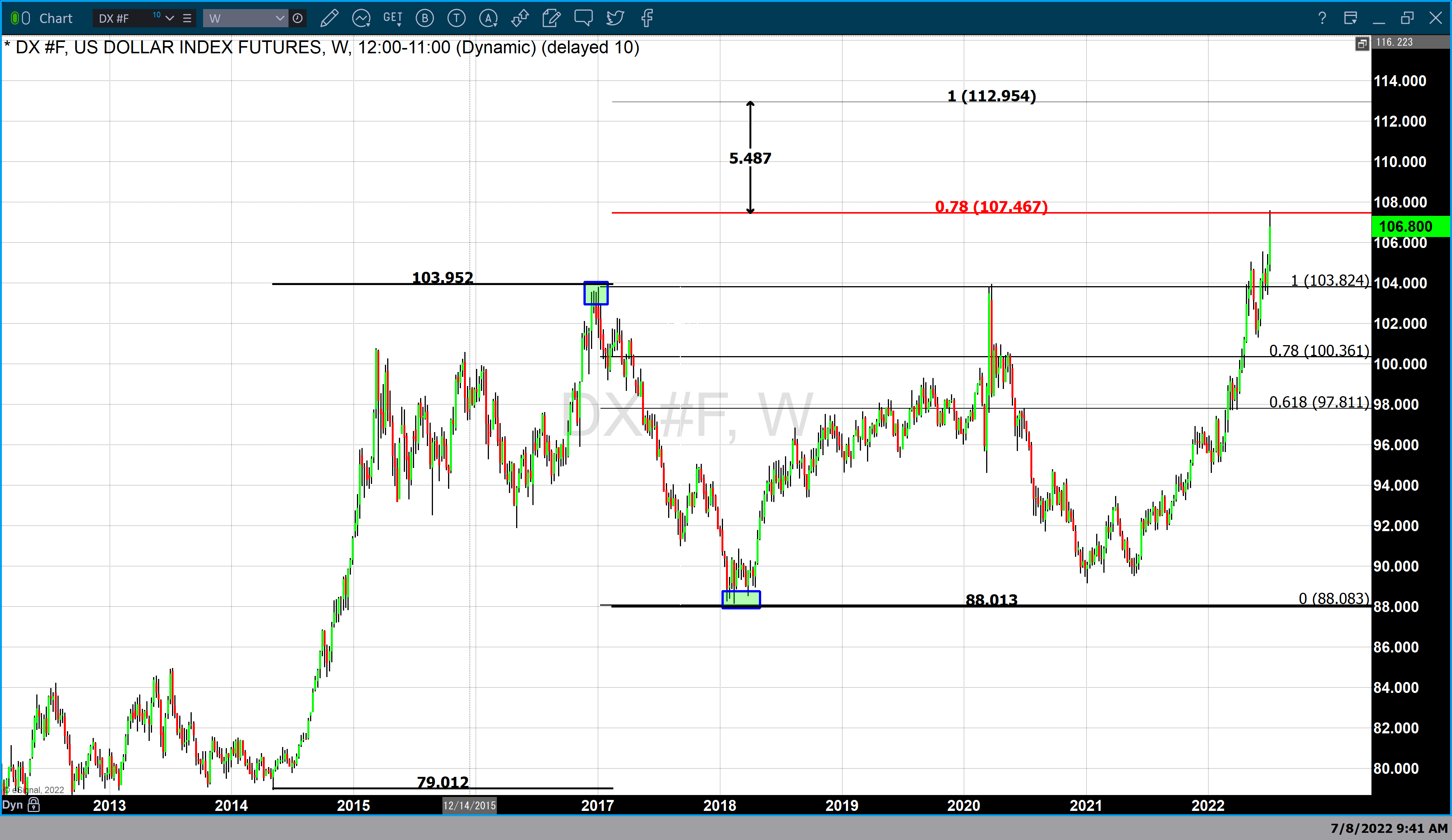
The primary force that moved gold substantially lower last week was dollar strength. The dollar index gained well over 2% last week accounting for over half of the price decline in gold.

Dollar strength was a result of traders and investors focusing on recent and future interest rate hikes by the Federal Reserve. Since March the Federal Reserve has raised rates on three occasions with each rate hike having a higher percentage increase than the last. The Fed raised rates by 25 basis points in March, 50 basis points in May, and 75 basis points in June.

Friday’s jobs report was forecasted to show that 250,000 jobs were added to payrolls last month. The actual numbers came in well above expectations with 327,000 jobs added last month. The unemployment level remained at 3.6%.

The fact that the actual jobs report came in above expectations strengthened the hand of the Federal Reserve to continue to raise interest rates substantially this month.

It is highly anticipated that the Federal Reserve will enact another 75-point rate hike at the July FOMC meeting. Before the Federal Reserve raised interest rates in March the fed funds rate was just ¼% or 25 basis points.

Currently, the interest rate set by the Federal Reserve is at 1 ½ % to 1 ¾. This would take the interest level set by the Federal Reserve to 2 ¼% to 2 ½%.

According to the CME’s FedWatch tool, there is a 93% probability that the Federal Reserve will raise rates once again by 75 basis points this month.

However, there are three more times that members of the Federal Reserve will convene for an open market committee meeting which leaves the door open for additional rate hikes. Because the Federal Reserve is data-dependent the number and size of the rate hikes will be based upon whether or not there is a substantial decrease in inflationary pressures.

That being said, it is most likely that this week’s CPI report will not have a dramatic impact on the Federal Reserve’s decision to raise rates as Chairman Powell and other Fed members have stated that the Federal Reserve will aggressively raise rates at the July FOMC meeting.

For those who would like more information simply use this link.

Wishing you, as always good trading,
Gary S. Wagner
The Gold Forecast

Free Educational Webinar: "Insider's" Secrets

Imagine learning the strategies that successful fund managers are using right now to invest and trade in this market - the worst market in 50 years.

Knowing the strategies professional traders use to deliver profits to their investors can inform and support your own trading.

Our friend, Adam Mesh, is inviting you to an educational webinar on Thursday, July 14th, at 1PM (ET) where he will be joined by Jay Hatfield from the C-suite at Infrastructure Capital Advisors, an extremely successful ETF company.

They are going to share the inside strategies and tactics they have used to build their Infracap Equity Income Fund.

Save My Seat

This educational webinar is designed to help you become the best trader/investor you can be and may even open your eyes to opportunities you may have never imagined in the markets.

If you want to be a better trader and investor, click here right now and show up on Thursday!

Enjoy,
The INO.com Team

P.S. This is an educational event. There is nothing to buy... come ready to learn.

This is a Trader You'll Want to Know

We have got to introduce you to someone.

That's if you don't already know him - after all, he is one of the most followed technical analysts on the globe.

JC Parets is the real deal when it comes to technical analysis. Not only is he a Chartered Market Technician (CMT), but he shows his followers how to unlock market secrets hiding in the charts.

We're teaming up to bring you a free technical analysis basics course.

In this 5-part series, you'll learn:

  • why technical analysis trumps fundamental analysis
  • when and why to use particular chart types
  • a crucial strategy when looking at trends that most traders get wrong
  • plus much more

There is no cost for this course, and you'll get your first lesson right away.

We know you'll thank us once you meet JC - there aren't many quite like him!

Start The Course

Enjoy,
The INO.com Team

Critical Report Due Out On Wednesday

Chairman Powell’s testimony before Congress this week painted a dire economic outlook which will include the continued contraction of the national GDP coupled with continued interest rate hikes.

During his testimony, it was evident that there was a subtle difference in his word track that was uncharacteristic and a dramatic change from his usual refined method.

The chairman made it clear that the Federal Reserve has one goal in mind above all others and that is to reduce the level of inflation. They emphatically stated that the actions of the Federal Reserve will most likely lead to a recession rather than a soft landing.

Yahoo finance captured his overall demeanor in a most articulate manner saying, “He said a recession caused by the Fed’s own monetary tightening remains a “possibility.”

A soft landing, with higher rates but a still-healthy economy, would be “very challenging” to achieve. And Powell said the Fed’s fight against inflation was “unconditional,” meaning nothing will stand in its way.”

The revisions by the Federal Reserve to their monetary policy most certainly would contract the economy and bring on a recession.

A recession is defined as “a period of temporary economic decline during which trade and industrial activity are reduced, generally identified by a fall in GDP in two successive quarters.”

The last GDP report revealed that the United States had an economic expansion leading to a 6.9% growth in the GDP for Q4 of 2021. If advanced estimates for the GDP Q1 are correct it will indicate a decrease in the real gross domestic product (GDP) for the first quarter of this year.

The last occurrence of a contracting GDP quarter to quarter occurred during Q2 of 2020. However, the following quarter (Q3 2020) revealed a robust increase in national GDP.

This is why next week’s report is so critical. On Wednesday, June 29 the BEA (Bureau of Economic Analysis) will release the U.S. GDP first-quarter report.

According to the advanced estimate released on April 28, “Real gross domestic product (GDP) decreased at an annual rate of 1.5 percent in the first quarter of 2022, according to the "second" estimate released by the Bureau of Economic Analysis. In the fourth quarter, real GDP increased 6.9 percent.”

Currently, there is a high probability that the actions of the Federal Reserve will lead to a recession. The question is not whether or not the United States will enter recession but rather when the recession will begin and how long the recession will last.

Daily Gold Chart

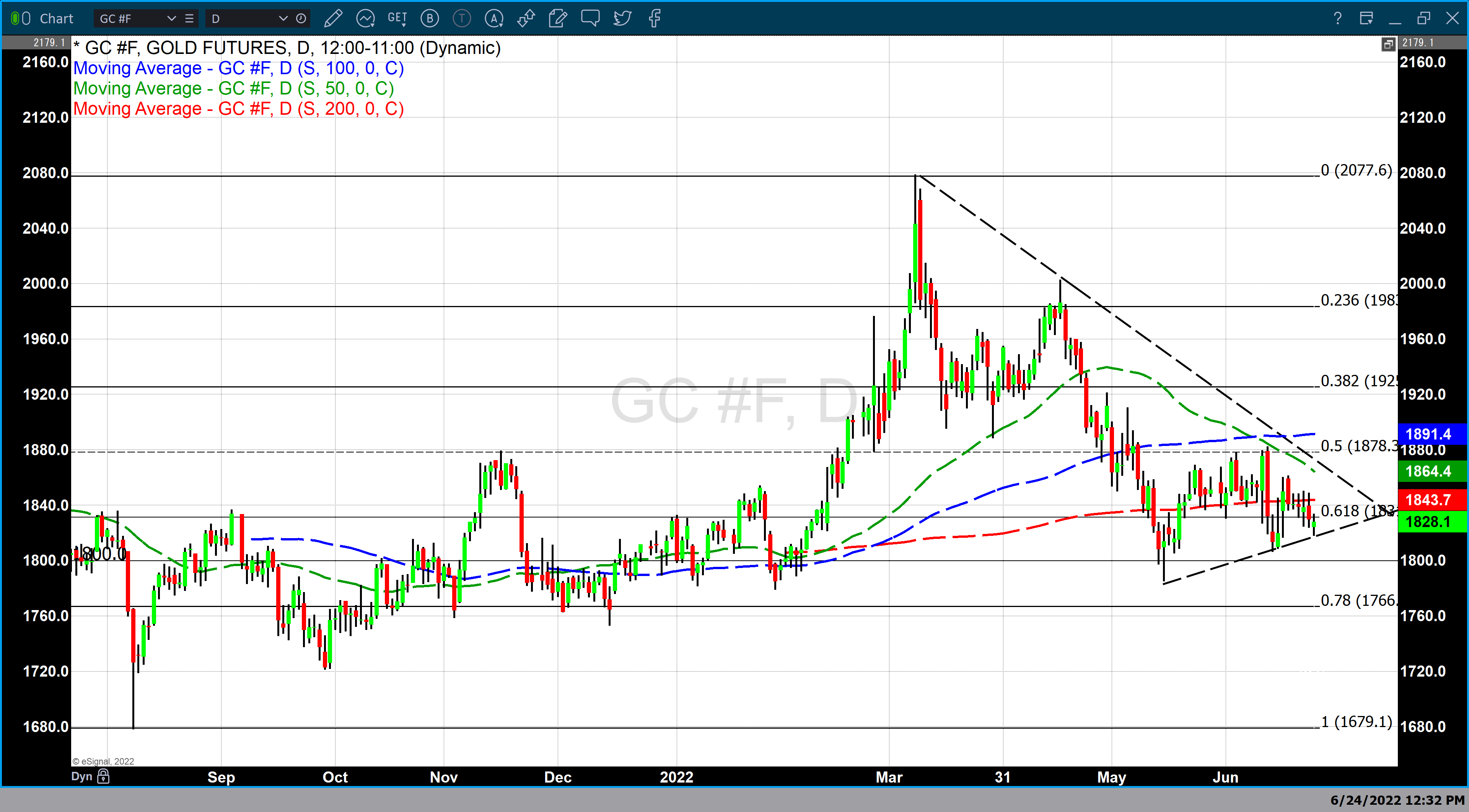
While a recession can stabilize gold pricing, and higher inflation certainly creates a bullish undertone for the precious yellow metal, rising interest rates have become a primary focus on the future price of gold and has pressured pricing lower since March of this year.

Gold has declined just over 12% from the highs of $2070 in March to gold’s current pricing of $1828. While it seems as though there is strong support for gold at $1800 depending on how aggressive the Federal Reserve becomes in regard to further rate hikes.

Besides the GDP report due out on Wednesday, on Thursday the government will release its latest core inflationary numbers when the U.S. PCE price index report is published.

For those who would like more information simply use this link.

Wishing you, as always good trading,
Gary S. Wagner
The Gold Forecast
Bear Market Q&A

The main question of bull or bear market has been answered quite loudly - BEAR!!! Now more investors are getting the memo and running for the exits at the same time. Steve Reitmeister, CEO of StockNews.com and Editor of the Reitmeister Total Return, is here to answer some questions about the current bear market.

Q: How long will this bear market last?

A: The average bear market in history has lasted for 13 months. That is measured from peak to valley. So in this case the peak of 4,818 was set on January 4, 2022. So if things went according to schedule we would say bottom is likely to be found around February 2023.

However the stock market rarely does anything according to schedule leading to the next question…

Q: Do you believe this bear market will be longer or shorter than the 13 month average?

A: I think it will be shorter because everything about the modern market works faster. Meaning that with so much computer based trading, volatility has increased with stocks rising and falling faster than ever before.

So quite possibly we find bottom faster this time around as well.

Q: Does that mean you expect stocks to fall less than the 34% average bear market decline because it will be a shorter time period?

A: Unfortunately not. I suspect we will wind up a bit closer to 40% decline given that the low rate TINA environment pushed stocks to higher than normal PE levels.

In fact many of the glamorous growth stocks of 2021 were seeing valuations not that far off the 1990’s tech bubble style levels. From that higher peak it will likely be a steeper than normal drop to find equilibrium.

Note that 3,180 represents a 34% decline from peak. And 2,891 is where we end up if 40% decline is in the cards.

Q: How should one interpret a positive day for stocks like today if we are in the midst of a bear market?

A: Consider this... does a bull market go straight up?

Of course not. There are extended bull runs followed by pullbacks and corrections. Yet as you look back over time the gains of the bull are undeniable.

Bear markets are no different. They don’t go straight down either. It is an ongoing process of bear runs to new lows followed by bounces and then another leg lower so on and so forth til bottom is found.

Now everything I said is my current guestimate with a wide range of potential outcomes. NOTHING about this bear, or any other, will go according to a preset pattern. That means we need to be flexible to adjust our plan according to the realities on the ground.

That includes when we start bottom fishing for the next bull run. We would rather be a touch early than a touch late.

That’s because on the late side there is usually a wicked 10-20% bounce from bottom that catches everyone by surprise.

So I suspect we will kind of work our way back to fully invested in 2-3 phases to never be leaning too far in the wrong direction when the market is finally ready to explode off the bottom.

Right now I imagine that first attempt at buying bottom would be around -30%…then down 34%…then hold on to that last part to see if indeed -40% is in the cards. However, at this stage we are getting WAY ahead of ourselves.

For now, there is likely a few months’ worth of bear market to come. Scary drops…shocking bounces (rinse and repeat).

Wishing you a world of investment success!

Steve Reitmeister… but everyone calls me Reity (pronounced “Righty”)
CEO, StockNews.com & Editor, Reitmeister Total Return


About the Author

Steve is better known to the StockNews audience as “Reity”. Not only is he the CEO of the firm, but he also shares his 40 years of investment experience in the Reitmeister Total Return portfolio. Learn more about Reity’s background, along with links to his most recent articles and stock picks.