Intel Corporation (INTC) Races to Dominate the AI Market – Will It Succeed?

In our June 3 post, we concluded that the resurgent Intel Corporation (INTC), which had weathered back-to-back quarterly losses amid softening PC demand, consequent surplus inventory, and realignment toward GPU-heavy and AI-centered enterprise demand, could be worth more than what was being suggested by its market price at that time.

By announcing its return to profitability during last week’s earnings release, the pioneer of modern computing lived up to our expectations while exceeding the ones on the Street. INTC posted a net income of $1.5 billion, compared to a net loss of $454 million during the previous-year quarter. Its adjusted EPS came in at $0.13 compared to an adjusted loss of $0.3 per share expected by Wall Street.

While the Market greeted the news with a 7% surge in the stock price in extended trading and a further 5% gain the following morning, INTC’s revenue, despite exceeding low expectations, declined 15.7% year-over-year to $12.9 billion, marking the sixth consecutive quarter of sales decline.
In view of a subdued topline, much of the outperformance in the quarterly results can be attributed to the progress INTC had made in cutting $3 billion in costs this year.

In addition to exiting nine lines of business since CEO Pat Gelsinger rejoined INTC to achieve a combined annual savings of more than $1.7 billion, the company slashed its dividend and announced plans to save $10 billion per year by 2025, including through layoffs.

With INTC’s cloud computing group, which includes the company’s laptop and desktop processor shipments, and server chip division, which is reported as Data Center and AI, reporting year-over-year declines of 12% and 15%, respectively, Pat Gelsinger forecasted “persistent weakness” in all segments of its business through year-end, and that server chip sales won’t recover until the fourth quarter.

With upside through cost optimization capped and customers prioritizing GPUs over CPUs to handle ever-increasing AI/ML workloads, INTC is eager to join the race currently being led by NVIDIA Corporation (NVDA) and Advanced Micro Devices, Inc. (AMD). The company is working on the manufacturing front, for which it significantly depends on Taiwan Semiconductor Manufacturing Company Ltd. (TSM).

By doubling down on the fab business, INTC aims to match TSM’s chip-manufacturing capabilities by 2026, enabling it to bid to make the most advanced mobile processors for other companies, a strategy the company calls “five nodes in four years.”

To that end, INTC is pursuing an aggressive IDM 2.0 road map with new manufacturing facilities in Oregon, New Mexico, Arizona, Ireland, and Israel in the pipeline to augment the capabilities of 15 fabs worldwide and facilities to assemble and test the manufactured chips in Vietnam, Malaysia, Costa Rica, China, and the U.S.

Among those, Arizona's new facilities would be manufacturing chips for the company and customers such as Amazon, Qualcomm, and others as part of Intel Foundry Services. While the company still depends on TSMC for 5nm chips used for AI applications, it aims to take a quantum leap in that direction with even smaller 18 A chips.

While companies such as Amazon.com, Inc. (AMZN) are resorting to chips designed in-house to support their cloud infrastructure, INTC, in addition to being the manufacturer of both wafers and packaging of AI accelerators, is also present with its Gaudi chips.

The company’s efforts are also receiving much-needed political encouragement in the form of the Chips and Science Act, which is aimed at on-shoring and de-risking semiconductor manufacturing in the interest of national security.

Recently, Pat and his team at INTC upped the ante by unveiling its new ambitious plans to incorporate AI into every product it creates. This announcement comes as the company’s upcoming Meteor Lake chips are rumored to feature a built-in neural processor specifically designed for handling machine learning tasks.

With an objective to “democratize AI,” Pat was loud and clear about INTC’s plans to make it a ubiquitous and integral feature of its products designed to cater to all segments of the computing ecosystem, including “at the edge in the Client, in the enterprise, as well as in the cloud.”
The upbeat CEO forecasted that AI would permeate all business domains, including the client-facing consumer electronics market, enterprise data centers, and even manufacturing, and make its way into personal devices, such as hearing aids and personal computers. AI is already present as a co-pilot for Windows 11, allowing users to type questions and perform specific actions, and it could play a significant role in the next iteration of Windows.

Bottom Line

For the third quarter of the fiscal, INTC expects adjusted earnings of 20 cents per share on $13.4 billion revenue at the midpoint.
Whether or not INTC manages to meet or exceed the above target could go a long way in helping investors determine if its ambitious turnaround is on track to restore the company to its former glory.
Will Twilio (NYSE: TWLO) and Amazon (NASDAQ: AMZN) Redefine AI Potential with Their Unstoppable Alliance?

Last week, at the Amazon Web Services (AWS) Summit in New York, San Francisco-based cloud communication and customer engagement platform Twilio Inc. (TWLO) announced its strategic partnership with technology giant Amazon.com, Inc. (AMZN). Right on cue, the market welcomed the announcement with more than a 5% intraday gain in the former’s share price while surging by as much as 11.7% during the trading session.

The Partner

As a dominant player in the CPaaS (Communications-Platform-as-a-Service) market, TWLO provides businesses with the tools to integrate voice calls, text messages, and security verification tools into their software and apps to drive customer engagement by facilitating seamless and personalized interactions on demand. This empowers businesses to expand their customer base and communicate with clients across the globe.

While potential growth avenues for TWLO include expanding its CPaaS offerings and forging partnerships with other major tech companies, competition from established tech giants could impact the company’s operations and revenue generation. However, that concern seems to have been mitigated by TWLO’s artificial intelligence (AI)-fueled strategic partnership with AMZN.

The Partnership

The renewal of vows and strengthening of ties, which seeks to enhance the company’s predictive AI proficiency, has closely followed a vote of confidence from the tech giant in which AMZN announced that it has acquired 1% stake in TWLO earlier in the week with its ownership of 1.77 million shares worth more than $108 million.

The association between the two businesses started back in 2016 when TWLO began serving as a Marketplace partner for AWS, which had become the world's largest cloud infrastructure platform. It signed two deals with AMZN to directly integrate its communication tools into AWS, which enabled developers to easily add TWLO's voice calls, text messages, audio clips, and other features to their mobile apps.

Fast forward to June 2022, and TWLO revealed its CustomerAI, which adds a technology layer that integrates generative AI and predictive AI tools into the company's customer engagement platform.

According to Twilio CEO Jeff Lawson, who was employed with AMZN between 2004 and 2005, “With generative and predictive intelligence, Twilio’s high-quality interaction data, and Segment profiles working together, every experience can be highly personalized and tuned with a level of sophistication that was previously only attainable by the tech giants. With Twilio CustomerAI, brands can transform their customer relationships and unlock their full potential.”

The Heavyweight

Coincidentally, also in June 2023, AWS, in response to the recent noise around AI being made by frontrunner Microsoft Corporation (MSFT) and challenger Alphabet Inc. - Class A (GOOGL), announced an allocation of $100 million for a center to help companies use generative AI. This technology has captivated the public imagination and shaped the business narrative since OpenAI unleashed ChatGPT.

While $100 million might be an apparent drop in the bucket for a company with $64 billion in cash and half a trillion dollars a year in operating expenses, the investment acknowledges the significance of generative AI and the importance of being a part of the conversation.
AWS CEO Adam Selipsky insists that the AI trend is real. For AMZN, that momentum applies to its Bedrock generative AI service and its Titan models, as well as the new innovation center.

While it might seem that the company, which got a head start of no less than seven years over MSFT and GOOGL in the business of renting out servers and data storage to companies and other organizations, might be late to the generative AI game, Selipsky, echoing Amazon founder and longtime CEO Jeff Bezos, said the company has succeeded by listening to customers.

In fact, AMZN’s leadership in the cloud infrastructure market could give the company heft and mileage in the generative AI race. “AI is going to be this next wave of innovation in the cloud,” Selipsky said. “It’s going to be the next big thing that pushes even more customers to want to be in the cloud. Really, you need the cloud for generative AI.”

Moreover, according to Selipsky, AWS provides a measure of credibility in offering generative AI that eludes others in the space. He emphasized, “I can’t tell you how many Fortune 500 companies I’ve talked to who banned ChatGPT in the enterprise. Because at least the initial versions of it just didn’t have that concept of enterprise security.”

Bottom line

TWLO Senior Director of Product Alex Millet expressed his optimism around the company’s partnership with AMZN, “With AWS’ predictive AI technologies, we are rapidly developing AI-native features and APIs.” He further added, “We believe our tools will change the way marketers, contact centers, developers, and data teams deliver these world-class customer experiences.”

Hence, while the OpenAI-MSFT alliance is garnering attention and reaping the first-mover advantage with GOOGL scrambling to play catchup, the coalition of AMZN and TWLO has the potential to emerge as the dark horse in what AWS CEO has termed as a “10K race.”

August Stock Market vs. Big 3 Economic Reports

Please enjoy this updated version of weekly commentary from the Reitmeister Total Return newsletter. Steve Reitmeister is the CEO of StockNews.com and Editor of the Reitmeister Total Return.Click Here to learn more about Reitmeister Total Return


SPY – The new bull market is hand as the S&P 500 (SPY) moves ever closer to the all time highs. However, that doesn’t mean we can fall asleep at the wheel as the health of the economy is always part of the stock investment equation. As such let’s review the Big 3 economic reports on the menu in early August and what that tells us about the market outlook and adjustments to our trading plan. Read on for the full story below…

This week we get served up the Big 3 economic reports to give us a wide ranging view on the health of the economy.

Typically, these are market moving events. However, with stocks on such a tremendous bull run, then the good news is likely priced in and the risk remains to the downside.

The first of those reports came in today, ISM Manufacturing. So let’s discuss the results along with a preview of the other 2 to shape our market outlook and trading plan.

Last week the key event was the Fed announcement on Wednesday 7/26. I gave a pretty thorough analysis of the event in this commentary.

The summarized version is that there is good reason to believe the Fed has made their last rate hike. Further, they have improved their future economic outlook to where they believe inflation can be tamed without creating a recession.

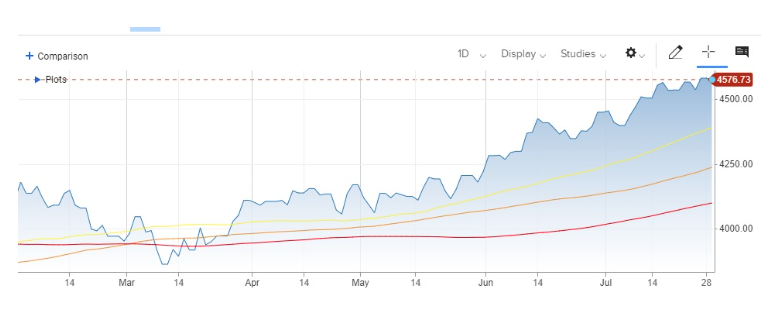
Investors already assumed that to be the case which was the catalyst behind the nearly non-stop rally we have enjoyed since mid March. That is when fears of the banking concerns started to go away allowing the S&P 500 (SPY) to bounce from 3,855 to the present level that is getting ever closer to the all time highs.

With the Fed announcement by the way side, plus Q2 earnings season in line with modest expectations, now attention turns to the Big 3 economic reports that kick off each new month.

ISM Manufacturing got things started on Tuesday morning. It is hard to say with a straight face that the 46.4 reading is good when everything below 50 is a sign of economic contraction. However, it is a step up from the even weaker 46.0 last month. More importantly, the New Orders component rose from recent weakness which generally means future readings will be higher as well.

However, given the importance of full disclosure I will admit that the Employment component falling to 44.4 could be a sign that the jobs market is finally about to weaken. However, that would not necessarily lead to a sell off as that was expected at some point during this aggressive rate hike cycle.

More likely investors will see that as a sign that wage pressure will abate…which leads to a lower overall inflation picture…which means the Fed will start lowering rates soon rather than later making the future economic and stock market outlook that much brighter.

The next of these Big 3 reports is ISM Services which taps into a much larger swatch of the economy. Previously that spiked from 50.3 to 53.9 in the July reading. This time around investors are expecting a more modest 52.0 reading.

Not great. But not terrible for an economy where the Fed is still slamming on the brakes with the highest rates in over 20 years.

Honestly, anything north of 50 for this report would be a green light for bullish investors. Below that would strike a note of caution. But likely nothing more than a very small sell off.

Coming down the homestretch, on Friday investors will digest the monthly Government Employment Situation report. Remember that the jobs market has been surprisingly resilient over the past 17 months as the Fed has been raising rates. That is why once again the market is expecting healthy job adds in the neighborhood of 190,000.

Equally important to the number of job ads is the reading for wage inflation. That was a bit too hot at 4.4% year over year according to the July reading. That is expected to keep moderating at this meeting which will only further embolden the Fed to prepare for an end to the rate hikes and future decreases. That more accommodative stance will be better for the economy…and better for stock prices as they will look more attractive as interest rates decline.

Price Action & Trading Plan

Now let’s check in with the following S&P 500 price chart to see what it is tell us:

 S&P 500 price chart Continue reading "August Stock Market vs. Big 3 Economic Reports"

Will Toyota Motor (TM) Take Tesla’s Crown as the EV King?

Tesla, Inc. (TSLA) gained significantly from the world’s shift to cleaner modes of transportation. Due to its first-mover advantage, the company became the highest-selling electric vehicle (EV) company in the United States. However, its edge has been cut short as traditional automakers like Toyota Motor Corporation (TM) are making rapid inroads in the global EV market.

TM was again the world’s top-selling automaker last year, selling more than 10 million vehicles. After achieving massive success in the internal combustion engine (ICE) vehicle segment, the Japanese automaker is transitioning from combustion engines to electric cars. During the first half of 2023, Toyota Motor North America sold 270,476 EVs, including hybrids, making up 26% of the total sales volume.

Moreover, the company sold 51,535 EVs in June, making up 26.4% of its total monthly sales. On June 13, 2023, TM held a technical briefing session, “Toyota Technical Workshop,” under the theme “Let’s Change the Future of Cars.” In the session, the automaker announced various new technologies to help it transform into a mobility company.

The company announced plans to sell 1.5 million EVs annually by 2026 and achieve carbon neutrality by 2050, aiming to reduce average CO2 emissions for the vehicles it sells worldwide by 50% or more by 2035 compared to 2019. TM also announced that it was evolving batteries with new technologies to power its next-generation battery electric vehicles (BEV) in 2026.

TM intends to enhance the performance of the popular liquid lithium-ion batteries by improving the energy density of square batteries. The next-generation BEV to be introduced in 2026 will have a cruising range of 1,000 kilometers (621 miles).

Additionally, the bipolar structure battery used in Hybrid Electric Vehicles (HEVs) is being adapted to the BEVs, helping the automaker provide customers with various battery options, from low-cost, popular batteries to high performance. However, the most prominent announcement from the company was that it was accelerating the development of solid-state batteries for BEVs.

Solid-state batteries are known to be more durable and long-lasting than traditional liquid lithium-ion batteries. The company is looking to mass produce such solid-state batteries to commercialize them by 2027-2028. Apart from batteries, the company also announced its plans related to hydrogen.
It is promoting external sales of fuel cells using Mirai’s hydrogen units, having already received offers for external sales of 100,000 units by 2030. The company also established a new organization called Hydrogen Factory which will make immediate decisions under one leader, from sales to development and production, all at once.

Furthermore, under its manufacturing axis, TM announced that it would start using Giga casting, a form of assembly-line automation under which the car body will be constructed from three main components in a new modular structure. Adopting giga casting will enable component integration, helping reduce vehicle development costs and factory investment.

Additionally, self-propelling production technology will reduce the processes and plant investment by half. For the first quarter, TM’s revenue came 7.2% above the consensus estimate. It sold 2.53 million Toyota and Lexus cars during the first quarter, rising 8.4% year-over-year, out of which 34% were hybrids and other electrified vehicles.

During its earnings announcement, the company said, “Sales volumes across all regions increased compared to the same period a year earlier due to productivity improvement efforts made together with suppliers.” The automaker maintained its operating income forecast of ¥3 trillion ($20.98 billion) for fiscal 2024. Also, its revenue is expected to come in at ¥38 trillion ($265.78 billion).

Here’s what could influence TM’s performance in the upcoming months:

Robust Financials

TM’s sales revenue for the first quarter ended June 30, 2023, increased 24.2% year-over-year to ¥10.55 trillion ($73.79 billion). The company’s operating income rose 93.7% over the prior-year quarter to ¥1.12 trillion ($7.83 billion). Its net income attributable to TM increased 78% year-over-year to ¥1.31 trillion ($9.16 billion). Also, its EPS came in at ¥96.74, representing an increase of 80.3% year-over-year.

Favorable Analyst Estimates

Analysts expect TM’s EPS for fiscal 2024 and 2025 to increase 602.4% and 0.5% year-over-year to $18.73 and $18.83. Its fiscal 2024 and 2025 revenue is expected to increase 2.7% and 2.7% year-over-year to $284.12 billion and $291.83 billion. Its revenue for the quarter ending September 30, 2023, is expected to increase 14.5% year-over-year to $71.26 billion.

Mixed Valuation

In terms of forward EV/Sales, TM’s 1.43x is 18.2% higher than the 1.21x industry average. Likewise, its 14.57x forward EV/EBIT is 3.5% higher than the 14.08x industry average.

On the other hand, its forward Price/Sales of 0.81x is 11.1% lower than the 0.91x industry average. Its 9.17x forward GAAP P/E is 44.2% lower than the 16.43x industry average.

High Profitability

In terms of the trailing-12-month net income margin, TM’s 7.72% is 84.3% higher than the 4.19% industry average. Likewise, its 12.62% trailing-12-month EBITDA margin is 18.5% higher than the industry average of 10.65%. Furthermore, the stock’s 9.23% trailing-12-month Capex/Sales is 184.9% higher than the industry average of 3.24%.

Bottom Line

TSLA’s dominance in the EV market is reducing as traditional automakers like TM are gaining market share. TM is serious about its electrification plans as it announced its ambitious EV strategy involving longer, more durable batteries, the use of Giga casting in its assembly lines, and its push to use hydrogen as an energy source.

TM’s long and successful history of making ICE cars, the company is likely to succeed in its EV endeavor. TM is also trading at a considerable discount to TSLA. Given its robust financials, favorable analyst estimates, and high profitability, I think TM is well-positioned to outperform TSLA.

US Bond Market Teeters on the Brink of Collapse – Seek Refuge in These 4 Stocks

Last week, in line with broad expectations on the Street, Federal Reserve Chair Jerome Powell announced the unanimous decision by the FOMC to raise key interest rates by another 25 bps. With this move, the central bank has raised the benchmark borrowing cost to 5.25%-5.50%, ratcheting it up from nearly 0% in about 16 months.

With a 2.6% rise in inflation, down from a 4.1% rise in Q1 and well below the estimate for an increase of 3.2%, and an annualized increase of 2.4% in the gross domestic product in the second quarter, topping the 2% estimate, there is increasing belief in the Market that Jerome Powell and his team at the Federal Reserve may be on the cusp of achieving the elusive “soft landing.”

In Mr. Powell’s words, “The staff now has a noticeable slowdown in growth starting later this year in the forecast, but given the resilience of the economy recently, they are no longer forecasting a recession.”

However, ECB raised interest rates by a quarter percentage point shortly after, citing persistent inflation. In such a scenario, despite increased optimism, businesses are expected to remain weighed down by high borrowing costs, and economic activity is expected to remain stifled due to relatively scarce credit.

Hence, there is still a significant probability that in order to overcompensate for the infamous “transitory” call that caused the Fed to arrive (really) late in its fight against demand-driven inflation, the central bank may be sowing the seeds of economic stagflation.

Moreover, with every increase in benchmark interest rates, a selloff of long-duration fixed-income instruments, such as the 10-year treasury notes, gets triggered, which causes a slump in their market value and a consequent increase in their yields. This also increases the benchmark 30-year mortgage rates, thereby depressing demand and deepening the crisis in which real estate has lately been finding itself.

After benchmark 10-year yields jumped by as much as 15 basis points above the key 4% level, Peter Schiff, CEO and chief economist at Euro Pacific Asset Management, warned of a crash in Treasuries. He has also predicted the benchmark 30-year mortgage rates to soon hit 8%, a level last seen in 2000.
Mr. Schiff’s apprehensions have also been echoed by David Rubenstein, co-founder of The Carlyle Group, who expressed his concern regarding the fate of commercial real estate as millions of people stay home and companies try to figure out what to do with empty offices.

An increase in borrowing costs would not just raise the cost of servicing the $32.7 trillion national debt; significant markdowns prices of legacy bonds and an inability by borrowers to service them due to economic slowdown could crush the loan portfolios of struggling banks and make them go the way of the dodo, such as the Silicon Valley Bank and the First Republic Bank.

With the Bank of Japan’s policy tweak of loosening its yield curve control sparking widespread shock in the markets that have been teetering on the brink of collapse, there is a material risk that an apparently resilient economy could find itself regressing into a full-blown recession just as Jerome Powell’s colleagues at the Federal Reserve have stopped forecasting it.

With HSBC Asset Management’s warning that a U.S. recession is coming this year, with Europe to follow in 2024, gaining credibility with each passing day, investors increasing their stakes in fundamentally strong businesses could be a time-tested method to navigate Mr. Market’s wild mood swings between unbridled euphoria and manic depression.

Here are a few stocks that are worth considering amid this backdrop:

Apple Inc. (AAPL)

According to a recent note from Fairlead Strategies, the technology and consumer electronics giant could witness a major upside in its stock. According to the agency, the stock could jump to $254 by the end of 2024.

AAPL, which has a history of revolutionizing products like the personal computer, smartphone, and tablet, has begun scripting the next key chapter in its success story with the announcement of its first product in the AR/VR market, the Apple Vision headset, which will sell for $3,499 when it is released early next year.

Regardless of any near-term and temporary softness and slowdown, a compounding machine such as AAPL, which boasts a sticky user base with a retention rate of over 90%, assures the company of adequate cash flow through repeat purchases and upgrades.

Moreover, AAPL’s board authorized $90 billion in share repurchases and dividends. It spent $23 billion in buybacks and dividends in the March quarter and raised its dividend by 4% to 24 cents per share.

Through relentless share repurchases, AAPL increased the existing shareholders' stake by decreasing its float, thereby increasing the remaining shares' intrinsic value (and consequently the price) without a proportional rise in market capitalization.

Johnson & Johnson (JNJ)

JNJ has been around for 135 years and is a worldwide researcher, developer, manufacturer, and seller of various healthcare products. The company operates through three segments: Consumer Health; Pharmaceuticals; and MedTech.

Over the past three years, which have been turbulent, to say the least, JNJ’s revenue has grown at a 6.7% CAGR. During the same period, the company also registered EBITDA and total asset growth of 7.7% and 8.1%, respectively.

Despite flagging sales of Covid 19 Vaccines, JNJ’s reported sales during the fiscal year 2023 second quarter increased by 6.3% year-over-year to $25.53 billion. During the same period, the company’s adjusted net earnings increased by 6.5% and 8.1% year-over-year to $7.36 billion and $2.80 per share, respectively.

In addition to its robust financials, the relative immunity of its demand and margins to potential economic downturns make it an attractive investment option for solid risk-adjusted returns.

Walmart Inc. (WMT)

In a previous discussion, we deliberated on how, despite inflationary pressures and online retail altering brick-and-mortar stores in today’s economy, budget retailers, such as WMT, have been relatively immune to the seismic shifts in the consumption ecosystem.

In fact, WMT has attracted new and more frequent shoppers, including younger and wealthier customers, who are turning to Walmart for both convenience and value. Consequently, according to its earnings release for the first quarter of the fiscal year 2024, the big-box retailer surpassed expectations for both earnings and revenue, with sales rising by nearly 8%.

Encouraged by the strong performance, WMT also raised its full-year guidance. It anticipates consolidated net sales to rise about 3.5% in the fiscal year. It expects adjusted earnings per share for the full year will be between $6.10 and $6.20.

WMT’s sales have reflected the shift toward groceries and essentials, with the former accounting for nearly 60% of the annual U.S. sales for the nation’s largest grocer. In fact, WMT’s grocery business helped to offset weaker sales of clothing and electronics, as sales of general merchandise in the U.S. declined mid-single-digits, while sales of food and consumables increased low double-digits.

Another bright spot for the retail giant has been growth in online sales, which jumped 27% and 19% year-over-year for Walmart U.S. and Sam’s Club, respectively. According to Rainey, curbside pickup and home delivery of online purchases fueled the growth.

Far from being complacent, WMT has been doubling down on initiatives, such as reducing and optimizing packaging and leveraging AI/ML to increase the efficiency of its operations.

Duke Energy Corporation (DUK)

As an energy company, DUK operates through two segments: Electric Utilities and Infrastructure (EU&I) and Gas Utilities and Infrastructure (GU&I).
Over the past three years, DUK’s revenue increased at a 5.4% CAGR, while its EBITDA has increased by 4.2% CAGR over the same time horizon.

On July 13, DUK announced its quarterly cash dividend of $1.025 per share of common stock, an increase of $0.02, and $359.375 per share on its Series A preferred stock, equivalent to $0.359375 per depositary share, payable on Sept.18, 2023, to shareholders of record at the close of business on Aug.18, 2023.

DUK currently pays $4.10 per share of common stock as annual dividends, which have grown for the past 11 years and at 2.5% CAGR over the past five years. Through the consistent return of capital, DUK provides adequate income generation opportunities for investors to help them tide over economic uncertainty.
On July 6, at Amazon Air Hub, DUK unveils Kentucky's largest utility-scale rooftop solar site, consisting of over 5,600 photovoltaic panels. It will feed up to 2 megawatts of solar power directly onto the electric distribution grid.

Utility companies such as DUK provide essential services that remain relevant and in demand regardless of economic inconsistencies.