Waiting For The Next Big Move

While we have recently suggested the US stock market is poised for further upside price activity with a moderately strong upside price “bias”, our researchers continue to believe the US stock market will not break out to the upside until the Russell 2000 breaks the current price channel, Bull Flag, formation. Even though the US stock markets open with a gap higher this week, skilled traders must pay attention to how the Mid-Caps and the Russell 2000 are moving throughout this move.

As we continue to advise our clients that the upside pricing cycle in the US stock market is being underestimated, see this research post: we also believe that increased volatility and price rotation will continue to drive larger rotations in price before the final breakout upside move takes place. We want to continue to warn traders that we still don’t have any confirmed upside breakout with price continuing to stay within this price channel in the Russell 2000. Eventually, when and if the price does breakout to the upside, we will have a very clear indication that continued higher prices and a larger upside move is happening. Until then, we need to stay cautious about the types and levels of rotation that continue within the markets.
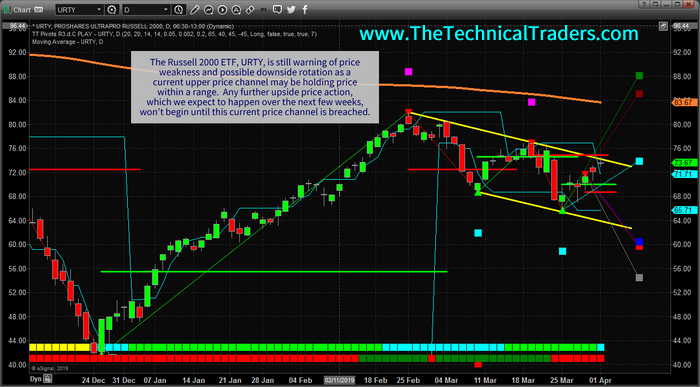
The Next Big Move

Recently, volatility has started to increase as can be seen in this VIX chart. If the Russell 2000 is not able to break this trend channel with this current upside price move, then we fully expect continued price rotation in the US stock markets and another increase in the VIX as this rotation takes place. The NQ recently rotated downward by nearly 4% while historical volatility continues to narrow. When volatility diminishes in extended price trends, we’ve learned to expect aggressive price rotation can become more of a concern. We expect the VIX to spike above 16~18 on moderate volatility as we get closer to the cycle inflection date near June/July 2019. Continue reading "Waiting For The Next Big Move"
ETF 'Fee War' Could Help You Realize A Larger Portfolio Balance

With more than 2,200 Exchange Traded Funds available to investors, fund managers are now finding that the lower they go in terms of fee’s, the more money they can attract. This isn’t a new idea as it was first spearheaded by the great late Jack Bogle, best known for his work at Vanguard and the man who is largely credited with the first index fund.

Bogle’s idea back then was that if he could get fund fee’s lower, he would be able to attract more money to the fund and therefore, in the long run, make more money for both his clients and his firm. Even decades after Jack changed the game for investment managers by slashing fee’s; Vanguard is still pushing the envelope on how low they can go. Recently the company filed regulatory documents showing that they were cutting the expense ratio on a number of ETFs; Vanguard Total Bond Market ETF BND (BND), Vanguard FTSE All-World ex-US VEU (VEU), Vanguard FTSE Europe ETF VGK (VGK), Vanguard FTSE Pacific ETF VPL (VPL), Vanguard Tax-Exempt Bond ETF VTEB (VTEB), Vanguard FTSE Emerging Markets ETF VWO (VWO) and Vanguard Total International Stock ETF VXUS (VXUS).

The move is the latest in what many have dubbed the ‘fee war’ which is taking place between fund managers. There is currently a handful of ETFs that have expense ratios as low as 0.03% two of which are managed by State Street Global Advisors and another two which are managed by Charles Schwab. There are three times as many ETFs with fees of 0.04%, and more than 150 with fees at or below 0.10%.
Continue reading "ETF 'Fee War' Could Help You Realize A Larger Portfolio Balance"

Gold Update: Reversal Pattern Emerges

Last time I updated the gold chart at the beginning of the year I focused on the long-term consolidation, which has started at the end of 2015 and has a tricky structure as all corrective stages do. I shared with you the three most feasible options of structure development.

The first one implies the straight move up beyond the former top of $1375 (blue labels), it took only 22% of your likes. The second option, which you liked the most (48%), offers triangular consolidation (green labels). The third alternative (red labels) gained 30% of your support, and it could bring gold back down to retest $1122 area before it goes up.

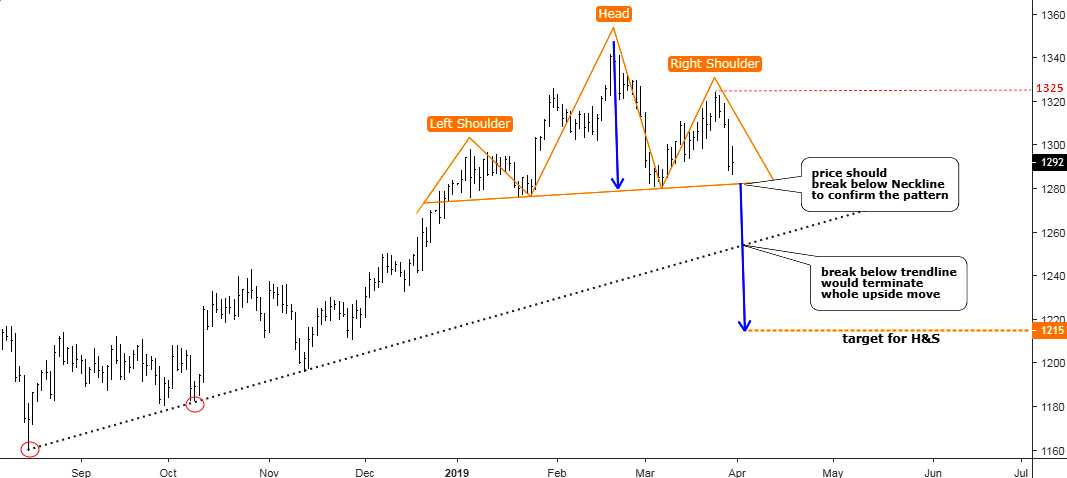
I am proud to have such smart readers of my posts as most of the time you accurately predict the market behavior as last time you did it with a Santa Claus rally of precious metals. These days I spotted one notorious pattern, which could terminate the first option, which collected the least support from your voting, that amazes me again and again.

Gold Daily Chart: Possible Head And Shoulders Pattern

LLLL
Chart courtesy of tradingview.com
Continue reading "Gold Update: Reversal Pattern Emerges"