How to Interpret the Jobs Report

Friday’s jobs report for September showed a decrease in monthly gains, with 263,000 new jobs added last month, a decline from the prior month in which 315,000 new jobs were added.

The deep impact it had on almost every asset class in the financial markets was not because of the tepid numbers but rather hopes by the Federal Reserve that these numbers would be even lower.
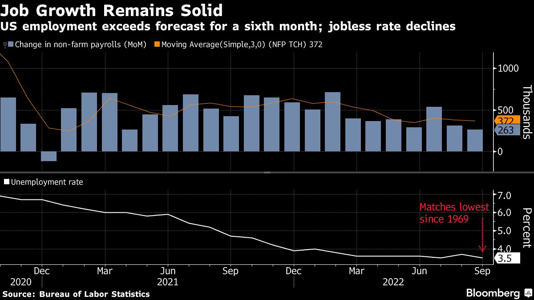
Bloomberg Jobs Graph

The Federal Reserve had hoped that Friday’s report would reveal even slower growth because that would indicate progress by the Federal Reserve in reducing inflation.

Inflation is still greatly elevated at a 40-year high even after the Federal Reserve has raised interest rates at every FOMC meeting since March. The Fed raised rates by 25 basis points in March, 50 basis points in May, and 75 basis points in June, July, and September. The Fed took their benchmark Fed funds rate from between 0 and 25 basis points in February to between 300 and 325 basis points in September.

Although Friday’s report indicated slowing job growth it is believed that this contraction is not enough for the Federal Reserve to slow down its current pace of interest-rate hikes. Continue reading "How to Interpret the Jobs Report"
ETF Explores New Signals Behind Corporate Profitability

There are many factors in play when it comes to a company's ability to succeed and reward shareholders.

One of the most difficult factors to measure has been human capital.

Current accounting methods treat human capital as a current or future expense.

Real estate and production equipment add to the balance sheet. However, a highly-skilled (and well-paid) workforce just detracts from profit and value.

In short, measuring the value of human capital in a business has been downright impossible. How do you quantify who has the best employees or how driven the employees are to drive corporate success?

How do you know when employees feel engaged, feel empowered to innovate, and feel like both the management and the mission align with their values?

Famed author and behavioral economist Dan Ariely is a founding member of Irrational Capital. This investment research firm that has unlocked the connection between companies with a high level of human capital and success in the marketplace.

Irrational Capital's Human Capital Factor (HCF) Index has the potential to change how businesses are valued forever. Continue reading "ETF Explores New Signals Behind Corporate Profitability"

An Auto Parts Winner in a Greener Future

The global auto industry is in an all-out drive toward a cleaner and greener future.However, for some suppliers to the auto industry, it has not been a pleasurable joyride.

Instead, current conditions are more like driving on a icy, treacherous mountain road in the middle of a blizzard. Only the most skilled drivers will make it to the bottom of the metaphorical mountain intact.

Tough Sledding for Auto Suppliers

Most auto suppliers are already feeling a squeeze due to rising energy prices and rampant inflation in other parts of the supply chain. They have little choice but to shoulder most of the extra costs of making their components sustainable to help the automakers meet their environmental targets.

And make no mistake: the carmakers are pushing their suppliers hard. For example, Reuters reports that BMW expects all of its battery and many of its steel and aluminum providers to produce materials made using renewable energy, while Volvo Car is targeting 25% recyclable plastic in its cars by 2025.

Consequently, many suppliers to the automobile industry are making large investments to “green” their companies, doing everything from developing recyclable parts to using renewable energy.

Simultaneously, many of these same firms have little leeway to raise the prices they’re charging automakers, which are themselves focused on reducing costs. Automakers are spending tens of billions of dollars to shift their focus to producing electric vehicles.

This difficult situation faced by the auto parts industry was summed up nicely by Joe McCabe, CEO of the research firm AutoForecast Solutions, who told Reuters: “We use the term disruptive all the time, but it’s much more than just disruptive. We’re going to see a real big shakeout the next five, 10 years in the auto supply chain.”

In other words, the auto industry’s move to a greener future, alongside the supply-chain problems that began during the pandemic and soaring costs, has killed the profit margins for auto parts suppliers and created a perfect storm for the industry.

It is likely that only the strongest and shrewdest companies will survive this extinction event in the sector. The rest will go the way of the dinosaur.

One company that I believe will survive is TE Connectivity (TEL). It is able to pass along price increases to its customers, and it pays a dividend, too. Continue reading "An Auto Parts Winner in a Greener Future"

Inflation Continues To Spiral Higher

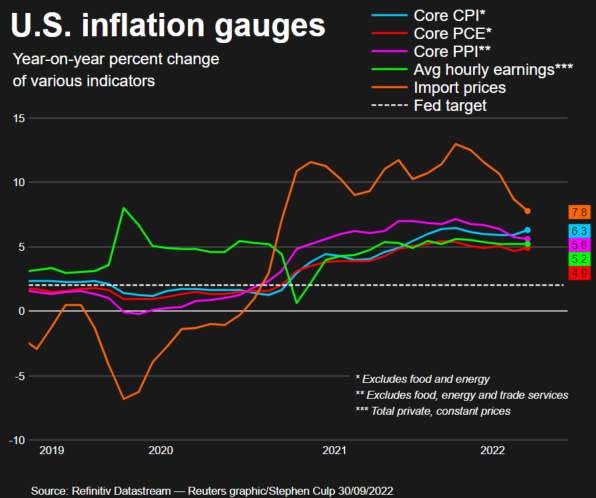
Key reports released last week in both the United States and the Eurozone revealed what global citizens have been acutely aware of. Inflation continues to spiral higher and at a staggering level.

This prompted Credit Suisse to issue a dire global economic outlook, saying that the “worst is yet to come”.

US Inflation Gauges

The Commerce Department released the latest inflation numbers vis-à-vis the PCE that revealed that the Core PCE jumped 0.6% in August. It shows that inflation is still intense and increasing.

The preferred gauge used by the Federal Reserve, the PCE (Personal Consumption Expenditures Price Index) revealed that inflation accelerated even more than expected in August. On a year-over-year basis, the core PCE which omits food and energy costs increased 4.9%, above projections of 4.7%. Continue reading "Inflation Continues To Spiral Higher"

3 Stocks to Leave Out of Your Retirement Portfolio

The Fed announced its third consecutive 75-bps interest rate hike last week, which has caused the benchmark indices to plunge. The S&P 500 has lost 5.2% over the past week and 23.3% year-to-date. Moreover, Goldman Sachs slashed its 2022 year-end S&P 500 target to 3600, down 16.3% from 4300.

According to Chris Zaccarelli, Chief Investment Officer, Independent Advisor Alliance, Charlotte, NC, “The Fed is going to raise rates until inflation comes back down, and they will cause a recession in the process.”

Also, Steve Hanke, a professor of applied economics at Johns Hopkins University, said, “The probability of recession, I think it’s much higher than 50% — I think it’s about 80%.”

Given the uncertain economic outlook, fundamentally weak stocks Uber Technologies, Inc. (UBER), Workhorse Group Inc. (WKHS), and AppHarvest, Inc. (APPH) might be best avoided for your retirement portfolio. These stocks do not pay dividends, which is the key requirement for a stock to be added to a retirement portfolio.

Uber Technologies, Inc. (UBER)

UBER develops and operates proprietary technology applications in the United States, Canada, Latin America, Europe, the Middle East, Africa, and the Asia Pacific. The company operates through three segments: Mobility; Delivery; and Freight.

On September 25, 2022, Pomerantz LLP announced the filing of a class action lawsuit against UBER and some of its officers, alleging violations of federal securities laws. The suit is on behalf of a class of all persons and entities except Defendants that purchased or acquired UBER common stock between May 31, 2019, and July 8, 2022.

UBER’s revenue came in at $8.07 billion for the second quarter that ended June 30, 2022, up 105.5% year-over-year. However, its net loss came in at $2.60 billion compared to an income of $1.14 billion in the year-ago period. Moreover, its loss per share came in at $1.33, compared to an EPS of $0.58 in the prior-year period.

UBER’s EPS is expected to decline 367% year-over-year to negative $4.67 in 2022. Its EPS is estimated to remain negative in 2023. It missed EPS estimates in three of the four trailing quarters. Over the past year, the stock has lost 42.3% to close the last trading session at $26.89. Continue reading "3 Stocks to Leave Out of Your Retirement Portfolio"