Is the Ruble a Worthwhile Bargain?

Lior Alkalay - INO.com Contributor - Forex


The ink on the second Minsk agreement hasn’t even dried and already speculators are rubbing their hands together in greedy anticipation, ready to take a plunge into the Ruble’s “bargain” rate against the Dollar in the hope of a quick recovery. The basis for that sentiment is rather simple; market movers have long realized that the Russian Ruble is no longer a financial game but rather a geopolitical one. If tensions around Ukraine ease, the Ruble is expected to get some respite; if, however, tensions increase then still more sanctions are likely to loom over the Russian economy and the Ruble trade turns to short. The constant escalation and de-escalation and vice versa of the Ukrainian crisis has forced Ruble players to exercise greater caution. Yet, for some, the latest Minsk agreement represents a broader and perhaps longer lasting de-escalation and thus might further suggest that the Ruble could regain some lost ground. To assess whether that assumption is viable we must first delve into the political intricacies of Russia’s showdown with the West. Continue reading "Is the Ruble a Worthwhile Bargain?"

Blame it on the weather

George Yacik - INO.com Contributor - Fed & Interest Rates

I expect to hear shortly the refrain among financial analysts and talking heads to explain the recent spate of relatively weak U.S. economic news: It’s the weather!

Last year about this time, you remember, we were told that the unexpected 2.9% annualized drop in first quarter 2014 GDP was an aberration and all due to the harsh winter weather. And the economy did indeed rebound sharply after that, with full year 2014 GDP growth coming in at 2.5%. Hardly spectacular growth, but a lot better than the horrible first quarter would have indicated and certainly a lot better than other places outside China and India.

So maybe there was something to that weather thing, although I think it took way too much of the blame. Continue reading "Blame it on the weather"

Needed: More Transparency at the Fed

George Yacik - INO.com Contributor - Fed & Interest Rates


The Federal Reserve is starting to feel some heat from both the right and the left about how secret its activities deserve to be from American taxpayers. The fact that next year is a presidential election year and the heat is being brought by two candidates for the Oval Office may mean that the pressure may amount to something this time.

On January 28 Sen. Rand Paul, R-KY, reintroduced his "Audit the Fed" bill that would subject the Fed's monetary policy discussions and decisions to audits by the Government Accountability Office (GAO).

"This secretive government-run bureaucracy promotes policies that have impacted the lives of all Americans," Paul said. "Citizens have the right to know why the Fed's policies have resulted in a stagnant economy and record numbers of people dropping out of the workforce."

Previous versions of Paul's bill – originally sponsored by his father, former presidential hopeful Ron Paul, and others – have gotten nowhere, largely because Democrats controlled the Senate. Now, of course, that body is now controlled by the Republicans. Paul got 30 co-sponsors to his bill. Continue reading "Needed: More Transparency at the Fed"

Short Copper, Pray For Gold, Watch Ratio

Aibek Burabayev - INO.com Contributor - Metals


Dear INO.com Readers,

Today, I'm reviewing three metals based on short-term analysis.

Copper Is A Good Sell

Daily Copper Candlestick Chart

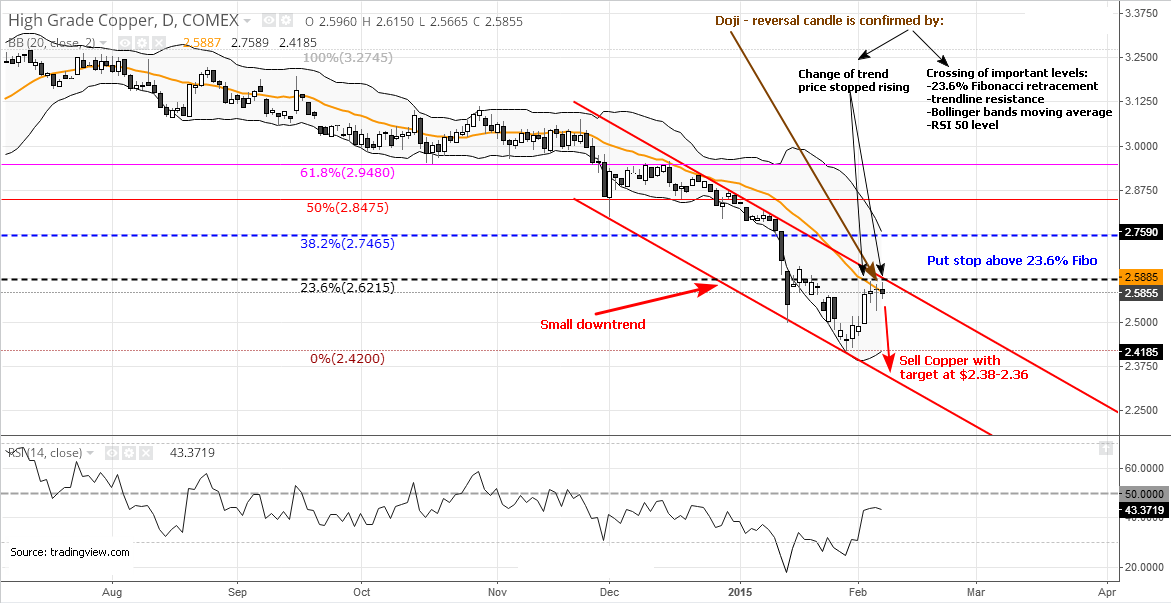
In my January post, I recommended selling copper above $2.75 and I hope you enjoyed a nice profit. For those of you who didn’t take that chance, below is my new one for you.

In December, copper entered a small steeper downtrend (highlighted in red) as the falling price accelerated. After breaking below the descending triangle’s base at $3.02 on the monthly charts, this red metal hit a multi-year low at $2.42, unseen from 2009, losing an impressive 20% in just 2 months. The price met the downside of the channel and quickly bounced off for a $0.20 gain and I will show why you should consider it a dead cat bounce. Continue reading "Short Copper, Pray For Gold, Watch Ratio"

Historical Lessons on the Greek Crisis

Lior Alkalay - INO.com Contributor - Forex


For many investors, this will feel too much like déjà vu by a half; the Greek woes are here yet again. And again, the Greek government is attempting to negotiate a new bailout deal with the Troika, even as European leaders debate whether or not to accede to that request. And, yet again, the question of a possible collapse of the European Currency Union emerges. However, unlike the last time, markets are reacting relatively calmly to the news of the breakdown of the current Greek bailout agreement. In part, that can be attributed to the lingering impact of the ECB’s Quantitative Easing program which was recently announced but it is also in part due to the broad belief that Greece would not likely exit the Eurozone. It seems investors’ two burning questions, i.e. will Greece leave the Eurozone and if it does, can the Eurozone survive, may be hard to disassemble. Nonetheless, it is a fact that, quite often, events in history can teach us as much about the past as about the future and it is those lessons which can help us disassemble those important questions.

Not the First Time for Greece

While the notion of Greece being the E.U.’s Achilles heel might sound like a story of only a few years past, the truth is it goes much farther back. This is the not the first time in relatively modern history that Greece has played a “spoiler” role, and since the Latin Monetary Union no longer exists, it’s not difficult to guess how the first saga ended. In 1865, the Latin Monetary Union became a framework of agreed currency exchanges set by its member states, e.g. Switzerland, Italy, France and Belgium; Greece and Spain joined a few years later. The monetary exchange system, which relied on the value of Gold, basically counted on each country to produce a coin at a specific gold weight that would be matched by all members, thus insuring a de facto single or one monetary currency. Continue reading "Historical Lessons on the Greek Crisis"