Important Bitcoin Update!

Back in May, I talked about my reasons why everyone should own a little Bitcoin (BTC).

Since then, BTC has been on a wild ride, to say the least!

But the factors I talked about in May are still at play. That’s why today we’ll do a much-needed update on why Bitcoin and why it should still be a part of just about everyone’s portfolio.

A Bitcoin Refresher

Before we get into what’s happened with Bitcoin recently, let’s take a step back.

Like other digital currencies, Bitcoin doesn’t exist in physical form. Rather, it exists in digital form on computers. And because most bank accounts exist in digital form, Bitcoin is like something you’re already used to Your bank account. And like your bank account, Bitcoin has utility: You can use it as a method of exchange or hold it as a store of value.

But beyond these similarities, Bitcoin and your bank account are pretty different. In order for your bank to function on your behalf as either a method of exchange or a store of value, it needs to sign off on your account’s value and existence. You also have to rely on the bank’s computers to make sure your money is safely guarded. Continue reading "Important Bitcoin Update!"

Weekly Stock Market Forecast

This week we have a stock market forecast for the week of 9/12/21 from our friend Bo Yoder of the Market Forecasting Academy. Be sure to leave a comment and let us know what you think!

The S&P 500 (SPY)

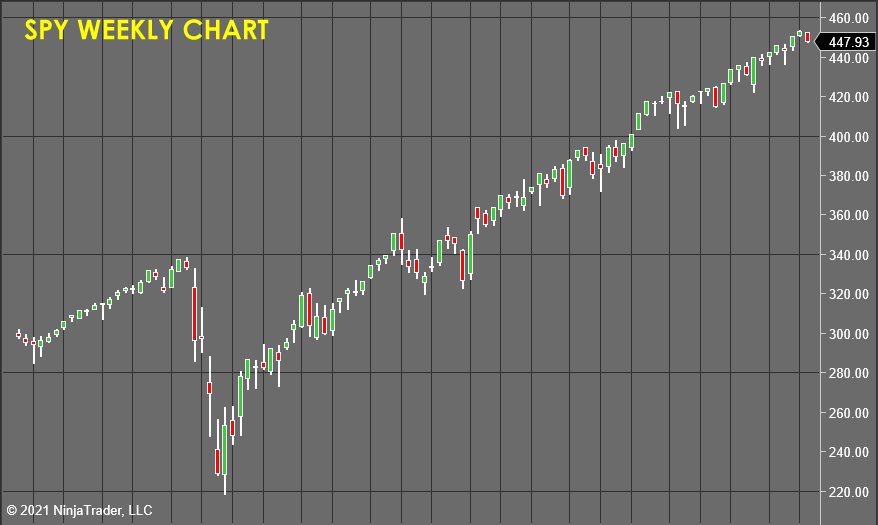
SPY Weekly Chart - Stock Market Forecast

After all our waiting, the S&P finally turned over and printed a bearish, non-hysterical candle on the weekly chart. So next week’s reaction will tell me a lot. If the bears come out in droves, then we can get confident and aggressive on the bear side, but if we sell off early, then close strong, it would indicate that we remain stuck.

I’m building a watch list of short opportunities, but it would be imprudent to enter now, as there just hasn’t been any actionable data coming out of this market for weeks. However, I’m hopeful that will change in the next 7 days. Continue reading "Weekly Stock Market Forecast"

The Inflation/Deflation Debate Wears On

Our 30 year Treasury yield ‘Continuum’ chart indicates that deflation is the dominant trend, but…

Steve Saville has written a post that got me thinking about carts and horses and more precisely, which comes before which. Is the inflationary horse pulling the deflationary cart uphill or is the deflationary cart leading the horse to drink from the shrinking liquidity pool periodically?

See The Crisis-Monetisation Cycle

In conclusion to this short post, Steve asserts…

“The crisis-monetisation cycle doesn’t end in deflation. The merest whiff of deflation just encourages central bankers and politicians to do more to boost prices. In fact, the occasional deflation scare is necessary to keep the cycle going. The cycle only ends when most voters see “inflation” as the biggest threat to their personal economic prospects.”

And over the course of decades now that is exactly the case. Every damn time that the public becomes terrified of declining asset (especially equity) prices the Fed springs into action.

On March 19, 2020, we asked… Continue reading "The Inflation/Deflation Debate Wears On"

Has The Taper Been Tabled?

A funny thing happened on the way to the taper, the U.S. jobs market hit a brick wall.

Last week’s underwhelming jobs report for August, which showed the U.S. economy adding only 235,000 jobs—less than a third of the consensus estimate of 740,000 and down sharply from July’s upwardly revised total of 1.05 million, may have put the kibosh on the Federal Reserve’s prospective plan to start reducing its $120 billion a month purchases of government and mortgage securities.

Last month, you’ll remember, Fed chair Jerome Powell, in his Jackson Hole speech, seemed to have joined the bandwagon started by his central bank colleagues calling for the Fed to start the tapering process soon. “If the economy evolved broadly as anticipated, it could be appropriate to start reducing the pace of asset purchases this year,” he said. However, he also provided this caveat: “Today, with substantial slack remaining in the labor market and the pandemic continuing, such a mistake could be particularly harmful.”

Friday’s job report could have provided enough of a reason not to taper, or at least put it on hold. Particularly discouraging was the net no new jobs in the leisure and hospitality industry after adding 350,000 jobs a month over the prior six months, including a net loss of 42,000 jobs in bars and restaurants. Continue reading "Has The Taper Been Tabled?"

Owning Berkshire Is Like Owning An ETF

Over the past 10 years, the ETF market has exploded and changed the way most investors invest. The ability to find a fund that focuses on specialized niche markets or just plow money into a major index fund has never been easier or more accessible to the average investor.

In the past, investors would have to have minimum amounts of money invested in a mutual fund, and the liquidity of those funds was very limited. Thus, it is difficult to get into and out of if and when you need the cash. But ETFs have changed all of that. No minimum amounts, no liquidity problems, and not to mention the very low fees, typically much, much lower than what you will find with a traditional mutual fund.

However, one equity that investors have been able to buy for years and decades has essentially offered, and still does, investors everything a large index ETF offers, but with even lower fees. That stock is Berkshire Hathaway (BRK-A, BRK-B). The stock that the famed investor, Warren Buffett, owns and stills runs to this day, despite being 91 years old.

Due to its large swath of companies, it owns Berkshire outright, and its investment portfolio is essentially a large index ETF, except you don’t have to pay fees. Berkshire’s current equity portfolio consists of 44.5% in technology companies, 30.3% in Financials, 12.7% in consumer staples, 4.7% in consumer discretionary, and 3.3% in telecommunications. Its largest holding is Apple at $120 billion, representing about 1/6th of Berkshire’s total market cap. But is still smaller than the companies most recent cash pile of $144 billion.

Most ETFs wouldn’t be permitted to have such a large cash pile, but Berkshire is because it's not an ETF. This cash allows the company to make deals and buy stocks when prices are primed and juicy. This has allowed Buffett and company to take advantage of some serious market miss pricing. In addition, it gave the company the ability to make very favorable deals during the financial crisis when companies were in dire need of cash. Other investors didn’t have the means or funds available, but Buffett did, and it paid off big time.

While most investors don’t think about the low fees index ETFs charge these days (and honestly, most of the big S&P 500 index ETFs have fees so low, they don’t really matter), the fact remains that once you buy BRK-B or BRK-A, if you have $425,000 lying around, you don’t pay any expenses as long as you own the stock.

Unfortunately, though Berkshire doesn’t pay a dividend, the company doesn’t give you an idea of what it will invest in, unlike most ETFs. ETF managers are typically required to adhere to the ‘fund invest prospectus,’ which spells out the goals and investment strategy of the fund. Essentially telling investors what industries and types of companies it will be investing in. With Berkshire, you buy and are signing up to allow Warren and his team to drive you down whatever road they decide to go on.

With that being said, Buffett’s track record has proven to be better, actually much better than fund managers track records over the course of not just a few years, but decades. Moreover, Buffett doesn’t have to adhere to certain rules and can buy companies whole; he has an advantage that fund managers don’t.

However, Warren did recently turn 91 years old. And his longtime partner Charlie Munger is 97. So, it's easy to make the argument that Berkshire may not be the same company in the future as it has been in the past, simply due to Warren’s and Charlie’s age. However, investors have been concerned about this for years, and Warren and Charlie are confidently handing the reins over to Todd Combs and Ted Weschler, who have proven themselves over the last few years as investors who may someday rival their two predecessors.

ETFs are great, and most investors should own them over trying to cherry-pick stocks. However, if you are a stock cherry picker or strictly a fund investor, you should still consider Berkshire as an investment since it's sort of the best of both worlds.

Matt Thalman
INO.com Contributor - ETFs
Follow me on Twitter @mthalman5513

Disclosure: This contributor Thalman owns shares of Berkshire Hathaway and Apple at the time this blog post was published. This article is the opinion of the contributor themselves. The above is a matter of opinion provided for general information purposes only and is not intended as investment advice. This contributor is not receiving compensation (other than from INO.com) for their opinion.