Weekly Stock Market Forecast

This week we have a stock market forecast for the week of 5/16/21 from our friend Bo Yoder of the Market Forecasting Academy. Be sure to leave a comment and let us know what you think!

The S&P 500 (SPY)

SPY Daily Chart - Stock Market Forecast

In last week’s forecast, the S&P 500 (analyzed here using SPY) had broken out to a new high, but as I wrote... Continue reading "Weekly Stock Market Forecast"

Why Everyone Should Own (A Little) Bitcoin

You don’t have to dig very deep to notice that when people talk about cryptocurrencies and the blockchain, they’re usually talking about Bitcoin (BTC).

In fact, to most people, BTC is synonymous with cryptocurrencies.

This huge popularity makes BTC the big player on the block. And with a recent price of $57,678 and a market capitalization of $1.1 trillion, investors are putting their money where their mouths are. And that’s having a dramatic effect on BTC price.

We’ll get into the nitty-gritty behind the best reasons for just about everyone to own at least a little Bitcoin in a sec.

But before we do, take a look at some of our prior installments on cryptocurrencies and the blockchain. We’ve talked about why you should own some cryptocurrency, what the blockchain and cryptocurrency mean to you, the basics of cryptocurrencies, and why they’re so important. They’ll help you get your head around the basics of cryptocurrencies like BTC and why they’re not as scary as they once were.

What is Bitcoin?

Bitcoin is a digital currency that lives in a distributed ledger on a place called the blockchain. Because of this digital nature, it doesn’t exist in a physical state, like gold or currency. And because it lives in a distributed ledger system on the blockchain, a vast array of computers track and secure the currency using cryptography. The people that run these computers are paid a fee for securing the network and making sure the transactions are correct by solving complex mathematical problems. These people are called miners and form the backbone of the BTC ecosystem. Continue reading "Why Everyone Should Own (A Little) Bitcoin"

World Oil Supply And Price Outlook, May 2021

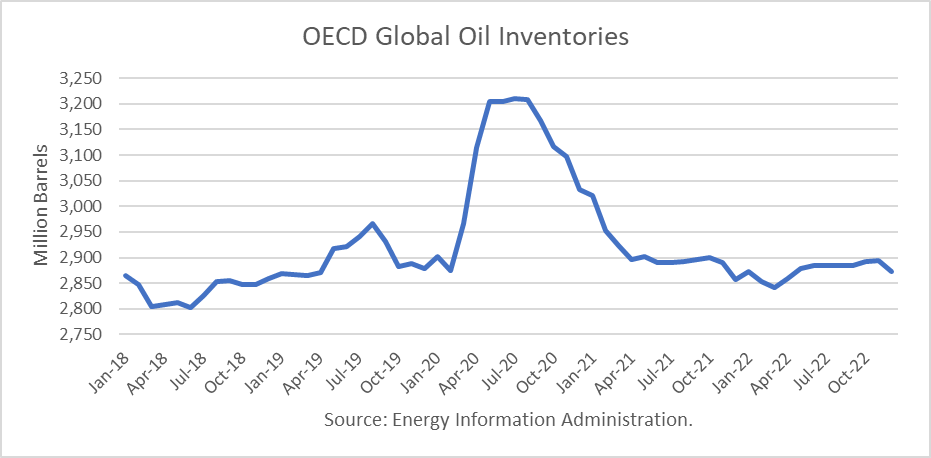
The Energy Information Administration released its Short-Term Energy Outlook for May, and it shows that OECD oil inventories likely peaked at 3.210 billion in July 2020. In April 2021, it estimated stocks dropped by 26 million barrels to end at 2.897 billion, 215 million barrels lower than a year ago.

The EIA estimated global oil production at 94.04 million barrels per day (mmbd) for April, compared to global oil consumption of 96.18 mmbd. That implies an undersupply of 2.14 mmb/d or 64 million barrels for the month. That implies non-OECD stocks dropped by 33 million barrels.

For 2021, OECD inventories are now projected to draw by net 168 million barrels to 2.858 billion. For 2022 it forecasts that stocks will draw by 22 million barrels to end the year at 2.873 billion.

OECD Global Crude Oil Inventories

The EIA forecast was made incorporates the OPEC+ decision to cut production and exports. According to OPEC’s press release on April 27, 2021: Continue reading "World Oil Supply And Price Outlook, May 2021"

Ethereum ETFs Go Live In Canada

While US regulators still have not yet approved a single Bitcoin (the largest and most popular cryptocurrency) Exchange Traded Fund, the Canadian regulators have now begun to move past Bitcoin and are approving ETFs that focus on other cryptocurrencies such as Ethereum.

On April 20th, not one but three new cryptocurrencies’ ETFs began trading in Canada. The CI Galaxy Ethereum ETF (ETHX.U), the Purpose Ether ETF (ETHH.U), and the Ether ETF (ETHR.U) are all now available for purchase by anyone in Canada and any investor who has access to international investments.

Canada already has three Bitcoin ETFs, the CI Galaxy Bitcoin ETF (BTCX.U), the Purpose Bitcoin ETF (BTCC.U), and Evolve’s Bitcoin ETF (EBIT.U). When those ETFs were approved in Canada, it was big news, the same as now with the Ethereum ETFs trading hands.

Bitcoin is and was the first cryptocurrency that got this whole new world of money and technology started. So, it makes sense when it was the first crypto ETF. However, many industry experts believe Ethereum actually has more real-world applications and will improve people's lives to a great extent than Bitcoin will ever be able to achieve. The reason being is because Bitcoin was created to be a form of money using blockchain technology. However, Ethereum was created to help people decentralize certain tasks and allow users to perform tasks on a decentralized platform with more speed, accuracy, and less oversight but more security. Continue reading "Ethereum ETFs Go Live In Canada"

Treasury Secretary Yellen's Gaffe

You kind of knew this was going to happen eventually. You’re just probably surprised it happened so fast and so publicly.

After serving as Federal Reserve chair for four years, until February 2018, and now Treasury Secretary since January, Janet Yellen could probably be forgiven for forgetting what position she holds. After all, in addition to being located in Washington, both the Fed and the Treasury pretty much work hand in hand, with the former directing monetary policy and the latter handling fiscal policy. Under the pretense, they’re both independent of each other.

But last week, Yellen let the cat out of the bag and ignited a one-day mini taper tantrum in stock prices, which is a little hard to understand, given that she only said what everyone else was already thinking. (But as we know, a gaffe is when a politician or government official accidentally tells the truth).

“It may be that interest rates will have to rise somewhat to make sure that our economy doesn’t overheat, even though the additional spending [proposed and already enacted by the Biden Administration] is relatively small relative to the size of the economy,” she said in a prerecorded interview at the Atlantic’s Future Economy Summit.

Later on, of course, she walked that back a little, telling the Wall Street Journal, “I don’t think there’s going to be an inflationary problem, but if there is, the Fed can be counted on to address it,” she said.

It was certainly much ado about nothing, but it raises an important question, namely: Other than raising interest rates, either directly or indirectly, what exactly can the Fed do to fend off higher inflation? Continue reading "Treasury Secretary Yellen's Gaffe"