U.S. Crude Oil Production Fell In December

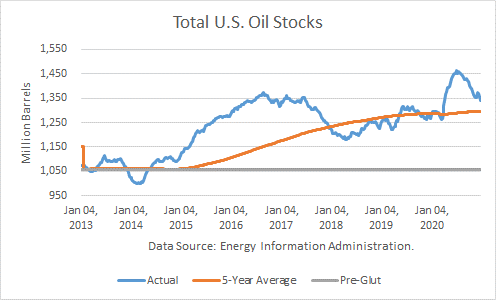
According to the Energy Information Administration, U.S. oil inventories (excluding SPR) fell by 14.9 million barrels last week to 1.342 billion, and SPR stocks were unchanged last week. Total stocks stand 47 mmb above the rising, rolling 5-year average and about 81.0 mmb higher than a year ago. Comparing total inventories to the pre-glut average (end-2014), stocks are 283 mmb above that average.

Oil

Crude Production

Production averaged 11.0 mmbd last week, unchanged from the prior week. It averaged 11.025 mmbd over the past 4 weeks, off 14.25 % v. a year ago. In the year-to-date, crude production averaged 11.504 mmbd, off 6.5 % v. last year, over 600,000 b/d lower. Continue reading "U.S. Crude Oil Production Fell In December"

The Problem With Bond ETFs Right Now

One of the first things an early or new investor is typically told is that bonds are safer than stocks but will offer lower capital appreciation than stocks. Or in simpler terms, bonds are less risky, and, therefore, they offer a lower reward. But in reality, these things we are taught about a bond's risks are not always true, depending on how you are invested in the bond, bonds, or a bond ETF.

Most people speak of the risk profile when they are talking about low risk. Low reward bonds is a scenario when the investor holds the individual bond themselves. Like stock ownership, a bond investor can buy individual bonds and hold them in their portfolio.

Let's quickly look at how and why bond prices change before we go any further. Say you buy a 1-year bond for $980.00, and when it matures in a year, it will be worth $1,000, meaning the bond you bought is yielding a 2% rate of return. Now let's say you hold the bond for the full year; you will make your 2% or $20 and be happy. Your only risk in this scenario is that whoever sold you the bond defaults on it, which for this example, is probably not likely. (The higher the interest rate on the bond at the initial time of sale typically indicates how risky the bond is and how likely the bond seller is to default. 2% is a very low risk in normal market conditions.)

If you plan to hold and ride the bond to mature, bonds are very low risk, as we have all been taught. However, if you plan to sell the bond before maturity, you are increasing your risk. For example, when you own the bond we spoke about above, that is paying a 2% rate of return, if the current market is demanding say a 4% rate of return on bonds, then to sell your bond, which you paid $980 for, you would have to offer another investor a 4% rate of return, or sell the bond at $960, so the buyer could realize a 4% rate of return, which is the current going rate for a bond if they held the bond to maturity. Continue reading "The Problem With Bond ETFs Right Now"

Leveraging Options To Navigate Frothy Markets

Wall Street capped off one of the most volatile years in history. The Dow Jones and S&P 500 ended the year at all-time highs, posting returns of 16.3% and 7.3%, respectively, for 2020. At the same time, the Nasdaq posted a return of 43.6% for the year. These unprecedented returns were achieved despite the S&P 500 nosediving over 30% earlier in the year due to the coronavirus pandemic sweeping the world. In this market environment harnessing options can allow traders to define risk, leverage a minimal amount of capital, and maximize returns.

All-time highs have been reached with the confluence of election certainty, improving vaccine prospects across the globe, and massive stimulus out of Washington. These positive developments have been priced into the markets. The broader indices are richly valued as measured by virtually any historical metric via stretched valuations, options put/call ratios, broad participation above 200-day moving averages, and elevated P/E ratios. Collectively, these may be potential warning signs of near-term pressures. Heeding these frothy market conditions via risk mitigation may be best served with risk-defined options trading.

Options: Margin of Protection and Defining Risk

Harnessing options in frothy markets allows one to define risk, leverage a minimal amount of capital, and maximize returns. Options can be structured to allow a margin of downside and/or upside stock movement while collecting income in the process. In these richly valued markets, allowing a margin of downside and/or upside stock movement may be a great strategy to heed potential market volatility. Continue reading "Leveraging Options To Navigate Frothy Markets"

The Year The World Fell Down The Rabbit Hole

Conspiracies and bias hurt investors. It’s no wonder so many people have been unable to attain proper market positioning in 2020. You invest with your heart, soul, fears, or even sometimes your intellect and you risk blowing yourself up at worst, or missing out at best. For much of 2020 Twitter has been a forum for ‘influencers’ with tens of thousands of followers spewing dogma and influencing their herds alright. I watched it happen all year, in the Twitter machine and at other venues.

You know the perma-bearish or ‘got gold?’ types, issuing dire warnings and authoritative discussion of just how bad off the world is (well, it ain’t good, I grant them that). But it’s the practical reaction or lack thereof, not the news itself that matters.

So Warren Buffett bought a gold stock. The gold “community” immediately seized upon it as validation and an opportunity to lecture the herds. What it actually was though, was a top prior to a healthy and much-needed correction (handily, right from our long-standing target of HUI 375).

Buffett Buys a Gold Stock! Continue reading "The Year The World Fell Down The Rabbit Hole"

World Oil Supply And Price Outlook, December 2020

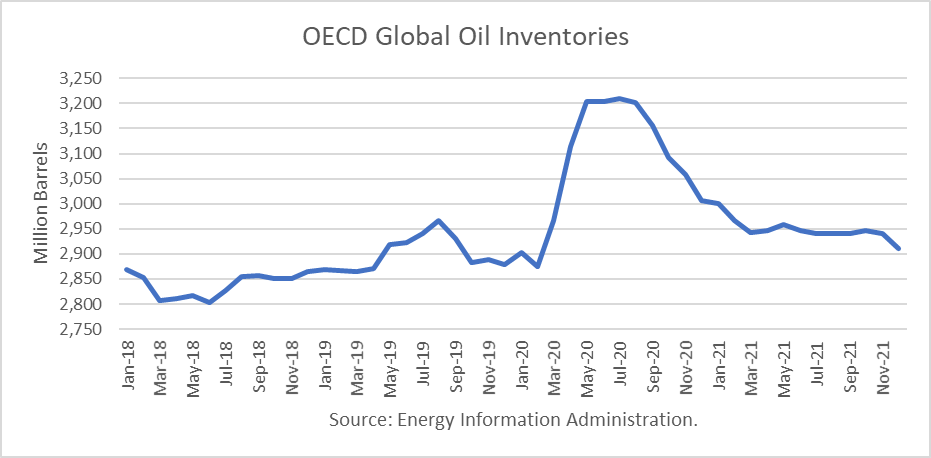
The Energy Information Administration released its Short-Term Energy Outlook for December, and it shows that OECD oil inventories likely bottomed in this cycle in June 2018 at 2.804 billion barrels. Stocks peaked at 3.210 billion in July 2020. In November 2020, it estimated stocks dropped by 34 million barrels to end at 3.057 billion, 169 million barrels higher than a year ago.

The EIA estimated global oil production at 93.45 million barrels per day (mmbd) for November, compared to global oil consumption of 95.59 mmbd. That implies an undersupply of 2.14 mmbd or 64 million barrels for the month. About 30 million barrels of the draw for November is attributable to non-OECD stocks.

For 2020, OECD inventories are now projected to build by net 127 million barrels to 3.006 billion. For 2021 it forecasts that stocks will draw by 95 million barrels to end the year at 2.910 billion.
Oil

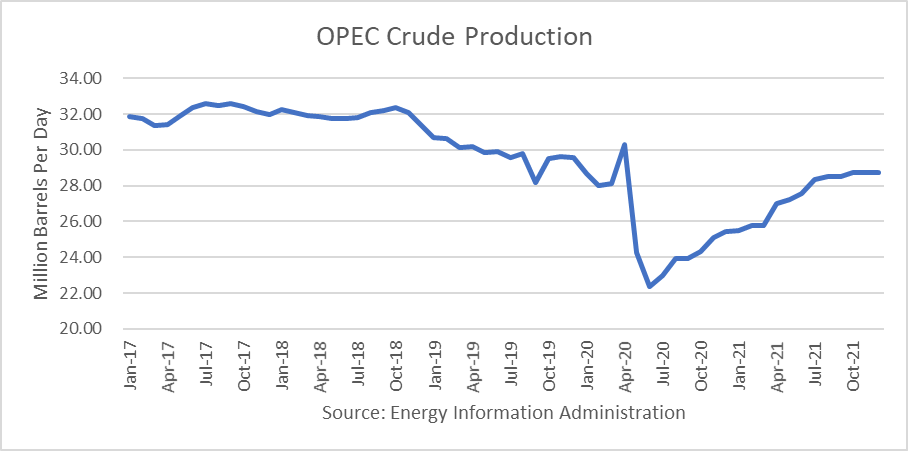
The EIA forecast was made incorporates the OPEC+ decision to cut production and exports. According to OPEC’s press release:

Adjust their overall crude oil production downwards by 9.7 mb/d, starting on May 1st, 2020, for an initial period of two months that concludes on June 30th, 2020. For the subsequent period of 6 months, from July 1st, 2020 to December 31st, 2020, the total adjustment agreed will be 7.7 mb/d. It will be followed by a 5.8 mb/d adjustment for a period of 16 months, from January 1st, 2021, to April 30th, 2022. The baseline for the calculation of the adjustments is the oil production of October 2018, except for the Kingdom of Saudi Arabia and The Russian Federation, both with the same baseline level of 11.0 mb/d. The agreement will be valid until April 30th, 2022. However, the extension of this agreement will be reviewed during December 2021.”
Oil

Oil Price Implications

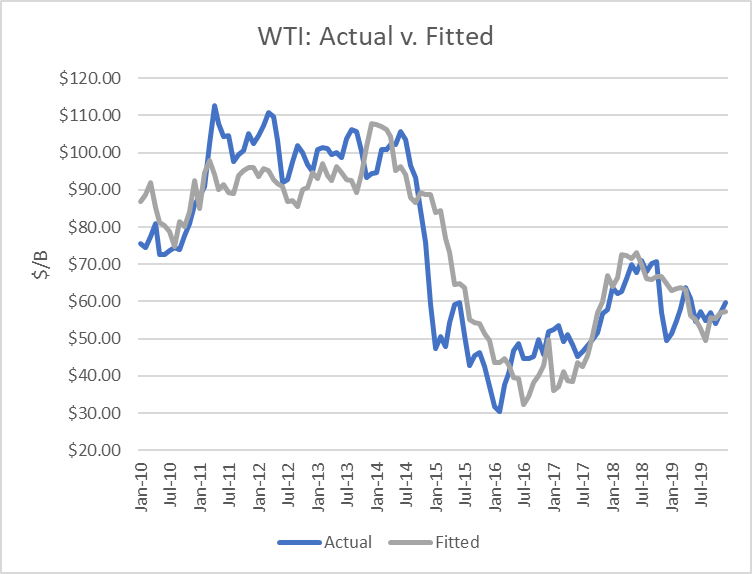
I updated my linear regression between OECD oil inventories and WTI crude oil prices for the period 2010 through 2019. As expected, there are periods where the price deviates greatly from the regression model. But overall, the model provides a reasonably high r-square result of 79 percent.
Oil

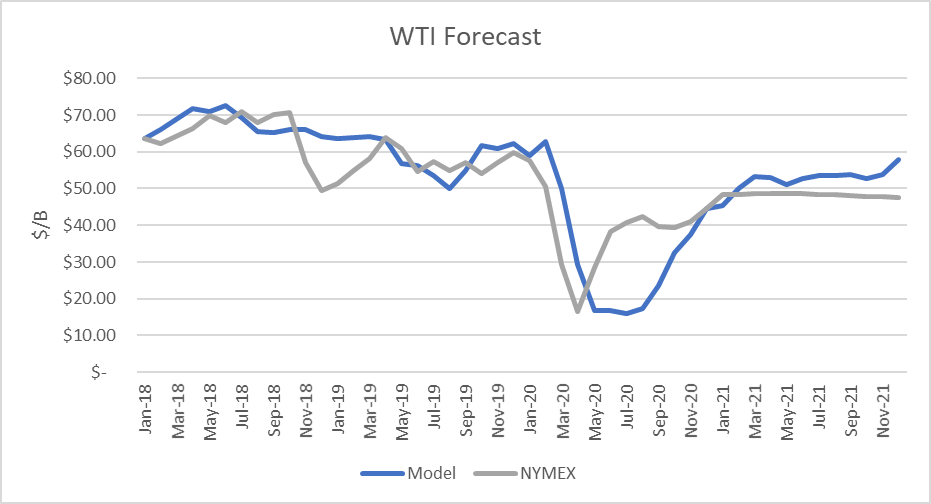
I used the model to assess WTI oil prices for the EIA forecast period through 2020 and 2021 and compared the regression equation forecast to actual NYMEX futures prices as of December 31st. The result is that oil futures prices are presently undervalued through the forecast horizon in 2021.
Oil

Uncertainties

April 2020 proved that oil prices can move dramatically based on market expectations and that they can drop far below the model’s valuations, whereas prices in May through December proved that the market factors in future expectations beyond current inventory levels.

The most important uncertainty is how deeply and how long the coronavirus will disrupt the U.S. and world economies. The announcements of vaccines and economic assistance lends credibility that a recovery is in store for 2021.

But what kind of recovery will it be? How much of business and daily life will be altered for the longer-term? Online meetings instead of face-to-face meetings, work-from-home, and other such changes may alter petroleum demand patterns long-term.

Conclusions

Equally, on the supply side, the transition away from fossil fuels has taken a big leap forward in 2020, with the major oil companies announcing investment shifts. The petroleum era is coming to a close, at least in terms of sustained growth.

Check back to see my next post!

Best,
Robert Boslego
INO.com Contributor - Energies

Disclosure: This contributor does not own any stocks mentioned in this article. This article is the opinion of the contributor themselves. The above is a matter of opinion provided for general information purposes only and is not intended as investment advice. This contributor is not receiving compensation (other than from INO.com) for their opinion.