Treasury Inversion And Political Fed Cycles

With so much news hitting the wires regarding the Treasury Inversion level and the "potential pending recession", we wanted to shed a little insight into this phenomenon and what we believe the most likely outcome to be going forward. Our researchers, at Technical Traders Ltd., believe the Treasure inversion is a reactionary process to overly tight US Fed monetary policies, consumer demand factors and outside cycle forces. There is very little correlation to inverted Treasury levels and causation factors other than the US Fed and global central banks. We believe consumers and consumer sentiment also play a role in setting up the conditions that prompt yield inversion. The one aspect we believe everyone fails to consider is the uncertainty that is associated with major US election cycles.

The US Fed is obviously a driving force with regards to yields and consumer expectations. In the past, the US Fed has rotated FFR levels up and down by enormous amounts (in some cases 200 to 500%+ over very short spans of time. Consumers, you know those people, the ones that are the actual driving force of the local and state level economies, have been the the ones having to deal with wildly rotating FFR levels and the consequences of their debt rotating from 4~7% average interest rates to 8~25%+ average interest rates over the span of just a few years.

Take a look at this chart that highlights the current and previous US Federal Reserve FFR rate changes. It is quite easy to see that consumers and business, on the receiving end of these changes, often swing from one extreme to another as the US fed makes these dramatic moves. And, yes, that last 2400% number is correct. The FFR went from 0.06% to 2.4% over the past 3+ years – do the math yourself if you don't believe us. Continue reading "Treasury Inversion And Political Fed Cycles"
Sweet Surrender

Janet Yellen had a pretty easy job when she was the Federal Reserve chair. By keeping interest rates at or near zero for years on end, she never heard any criticism from the president, government officials or the financial markets. Since he became Fed chair a little over a year ago, Jerome Powell has gotten nothing but flack, from President Trump – who was at it again last week – to a whole swarm of people on Wall Street complaining that the Fed was ruining their returns.

Powell got the message several months ago, and last week he handed in his formal surrender. Not only did the Fed leave interest rates alone at its monetary policy meeting, but it indicated that there would likely be no more rate hikes the rest of this year, and maybe next year, too. “It may be some time before the outlook for jobs and inflation calls clearly for a change in policy,” Powell said.

The Fed also called a halt to the runoff in its still humungous Treasury securities portfolio. Beginning in May, the Fed will slow to $15 billion – from the current $30 billion -- the monthly redemptions of its Treasury holdings, with the runoff to end in October, meaning its balance sheet will start growing again.

So now Powell and his Fed mates can sit back blissfully and listen to the silence, at least for now. Continue reading "Sweet Surrender"

AMC - 10% Post Earnings Pop And Captain Marvel Catalyst

Captain Marvel has pumped life back into the domestic box office, delivering an epic $153 million opening weekend debut, while hauling in $455 million worldwide. AMC Entertainment Holdings Inc. (AMC) has been struggling as of late on the heels of a record-breaking year at the box office in 2018 in conjunction with the disastrous stock market in Q4 of 2018. Despite a robust slate of movies for 2019, the year has been off to a sluggish start at the box office. AMC will likely have a nice catalyst as the slate of 2019 movies roll out, and the box office numbers strengthen. To smooth out these box office revenue fluctuations, AMC has a rapidly growing loyalty program with over 700,000 members to evolve a large segment of its business mix towards a subscription-based model. This will allow durable and predictable revenue streams in the backdrop of changing box office dynamics. AMC offers a great dividend yield of over 5% and accelerating revenue and EPS growth. The company is reengaging the consumer via digital, mobile and loyalty program options, reformatting theaters to enhance the user experience and international expansion augmented by a healthy share buyback program. The stock looks very attractive considering its depressed valuation, solid Q4 earnings that drove the stock higher and company initiatives to drive the consumer experience. The long term growth narrative remains intact while revenue continues to grow at a healthy clip.

2019 Box Office Finally Jolted

Disney (DIS) has finally released its first highly anticipated film of 2019 with Captain Marvel (the first female lead for a Marvel film). The film has performed exceptionally well, delivering an opening weekend box office gross of $457 million worldwide and $153 million domestically (Figure 1). The first two months of the year for the domestic box office has been a struggle relative to 2018. Captain Marvel brought in the third highest March opening of all-time and places the film on par with past blockbusters such as The Dark Knight, The Hunger Games and Rouge One. Dumbo, Avengers 4, Aladdin, Toy Story 4, Lion King, Frozen 2 and Star Wars Episode 9 is Disney’s slate of films that will bode well for the box office on the domestic front as these films stand to rack in billions in box office receipts. It’s noteworthy to point out that Disney is poised to defend its box office dominance again in 2019 for the fourth consecutive year. Continue reading "AMC - 10% Post Earnings Pop And Captain Marvel Catalyst"

U.S. Equities Price Anomaly Setup Continues

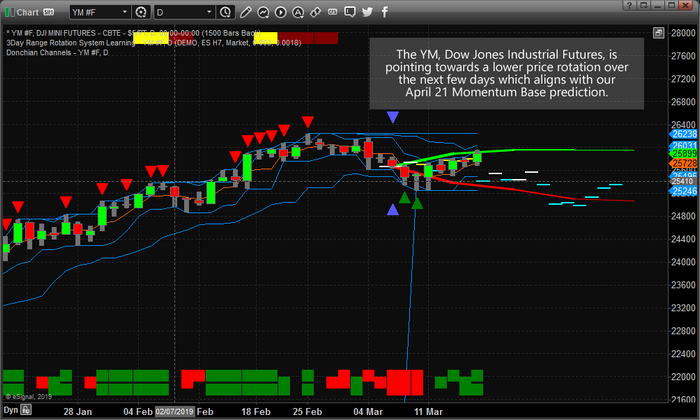
This research post highlights what we believe to be a unique price anomaly setup in many of the US major markets this week. Our research suggests that April 21, or near this date, will be an important price inflection point base level for the US stock markets. We believe a unique price base will begin to form near this date and a bigger price move in May/June 2019 will unfold.

Our Advanced Dynamic Learning (ADL) price modeling system is suggesting the rotation in the US stock market may stay somewhat muted before this move on April 21 begins. The ADL predictive modeling system is one of our proprietary price modeling utilities that our research uses to identify key levels of future support and resistance as well as to watch for "price anomalies" that setup. Price anomalies are where the current price level of any symbol is greatly diverted from the ADL predictive price level. When this happens, the price will usually "revert" back to near the ADL levels at some point in the immediate future – sometimes setting up a great trading opportunity.

This Daily YM chart shows a current price anomaly in the YM of about 1000 points. This is a pretty big range for skilled traders that are capable of identifying the right trade. The ADL system is suggesting that YM will rotate lower between now and the end of April by at least 800~1000 pts.

adl price modeling system
Continue reading "U.S. Equities Price Anomaly Setup Continues"

World Oil Supply And Price Outlook, March 2019

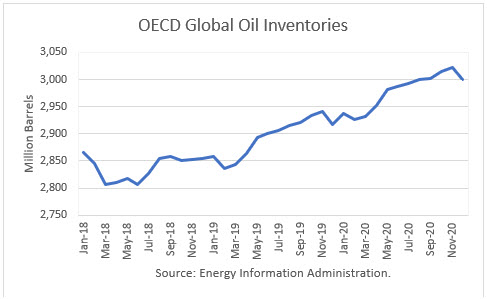
The Energy Information Administration released its Short-Term Energy Outlook for March, and it shows that OECD oil inventories likely bottomed last June at 2.806 billion barrels. It estimated a 21-million barrel decline for February to 2.837 billion, 9 million barrels lower than a year ago.

However, throughout 2019, OECD inventories are expected to rise rather quickly through November. At year-end, EIA projects stocks to be 2.918 billion barrels, 64 billion more than at the end of 2018.

For 2020, EIA projects that stocks will build another 82 billion barrels to end the year at 3.000 billion. That would push stocks into glut territory.

oecd oil inventories

Oil Price Implications

I updated my linear regression between OECD oil inventories and WTI crude oil prices for the period 2010 through 2018. As expected, there are periods where the price deviates greatly from the regression model. But overall, the model provides a reasonably high r-square result of 80 percent. Continue reading "World Oil Supply And Price Outlook, March 2019"