Hasbro: "We're Past the Toys "R" Us Debacle"

The Toys “R” Us bankruptcy has proven to be an albatross around Hasbro’s neck despite the confident, forward-looking narrative that’s been put forth for the previous two quarters by its CEO. The recent fourth-quarter earnings were disappointing, to say the least, capping off its historically best quarter. Revenue declined on an annual and quarterly basis by 12% and 13%, respectively. Despite these Toys “R” Us headwinds, Hasbro remains confident as the company annualizes the inventory glut caused by the liquidation. Hasbro (HAS) has a compelling future across its portfolio with many catalysts on the near and long term time horizon. This confident future was reinforced with an 8% increase in its quarterly dividend payout despite its revenue declines.

Hasbro is setting the post-Toys “R” Us bankruptcy narrative and laying out a business roadmap for long term profitable growth across its brands. This sentiment has been further bolstered by positive commentary from its CEO that the company will absolve itself of this Toy “R” Us related bankruptcy headwind come 2019. There's many current and future growth catalysts for Hasbro in movie franchises such as Marvel, Star Wars and other Disney (DIS) properties (Hasbro is the exclusive toy maker), potential e-sports with Dungeons and Dragons and Magic: The Gathering, newly acquired Power Rangers franchise which will emulate Hasbro’s My Little Pony and Transformers’ Bumblebee within Hasbro Studios and its legacy games such as Monopoly and Nerf.

Jim Cramer’s Mad Money 2018 Interviews

Hasbro’s CEO Brian Goldner has had a string of interviews with Jim Cramer on Mad Money. Over the past year, Goldner has had the tough task of getting out in front of the Toys “R” Us bankruptcy and glut of merchandise. Continue reading "Hasbro: "We're Past the Toys "R" Us Debacle""
How I Learned To Stop Worrying And Love The Deficit

John Maynard Keynes is generally given credit for the economic axiom, “We owe it to ourselves.” That idea has caught fire with the left in our country, who are now trumpeting a world where government deficits and debt – at least at the federal level – simply don’t matter, because, well, see Lord Keynes.

This idea even seems to have gotten sympathy – or at least, seems to be taken more seriously than you would have thought – by formerly level-headed financial publications such as the Wall Street Journal and Bloomberg BusinessWeek. Both of them have published lengthy stories recently which have come to the same conclusion, namely that, yeah, this could actually work.

Last week, the Journal’s story was headlined “Worry About Debt? Not So Fast, Some Economists Say,” supported by the subhead, “U.S. deficits may not matter so much after all—and it might not hurt to expand them for the right reasons.” A couple of weeks before that Businessweek’s cover story featured the grande dame of the so-called progressive wing of the Democrat Party, Congresswoman Alexandria Ocasio-Cortez. Continue reading "How I Learned To Stop Worrying And Love The Deficit"

Best January In 32 Years! Is It A Sign Of How 2019 Plays Out?

After having the worst December in more than 87 years, the markets bounced back in January, gaining 7.9% in the month and the best January the market has experienced since 1987. This follows last January when the S&P 500 increased by 5.6%, which at the time was the best January the index had seen since 1997.

Historically when the market finishes January in the black, the market finishes higher for the year. Since 1928 when the market is up in January, it has finished the year higher 71% of the time. On a smaller timeframe say since 1950, when the market ends January higher, it has ended the year higher 85% of the time or 58 out of 68 times.

Now maybe your thinking to yourself that in 2018 the market was higher in January but ended the year in the red, down 6.2%. Well since 1980, we have not seen consecutive years in which the market end January higher, but finished the year in the red. Continue reading "Best January In 32 Years! Is It A Sign Of How 2019 Plays Out?"

Our May Stock Market Prediction - Part 2

If you missed PART 1 (SP500 Price Forecast) be sure to read it here.

Here is PART II let’s take a look at the NQ Weekly chart with the ADL predictive price modeling.

We are going to include predictions made by our Adaptive Dynamic Learning (ADL) price modeling system that originated from December 2017 going all the way forward through to the end of May 2019.

At this point, we are going to highlight our earlier predictions (all of 2018 and into Q1/Q2 of 2019) and show you what the market has done since these calls were made back in September 2018. Pay attention to this weekly chart and pay attention to the YELLOW ARROWS on this chart. We have highlighted key predictive price modeling points with these yellow arrows on the chart to show you what our ADL predictive modeling system suggested would happen back in December 2017.

Now, take a look at the NQ Weekly chart with the ADL predictive price modeling results displayed onto it. Pay attention to the similarities in the price patterns and the rotational modeling differences between the two charts. The ES ADL modeling predictions from “Part I” are similar to this NQ chart, but the differences really tell us about how the technology-heavy NASDAQ (NQ) will react in a different manner than the Blue-Chip heavy ES. Continue reading "Our May Stock Market Prediction - Part 2"

World Oil Supply, Demand And Price Outlook, February 2019

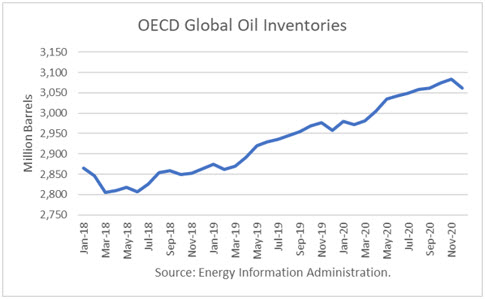
The Energy Information Administration released its Short-Term Energy Outlook for February, and it shows that OECD oil inventories likely bottomed last June at 2.806 billion barrels. It estimated a 12 barrel gain for January to 2.875 billion, 10 million barrels higher than a year ago.

Throughout 2019, OECD inventories are generally expected to rise after June. At year-end, EIA projects ending the year with 2.957 million barrels, 94 million more than at the end of 2018.
For 2020, EIA projects that stocks will build another 105 million barrels to end the year at 3.062 billion. That would push stocks into glut territory.

Energy Outlook

Oil Price Implications

I updated my linear regression between OECD oil inventories and WTI crude oil prices for the period 2010 through 2018. As expected, there are periods where the price deviates greatly from the regression model. But overall, the model provides a reasonably high r-square result of 80 percent. Continue reading "World Oil Supply, Demand And Price Outlook, February 2019"