Copper Could Face Strong Headwinds From China and Australia

Aibek Burabayev - INO.com Contributor - Metals


Copper topped the ranks at the end of last year and moved north to the middle of February without breaking any serious resistance peaking at $2.8230. Then the price drifted lower, closer to the area of the December 2016 low at $2.4480 as projected in my previous update. Copper has now bounced higher and I would like to share with you some new data, which could change my outlook for the metal.

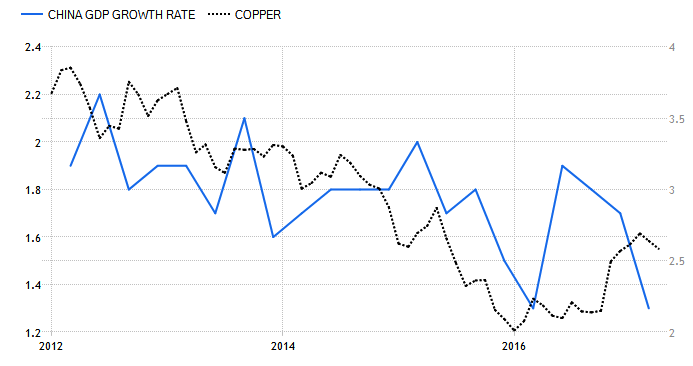
I would like to start from Chinese data as they are the top importer of the metal in the world. China’s copper import dropped almost 20% in 1Q of 2017 according to the Chinese customs statistics and this is not supporting the pricing information. Below are two charts to show you more headwinds from China.

Chart 1. Copper Vs Chinese GDP Growth Rate (Quarterly)
Chinese GDP vs. Copper
Chart courtesy of tradingeconomics.com

The Chinese economy (left scale, blue) advanced only 1.3 percent in the 1Q of 2017, following a 1.7 percent growth in the previous three months and missing market estimates of a 1.6 percent growth. It has been the weakest expansion since the 1st quarter of 2016. GDP Growth Rate in China averaged 1.84 percent from 2010 until 2017. Continue reading "Copper Could Face Strong Headwinds From China and Australia"

A Very Interesting New ETF, The 'Short Squeeze' ETF

Matt Thalman - INO.com Contributor - ETFs


On March 21st shares of The Active Alts Contrarian ETF (NASDAQ:SQZZ) began trading. SQZZ is the first ETF of its kind and opens the door for investors looking at investments from a slightly different angle. SQZZ is in a nutshell a 'short squeeze' Exchange Traded Fund.

First I will explain how shorting a stock works and what a 'short squeeze' is and then I will discuss SQZZ and why I like it.

What Does It Mean To 'Short' A Stock and What's A 'Short Squeeze'

If you don’t 'short' stocks very often, the concept of a 'short squeeze' and how this ETF will make money may be a little confusing. But I will start at the beginning and try to explain it all.

First, when a stock is sold 'short' that means the investors believes the price of the stock will move lower, not higher. If you buy stocks believing the share price will be higher in the future, what most people typically do, that is called going long on a stock. Hence, the phrase, 'going short' a stock when you think the share price is going to decline. Continue reading "A Very Interesting New ETF, The 'Short Squeeze' ETF"

Want A Federal Student Loan? Just Shake My Hand

George Yacik - INO.com Contributor - Fed & Interest Rates


Fans of the 1970s classic sitcom “The Odd Couple” might remember the episode in which Oscar Madison introduces his roommate Felix Unger to his sleazy insurance agent from Lloyd’s of Lubbock, whose come-on is that he offers you a policy just by shaking your hand. It appears that Lloyd is back in business, only now he’s working for the federal government. Or at least his underwriting guidelines have been adopted by the U.S. Department of Education.

The Wall Street Journal published a long story on Monday about the federal Parent Plus loan program, which it says “asks almost nothing about its borrowers’ incomes, existing debts, savings, credit scores or ability to repay. Then it extends loans that are nearly impossible to extinguish in bankruptcy if borrowers fall on hard times.”

And lots of them have. As of September 2015, 11% of Parent Plus borrowers hadn’t made a payment on their loans in at least a year, which “exceeds the default rate on U.S. mortgages at the peak of the housing crisis.” And the problem is only going to get worse. The number of families with Parent Plus loans has jumped more than 60% since 2005, the Journal reports, to 3.5 million at the end of last year. They owe a combined $77.5 billion, or an average $22,000. Continue reading "Want A Federal Student Loan? Just Shake My Hand"

Why OPEC's Cut-Extension Is Another Blunder

Robert Boslego - INO.com Contributor - Energies


OPEC, led by Saudi Arabia, blundered when it decided to engage in a battle for market share in November 2014. It assumed it could drive American shale oil companies bankrupt and then pick up their market share.

But this strategy was destined to fail. For one thing, they didn’t take into account that American shale oil companies had hedged their future production. That protected the companies from experiencing the impact of lower prices to the extent that they had hedged.

Second, they didn’t take into account the American bankruptcy system. Companies can continue as “zombies” surviving by cutting costs to the bone, and selling assets to other companies at a discount to keep afloat. The buyers then have a lower “cost basis.”

Third, they didn’t take into account their own vulnerabilities. Sure, their national oil companies have low production costs but their oil revenues largely support the national budgets. They need high oil prices to balance their budgets, effectively making them high-cost producers (e.g., KSA about $65/b in 2017). Continue reading "Why OPEC's Cut-Extension Is Another Blunder"

Silver Update: The Time Is Up

Aibek Burabayev - INO.com Contributor - Metals


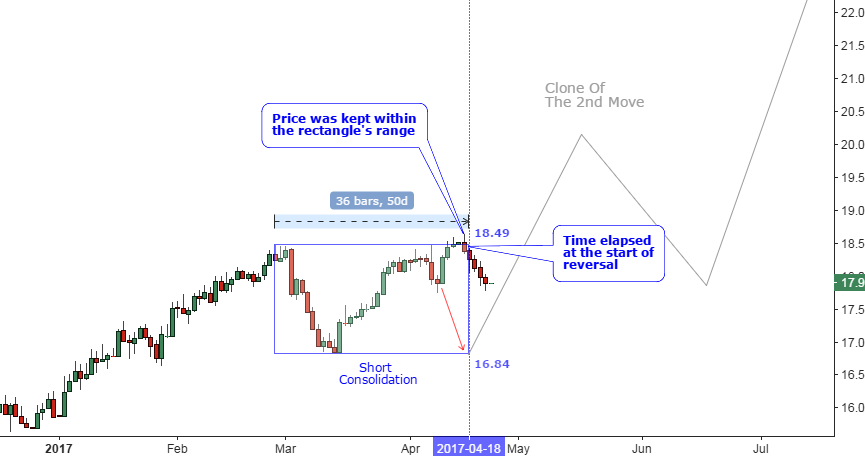
This post is dedicated to silver as the projected period of consolidation set in my previous Gold & Silver post finished last week on Tuesday, the 18th of April. Let’s see the result of that “Cloning” experiment below.

Chart 1. Snapshot Of Experiment Result: Good Range Wrong Timing

Silver Chart
Chart courtesy of tradingview.com

The chart above is a snapshot of the projected graph within the “Cloning” experiment posted earlier. As we see the price didn’t follow the red down arrow and reversed higher up to the top of the rectangle where it was blocked successfully. And the anticipated down move started right at the end of projected period missing the time target. Continue reading "Silver Update: The Time Is Up"