WSJ Takes A Leap Too Far In Assigning Causation To Energy Sector Valuations

Adam Feik - INO.com Contributor - Energies


The WSJ Morning MoneyBeat blog post for Tuesday, March 22, was entitled, “Energy Stocks Are the Most Expensive in S&P 500.”

Are they really?

As I read the WSJ’s post, I decided I really have to use this as an opportunity to help dispel some widely – nay, almost universally held – notions about using P/E ratios to predict stock price movements.

How Not To Use P/E

Almost all investors, in my experience, routinely fall into the trap of misusing the P/E. In fact, I admit I fell into the same bad habit for many years myself. Until a couple of years ago (more on that later).

Don’t get me wrong. It’s not that the ratio can’t be useful. On the contrary, when properly interpreted, P/E can be an indication of sentiment, which is always important for an investor to understand. When P/Es are low (remembering to mentally adjust absolute P/E figures to account for differences in interest rates, inflation, and other market conditions in order to accurately assess whether P/Es are truly “low” or not), sentiment is probably somewhat sour, generally speaking. High P/Es (all things considered) generally mean investors feel willing to “pay up” for earnings, growth, dividends, and/or other perceived benefits of owning stocks. And again, having a feel for what the market’s sentiment is can be helpful (often in a contrarian sort of way).

Beyond the ratio’s use as a rough sentiment gauge, however, I’ve learned several things in the last couple years about using (or misusing) P/E ratios (for individual stocks and for the broad markets), which I’ll summarize as follows: Continue reading "WSJ Takes A Leap Too Far In Assigning Causation To Energy Sector Valuations"

McKesson Goes On Acquisition Spree And Announces Layoffs

Noah Kiedrowski - INO.com Contributor - Biotech


Introduction

McKesson Corporation (NYSE:MCK) has been on an acquisition spree as of late and announced layoffs of 1,600 workers or about 4% of its U.S. workforce. These collective efforts are aimed to stem any losses in revenue from a hit to its customer base while continuing to drive value for shareholders. McKesson has agreed to acquire two privately held medical firms that focus in oncology for a total of $1.2 billion. McKesson has also agreed to acquire Ontario-based Rexall Health for $2.2 billion in Canada. Layoffs are underway as well after the company determined “reductions in our workforce would be necessary to align our cost structure with our business model.” McKesson is being proactive and aligning its cost structure to in a fiscally responsible manner in order to remain competitive and add value to shareholders. After the recent political induced healthcare sell-off, many healthcare stocks look attractive at these levels, specifically McKesson. Once the political cycle is complete in 2016, these stocks will likely benefit from the mere absence of political headwinds. McKesson has hit a 52-week low and remains near that level and boasts a P/E of 16 and a PEG of 1.46. McKesson appears very attractive considering its EPS growth, dividend payout, acquisitive mindset and share buyback program. Continue reading "McKesson Goes On Acquisition Spree And Announces Layoffs"

Gold Update: Bulls Finally Took The Ball

Aibek Burabayev - INO.com Contributor - Metals


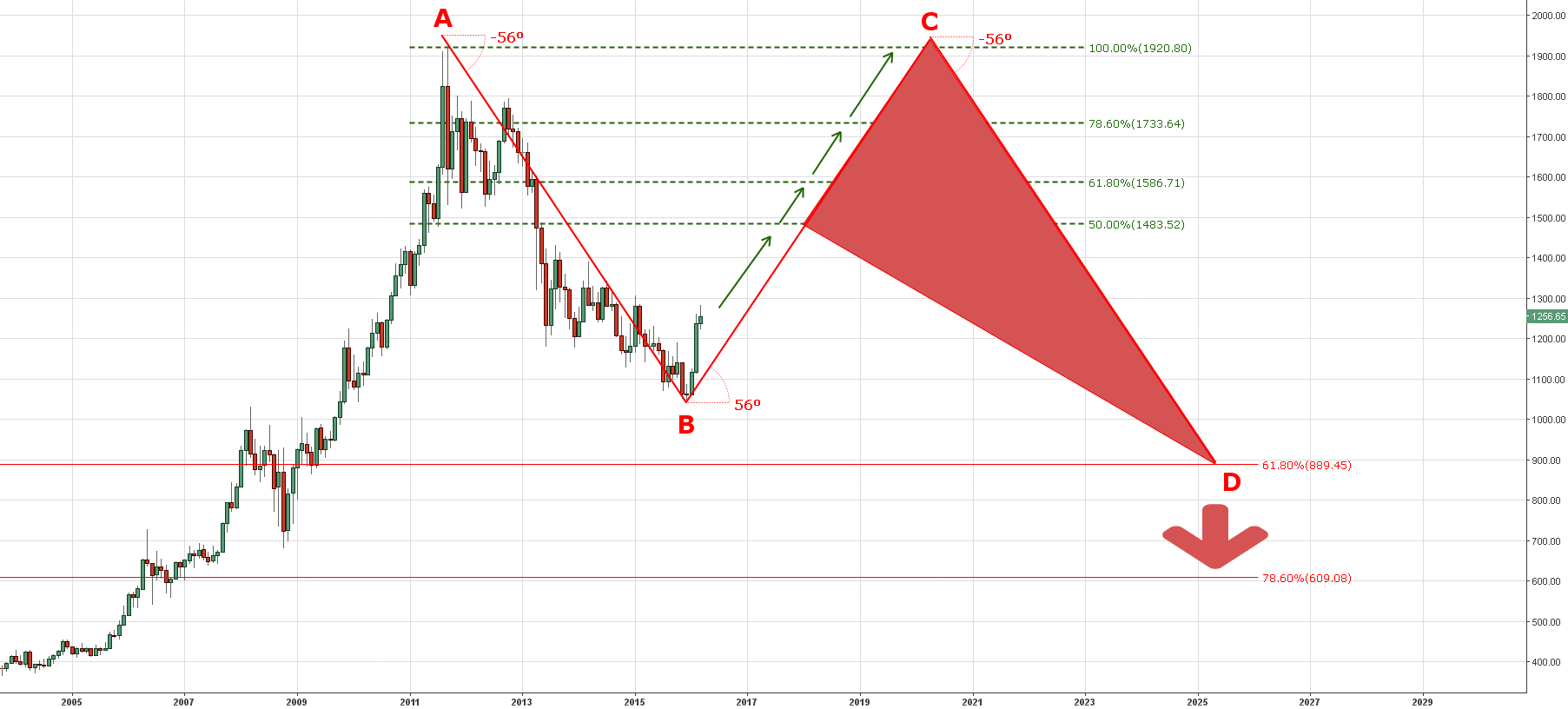
February scored the first point in favor of the bulls breaking the downtrend. Usually, when we get something that we want, after moments of winning euphoria, we start to feel sad about further uncertainty – what is next? To avoid that feeling we should work out a new plan like the one that I prepared for you below.

Chart 1. Gold Monthly: Gold Bugs, How Deep Is Your Love?

Monthly Gold Chart
Chart courtesy of tradingview.com

Speaking globally, the sad thing for the bulls is that we can’t be sure of the Big Bull Run until the price is below the previous high at $1920. I can add more points saying that there is still a chance of a complex correction, which can last longer, much longer. Gold was in an uptrend for 12 years and the current correction took only 4.5 years. Therefore, the probability of its prolongation is high as the correction might last longer the than major trends. It is human nature when we have a clear idea to act decisively and swiftly (trends), but once we fall into a thoughtful mood reflecting of further plans we are losing/taking our time to think everything thoroughly (corrections). Continue reading "Gold Update: Bulls Finally Took The Ball"

Follow The Transportation Sector To Profits

Daniel Cross - INO.com Contributor - Equities


Certain sectors of the economy have predictive qualities. Known as leading indicators, changes in these industries tell investors whether the economy is expanding or contracting before more solid data comes out.

Transportation is one of those sectors that tells investors how healthy the economy is. When transportation companies are doing poorly and missing earnings, it's often a sign that the economy isn't doing well. On the other hand, when profits are up it can mean that businesses are shipping and manufacturing more goods that need to be delivered.

After a rough start to the year, the transportation sector has rebounded strongly. Just tracking the SPDR S&P Transportation ETF (PACF:XTN) since it dipped in January shows an improvement of 17% to date. Hedge funds have also been expressing an interest in transportation stocks lately with large purchases in a number of trucking companies. Continue reading "Follow The Transportation Sector To Profits"

Euro Out Of The Woods?

Lior Alkalay - INO.com Contributor - Forex


No doubt the most dramatic event of the FX market this past week was the ECB decision. Draghi, it seems, has finally "cut the mustard." He delivered a powerful response to the latest softness in Eurozone inflation. Essentially, the ECB expanded its QE program to €80Bln of purchases a month and pushed the deposit rate lower into negative territory. But if you expected these moves to play right into the bears' hands (as it has in times past) you might be in for a surprise.

Eurozone: The Good vs. Bad

When the Euro ended up higher in the aftermath of the ECB decision many were caught off guard. Some claimed the Euro's reprieve was the result of Draghi's rhetoric which suggested no more "bazookas" anytime soon.

But what seems more probable is that Draghi's words might just be the consequence rather than the cause. That is the consequence of some green shots that had started to appear in the latest Eurozone data. Those readings suggested that printing money until the apocalypse was not necessarily needed. That's what we call the "good news."

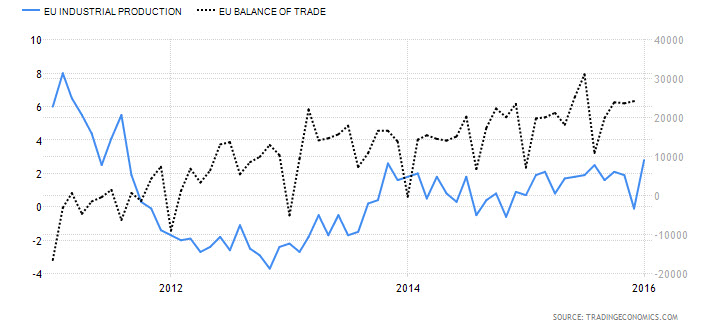
Below are two important indicators for the Eurozone; the balance of trade and industrial production. Both indicators are keenly scrutinized for this export-oriented region.

EU Industrial Production vs. EU Balance Of Trade
Chart courtesy of Tradingeconomics

The balance of trade figure has upticked higher and reaffirmed its rising trend from 2012. This suggests that the Eurozone exports more goods than it buys. Continue reading "Euro Out Of The Woods?"