
Navigating Volatile Markets Via Share Buyback Investing - Part 2

Noah Kiedrowski - INO.com Contributor - Biotech


Introduction

Share buybacks can serve as an effective way to drive shareholder value via returning capital to shareholders by repurchasing its own stock. Share buybacks are primarily driven by companies that strongly feel their shares are undervalued based on current fundamentals, future growth prospects and cash on hand. Taken together, executive boards approve share buyback programs based on these attributes in concert with undervaluation on the open market. Additionally, the company of interest feels a sense of bullishness and confidence on the future and sustainability of their business.

Theoretically, repurchasing and retiring shares satisfies many shareholder friendly objectives:

1) Reducing the number of shares tilts the supply and demand curve thereby removing shares will decrease supply and in turn increase demand and drive the share price higher

2) Earnings per share increase since earnings are now dividend over fewer shares

3) If share buybacks are coupled with a dividend, the dividend yield may increase if the aggregate quarterly payout amount remains unchanged thus; as a result the payout will be divided over fewer shares.

I'll be using The PowerShares Buyback Achievers ETF (PKW) as a proxy for this analysis. PKW focuses on U.S. companies that have reduced their shares outstanding by at least 5% in the previous year and weights these holdings by market capitalization, subject to a 5% cap within the ETF portfolio. PKW may present an opportunistic niche in which to invest and potentially capitalize on a cohort of companies that engage in aggressive buyback programs, particularly in these volatile markets. Continue reading "Navigating Volatile Markets Via Share Buyback Investing - Part 2"

Copper Update: Crude Oil Signals To Cover Shorts

Aibek Burabayev - INO.com Contributor - Metals


Last month, I published a post about the correlation of the World GDP and Copper prices. I also covered the close correlation of Crude Oil and Copper prices.

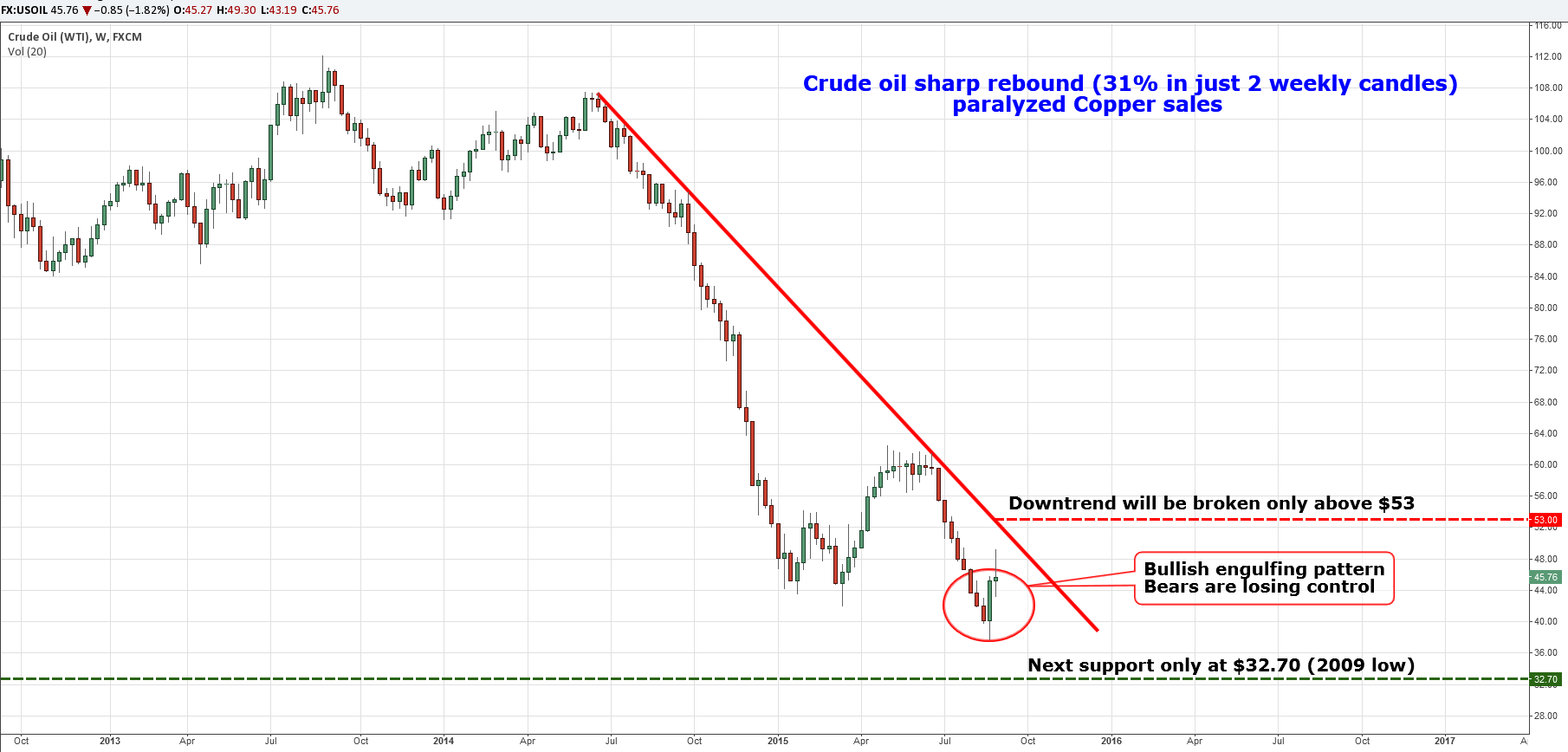
Chart 1 Crude Oil weekly: Sharp rebound

NYMEX Crude Oil
Chart courtesy of TradingView.com

As seen in the above weekly chart, Crude Oil bulls attacked the market without a declaration of war and caught sellers unaware. The price quickly grew more than $10 in just three days.

This severe price action on the weekly chart has formed a so-called Bullish Engulfing pattern. That's when the small red bearish candlestick is followed by a large green bullish candlestick that completely eclipses (engulfs) the previous week's candlestick. It means that bulls have taken control of the market and the price has gone lower (or is at the end of the decline). Continue reading "Copper Update: Crude Oil Signals To Cover Shorts"

Important Technical Indicators For Trading Binary Options

Vinz de la Fuente - INO.com Contributor - Binary Options


Trading Accordingly

Binary Trading could be simple to trade, but the difficulty comes up with how you will win your trade by knowing which direction you will choose. Traders can actually have a higher chance of winning every trade by simply knowing and applying some technical indicators whenever they trade in the market. Technical indicators can help identify price patterns and historical market behavior on market charts. Most of the traders are plainly looking at the wider trends in the market and then they will trade according to the direction of the trends, but sometimes success in using this is not assured.

The Technical Indicators

The technical indicators listed below are used widely in the market and have proven to be effective in some traders perspective. However, there is no 100% guarantee that it will be effective in every trading activity and it also has time-frame factors to be considered. Continue reading "Important Technical Indicators For Trading Binary Options"

4 Companies You Can Own That Operate Your Favorite ETFs

Matt Thalman - INO.com Contributor - ETFs


SPDR S&P 500 ETF (SPY), Schwab U.S Broad Market ETF (SCHB), State Street Corporation (STT), Invesco (IVZ), Wisdom Tree (WETF), BlackRock (BLK), ETF investing, ETF's, benefits of etfs,

But first, maybe you are wondering what an ETF operator does and how do they make money?

Plan and simply an ETF operator sponsors and runs an exchange traded fund. ETF's are either managed or unmanaged. Managed would mean someone is actually deciding which investments to hold in the ETF in order to gain the highest return. Unmanaged ETF's are ones that simply track a corresponding index; such is the case with the SPDR S&P 500 ETF (SPY) which tracks S&P 500.

An ETF operator makes its money by charging a fee to manage the ETF. These fees are usually displayed as a percentage. These fees or the annual expense ratio, as it is often called, can range in amounts from as little as 0.04% which is the case with the Schwab U.S Broad Market ETF (SCHB), up to more than 3% with some of the exotic funds. Managed funds always carry a higher expense ratio as they require daily monitoring by the managers. Whereas with unmanaged funds a manager only has to make changes when the index the fund tracks changes, which is not usually very often. Think of it this way, managed means constant attention baby-sitting while unmanaged means no to little baby-sitting and the more baby-sitting, the higher the price.

So now that we know how they operate and were the revenue comes from let's take a look at a few ETF operators. Continue reading "4 Companies You Can Own That Operate Your Favorite ETFs"

Playing The Oil & Gas Pipeline Opportunity In America

Adam Feik - INO.com Contributor - Energies


One thing the energy production boom means – besides the wild, now-14-month-long crash in oil and gas prices – is that pipelines and energy infrastructure are going to remain in high demand. As American oil & gas companies continue producing – as they've shown they can & will do –, those producers will have to continue using the services of the pipeline, transportation, and storage facility owners.

The term "MLP" can mean many things

Many investors equate "pipelines" and "energy infrastructure" with Master Limited Partnerships (MLPs) like Enterprise Product Partners (EPD), Energy Transfer Partners (ETP), Williams Partners LP (WPZ), Enbridge Energy Partners (EEP), Magellan Midstream Partners LP (MMP), etc.

Yet not all MLPs are pure pipeline plays, nor are all pipeline companies are structured as MLPs!

First, many MLPs aren't "midstream" energy companies at all, but rather, are involved in "upstream" activities like exploration and production (e&p). As a result, these "upstream" MLPs' distributions depend on production – which, in turn, is highly affected by oil & gas prices. Continue reading "Playing The Oil & Gas Pipeline Opportunity In America"