China's Real Problem: The Yuan

Lior Alkalay - INO.com Contributor - Forex


In the past few weeks, and especially this last one, equity investors watched in horror as China's stock market began to disintegrate. More than $3 trillion in value disappeared in what seems like the blink of an eye. Over the same period, the FX market has been preoccupied with the unfolding events in Greece. Many investors believe that, while Greece is very relevant to the FX market, China's problem pertain only to a bubbly stock market. If that's what you believe, too, you thought wrong! China's stock crash is a mere side effect of the country's real problem – the Chinese Yuan.

China's Ambition for the Yuan

The Yuan has always been a critical tool for Chinese policy makers. During the 1990s, China essentially sacrificed the Yuan in favor of growth as it aspired to become the world's factory. That thanks in large part was to a cheap labor force. Cheap labor is essentially only possible with an undervalued currency. The Chinese government succeeded in its endeavor. China rose to prominence, moving swiftly from a somewhat marginal economy to the world's second largest economy. There is no other way to describe it except as a phenomenal economic achievement and one skilfully executed.
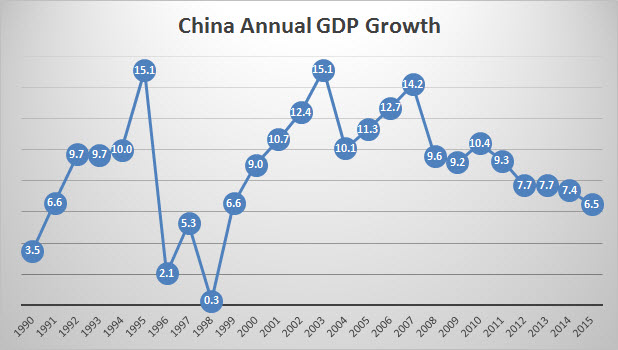
China Annual GDP Growth

Now, Chinese leaders have reached their next resolution and are set to take the first step. Once again, the government’s resolve relates to the Yuan. In order to avert a Japanese style of rise and decline, China's government wants to do things differently. The government recognizes that it must turn the Yuan into a reserve currency, one that matches the dollar. This will allow China to turn into a more sustainable credit-driven economic model, à la the United States. Continue reading "China's Real Problem: The Yuan"

Slip Slidin' Away

George Yacik - INO.com Contributor - Fed & Interest Rates


The Federal Reserve's interest rate liftoff schedule for this year is slowly but surely slip slidin' away, like a space launch aborted by bad weather. It makes you wonder which government agency is directing U.S. monetary policy, the Fed or NASA.

The minutes of the Fed's June 16-17 monetary policy committee meeting released July 8 were a lot more dovish than the announcement that immediately followed the meeting. It now looks like a September rate liftoff isn't as baked in the cake as many previously believed just a few weeks ago.

Since then, of course, a lot has changed, almost all of it conspiring against an early rate increase. September is a lot less likely to happen now, and even December looks doubtful. I didn't think the Fed was courageous or confident enough to make a move this year anyway, so the events of the past few weeks make me more comfortable with that position. Continue reading "Slip Slidin' Away"

Year Of Shocks: Which Of The Safe Havens Saved The Most?

Aibek Burabayev - INO.com Contributor - Metals


It's only the middle of the year, but we've already seen quite a lot, even for the seasoned investor.

The Swiss National Bank (SNB) kicked off the ball in January for what has proven to be a nightmare year thus far. It's caused a lot of tears and fears among investors, some of them went bankrupt in one day after it let the franc go.

Greece and it's possible leave of the single currency zone has been dubbed the "Grexit." It's added turmoil to the markets over the last month with currencies crosses opening with gaps on the last two consecutive Mondays. The single currency zone has never been so vulnerable from the day of its launch, as Greek precedent can find followers and bring Germany a lot of headaches furthermore.

The United Kingdom also played its role with the Queen's speech this May containing words of possible divorce with the European Union in 2017, which was named "Brexit" (Britain's exit) a la Grexit.

All of the cases mentioned above are episodes of the world currency war and the first prey of it is the European single currency that has been damaged a lot. Continue reading "Year Of Shocks: Which Of The Safe Havens Saved The Most?"

Don't Worry About Bulls or Bears, This 'Sin' Stock Is A Buy Regardless

Daniel Cross - INO.com Contributor - Equities


Sin stocks are popular with most investors. These are the types of companies that peddle alcohol, cigarettes and gambling to consumers – products and services that appeal to vices. It's popularity is easy to understand though. These companies tend to do well regardless of the economic environment. Whether the economy is expanding or contracting, people will still consume alcohol, smoke cigarettes and gamble.

For long-term investors, these are good stocks to own. They might be subject to short-term volatility, but generally have high free cash flow, operating margins and growth expectations. Alcohol in particular right now has a lot of potential for future growth.

The expanding global middle class – especially in BRIC economies – are becoming more demanding of what they want. Name-brand liquor and beer have proliferated in these countries as consumers have developed disposable income. Continue reading "Don't Worry About Bulls or Bears, This 'Sin' Stock Is A Buy Regardless"

Time For Europe To Cut Its Losses

George Yacik - INO.com Contributor - Fed & Interest Rates


One of the most exasperating novels I've ever read is Of Human Bondage by W. Somerset Maugham. The "hero" of the novel, Philip Carey, is hopelessly infatuated with Mildred Rogers, an unattractive, sickly, boorish shop girl several social rungs lower than himself. She takes horrible advantage of the good-natured generosity and sincerity of Carey, who time after time bails Mildred out of one self-created problem after another, only to be kicked in the pants (figuratively, of course) for his trouble and good intentions. And yet he continually comes back for more.

While you're reading the book (or watching one of the movies based on it), you keep asking yourself: When the heck is Carey ever going to wake up and smell the coffee?

Does this sound like any current European crisis you may have read about recently in the financial media? Continue reading "Time For Europe To Cut Its Losses"