Feds Hawkish Demeanor Puts Pressure On Gold

This week's market participants seemed complacent in regards to the Russian invasion of Ukraine and the current level of inflation. Four of the five trading days this week were characterized as having lower closes than its opening price and lower closes compared to the prior day's closing price.

On Wednesday, when the Federal Reserve concluded its FOMC meeting, gold hit its lowest value with the April futures contract trading to a low of $1895. Although gold recovered from its low, its closing price was the lowest value of closes this week. Thursday was the only day in which gold closed above its open and above the prior day's closing price. Continue reading "Feds Hawkish Demeanor Puts Pressure On Gold"

Big Banks' Meltdown Overblown

Higher Expenses and Geopolitics

Capping off 2021, the cohort of big banks had the perfect set-up with secular trends via a confluence of a rising interest rate environment, post-pandemic economic rebound, financially strong balance sheets to support expanded buybacks and dividends, a robust housing market, and the easy passage of annual stress tests. However, as earnings season kicked off in January 2022, investors saw a step-up in expenses, specifically wage inflation. Bank of America (BAC), JPMorgan Chase (JPM), Morgan Stanley (MS), Wells Forgo (WFC), and Goldman Sachs (GS) all reported very strong quarters; however, investors couldn't look past the increasing expenses and these stocks sold-off as a result.

To exacerbate the sell-off across the financials, the geopolitical backdrop with the Russian/Ukraine conflict paved the way for a second leg down. This one-two punch resulted in BAC, JPM, and GS selling off 18.3%, 22.3%, and 22.6%, respectively, from their 52-week highs through the first week of March. However, as Jerome Powell sets the stage for an economic "soft landing" with the clear commitment of raising interest rates by 25-basis points and the geopolitical headwinds inevitably abating, the big banking cohort looks appealing at these levels.

Big Banks

Immaterial Geopolitical Exposure

The big banking cohort has minimal to no direct exposure to Russia; thus, the second leg down in this space is not tied directly to the geopolitical conflict. This is especially important as the geopolitical tensions rage on and possibly snap up these stocks as a function of overall market sentiment. Overall, the big banks generate an inconsequential amount of revenue from Russia, per Bank of America's analysis of regulatory 10-K filings. Continue reading "Big Banks' Meltdown Overblown"

Interest Rates Are Going To Go Higher

Even while the Russian-Ukraine conflict continues to rage on, the fact of the matter is the US, and honestly, the majority of the world is dealing with higher-than-expected inflation. And the most direct way to bring that inflation back down to sustainable levels is for the Federal Reserve and other central banks around the world to take action and increase interest rates.

Prior to the Russian-Ukraine situation occurring, it was widely expected that the Federal Reserve would raise the benchmark interest rate by 0.5% in March. However, now that the war in Ukraine is occurring, many believe the Fed will only increase rates to 0.25% in March and reassess the situation at the following meeting.

However, even while most market participants expect a rate hike of just 0.25%, some Fed officials still believe that a 1.00% rate hike is justified in March. While there is talk of the 1% hike, very few believe it will occur in March, especially since the Russia-Ukraine situation.

Furthermore, market participants also need to consider when and how quickly the Federal Reserve decides to start winding down its balance sheet. Some believe when the Fed begins that process, it could have more of an effect on interest rates than when the Fed actually raises rates since the Fed was a huge buyer of bonds. Since the bond market and bond interest rates are essentially determined by supply and demand, if demand is weak due to limited buyers, the interest rates will increase until buyers step in. With the Fed no longer buying and potentially selling bonds, supply will be high, which will require much more attractive yields in order to entice investors to step in and buy bonds.

So as an investor, how can you profit from this information? Continue reading "Interest Rates Are Going To Go Higher"

Crypto: Failed Rally Builds Ambiguous Pattern

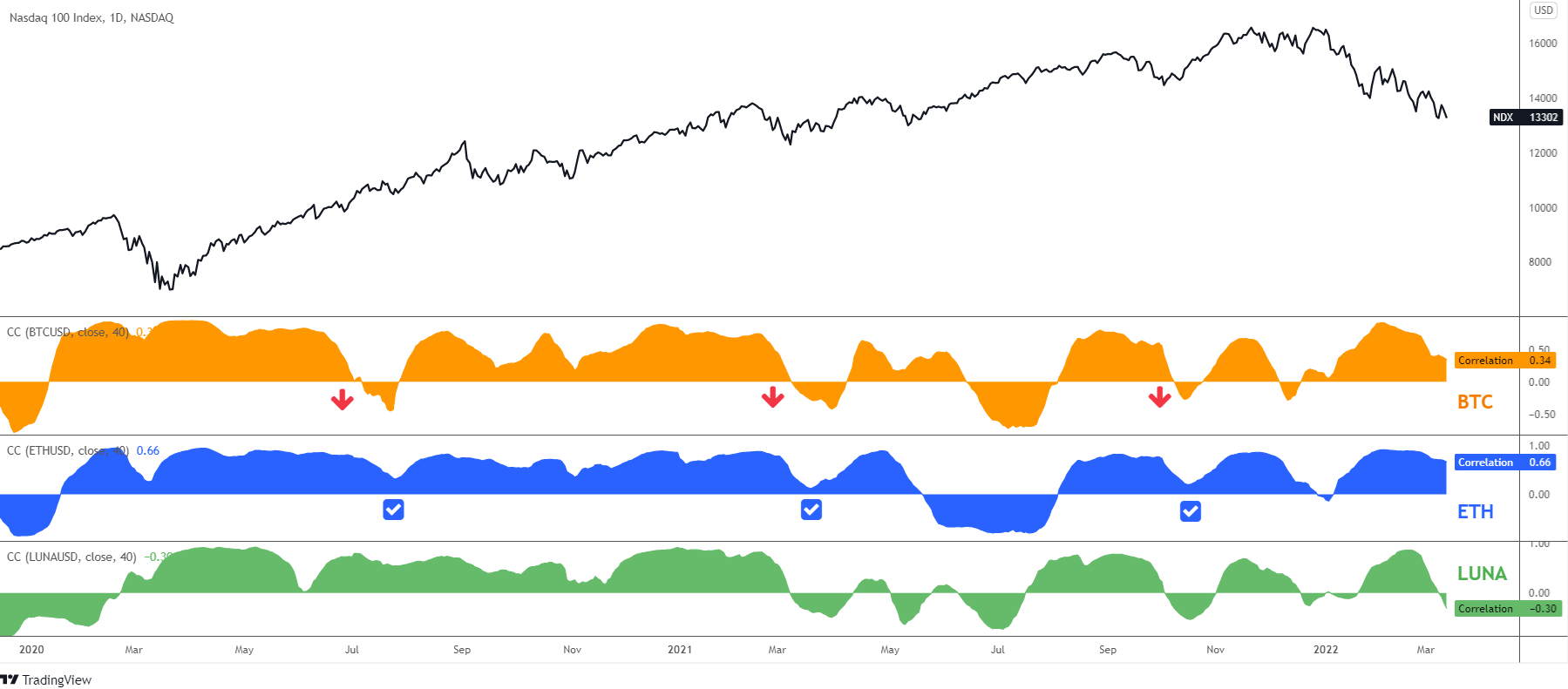
Before starting the crypto update, I would like to check an assumption circulating in the media regarding a strong correlation of Bitcoin with the Nasdaq 100 index in the chart below.

Crypto

It is safe to say that over the past two years, most of the time, Bitcoin was in a positive correlation with the Nasdaq 100 index. However, the current positive relationship is cooling down as we saw an almost absolute correlation at the beginning of February at 0.91, and these days it slipped down to 0.34.

Miscorrelation periods usually appear due to the higher volatility of Bitcoin and longer periods of price inertia in the stock index. In other words, these two instruments have different speeds. Continue reading "Crypto: Failed Rally Builds Ambiguous Pattern"

Gold Corrects After Challenging Record High

On Tuesday, March 8, gold futures traded to an intraday high of $2078, roughly $10 below the all-time high of $2088, which was achieved in August 2020. The current decline in gold is the first real price decline since January, when gold hit a low of approximately $1780. Until Tuesday of this week, what followed in February was a dynamic rally resulting in gold gaining approximately $300 when gold traded to $2078. On Wednesday, March 9, gold opened above Tuesday’s closing price of $2043 but closed dramatically lower, resulting in a price decline of $72. Tuesday’s strong decline resulted in gold losing 3.49% in value, the largest single-day loss in 2022.

As of 4:45 PM EST on Friday, March 11 gold futures basis, the most active April Comex contract is currently fixed at $1990.20, a net decline of $10.30 or 0.51%. However, this decline can be largely attributed to dollar strength. Currently, the dollar is up by 0.63% and with the dollar index fixed at 99.12. While gold pricing is lower today, it is completely the result of dollar strength and fractional buying of gold.

Kitco Gold Index (KGX)

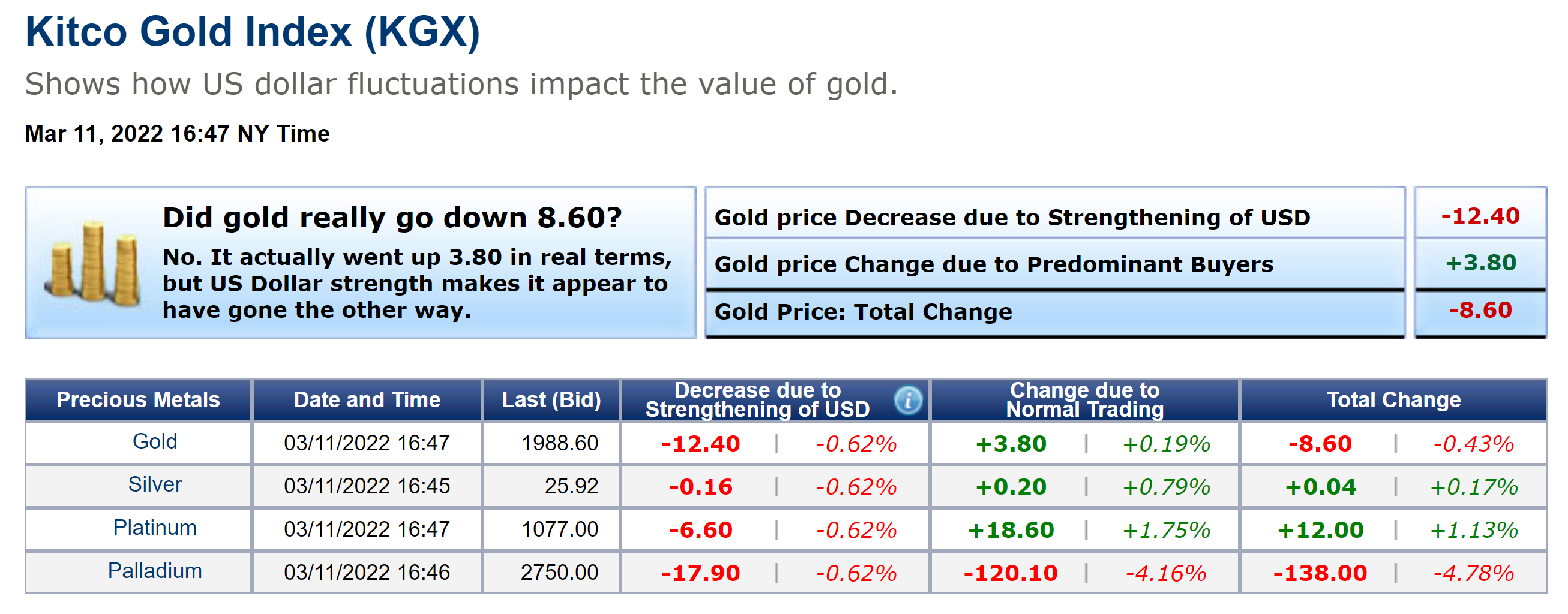
Currently, spot gold is fixed at $1988.60, a net decline of $8.60 on the day. The Kitco Gold Index shows that dollar strength resulted in gold declining $12.40, and fractional buying resulted in a gain of $3.80, resulting in the net change today of -$8.60. Continue reading "Gold Corrects After Challenging Record High"