Powell Tempers The Taper Talk

Federal Reserve Chair Jerome Powell’s comments at last Friday’s virtual Jackson Hole Economic Symposium received different interpretations from the financial media, but the bond and stock markets seemed to understand that the Fed isn’t going to be embarking on any significant change in its accommodative policies in the near future; i.e., don’t worry about the taper.

According to the Wall Street Journal’s headline, “Powell Says Fed Could Start Scaling Back Stimulus This Year.” But Yahoo Finance had a much more circumspect take. Its headline read: “Powell: Reversing Fed stimulus too early could be 'particularly harmful.’”

“Today, with substantial slack remaining in the labor market and the pandemic continuing, such a mistake could be particularly harmful,” Yahoo quoted Powell as saying, although further down in its story, it added an additional quote: “If the economy evolved broadly as anticipated, it could be appropriate to start reducing the pace of asset purchases this year.”

As several other Fed officials stated, that seemed to seal the deal that the Fed will start the asset tapering process sometime in the fourth quarter and maybe wrap it up early next year. Left up in the air is exactly how much the Fed plans to taper and at what point it will stop, although Powell made it sound like it may not happen at all if economic changes intervene. In any event, the markets seemed to like what Powell said, as stock prices rose and bond yields fell. Continue reading "Powell Tempers The Taper Talk"
American Express: A Compelling Buy

American Express (AXP) blurs the line between a traditional credit card company and effecting traditional banking services such as personal and business loans and savings accounts. This business model blend makes American Express a dual-threat as it can ride the wave of improved consumer spending coming out of the pandemic as witnessed by its blow-out second-quarter earnings and rising interest rates as the Federal Reserve steps off its accommodative easing policies. American Express has recently dropped over 10% from its 52-week high after target price hikes and upgrades across a broad range of analysts. Couple this with inexpensive valuation metrics, and the fundamental and technical investment case comes together nicely. American Express sits in the sweet spot of an improved consumer and a potential rising interest rate environment.

Latest Earnings and Growth

The recent earnings report by American Express demonstrated its strength and potential growth moving forward as the pandemic continues to subside. Analysts across the board upgraded the stock and increased the price targets because of these stellar earnings. Earnings blew past analysts' estimates, driven by a recovery in global consumer spending, specifically on travel. Consumer spending logged double-digit growth in the second quarter. The U.S. consumer has "rocketed ahead on travel," per CFO Jeff Campbell, with spending related to travel and entertainment on its cards within the United States reaching 98% of pre-pandemic levels. On global travel and entertainment spending, he said it had recovered to nearly 70% of 2019 levels, two quarters earlier than previously expected. Strong demand for premium, fee-based products helped drive the addition of U.S. Platinum card members to record levels, per CEO Stephen Squeri. The company sold 2.4 million new proprietary cards in the quarter, while spending on goods and services on its cards grew 16% on a currency-adjusted basis. Net income rose to $2.28 billion, or $2.80 per share, for the quarter ended June 30 from $257 million, or 29 cents per share, a year earlier. Analysts had expected $1.67 per share, according to Refinitiv IBES data. Excluding interest expense, American Express’ total revenue rose 33% to around $10.24 billion. Continue reading "American Express: A Compelling Buy"

Weekly Stock Market Forecast

This week we have a stock market forecast for the week of 8/29/21 from our friend Bo Yoder of the Market Forecasting Academy. Be sure to leave a comment and let us know what you think!

The S&P 500 (SPY)

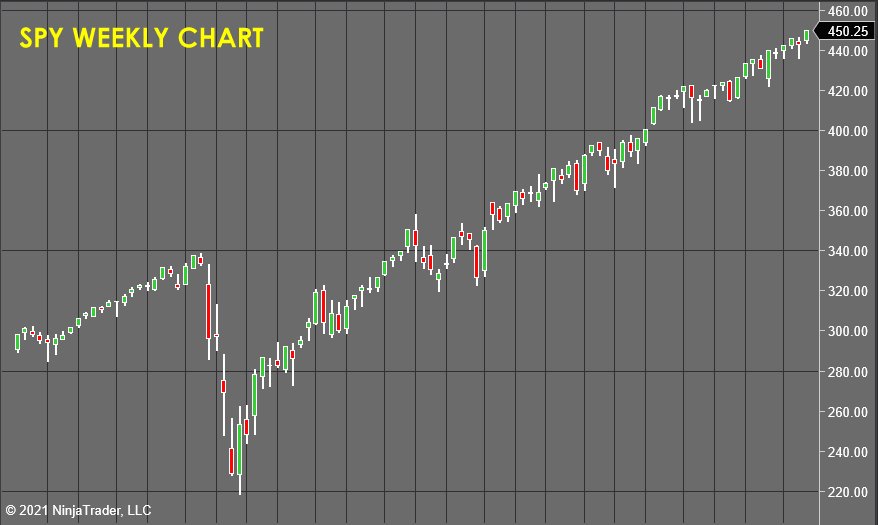
SPY Weekly Chart - Stock Market Forecast

Another week has gone by, and another week of drifting from the markets as we work our way through the August doldrums.

The market keeps drifting higher, and I’ve been enjoying the summer and keeping my powder dry as I wait for a catalyst to break us out of this inflation-driven drift.

With a heavy heart, I see what I think is that catalyst in the form of a Category 4 hurricane, which is currently pummeling the state of Louisiana as it makes landfall with 140MPH+ winds.

I put off publishing this forecast as long as I could in order to find out how bad things were likely to be before I could make as accurate a forecast as possible for all of you... Continue reading "Weekly Stock Market Forecast"

Stock Market Risk Not Yet Realized

The stock market is at high risk, but…

The ‘but’ is the old saying “markets can remain [seemingly] irrational longer than you can remain solvent” if you fight a trend that is intact at any given point. Since March 2020 that trend has been up.

Structurally Over-bullish

Below is a chart showing the 10-week exponential moving average of the Equity Put/Call ratio (CPCE) that we review periodically in NFTRH for a view of the structural over-bullish situation in stocks. I write structural because it has extended much longer than extremes in the CPCE have done at previous ‘bull killer’ danger points, after which risk was realized in the form of moderate to severe corrections.

The trend began logically enough at a ‘bear killer’ reading in the midst of max pandemic fear. We noted at the time that market participants were not just bearish, not just risk-averse, but absolutely terrified. So the recipe is this: take 1 lump of terrified investors, add a heaping helping of the Fed’s money printing and voila, enjoy the taste of a slingshot rally that is very filling despite its inflationary odor.

Risk? Well, when SPX took out the previous 2020 high last summer we established a target of 4400 (conservative) to 4600 (at an extreme). The market is in the target zone, CPCE has begun to labor up and out of the structurally over-bullish floor and well, it could be a signal of a later stage bull market. But a warning about jumping into a heavily active bearish position is that using the run-up to 2016 as an example, the pressure can build for months, even years before risk is realized. Another caveat to going full frontal bear is that the EMA 10 is starting to hook down again as pressure is being relieved lately. Continue reading "Stock Market Risk Not Yet Realized"

World Oil Supply And Price Outlook, August 2021

The Energy Information Administration released its Short-Term Energy Outlook for August, and it shows that OECD oil inventories likely peaked at 3.207 billion in July 2020. In July 2021, it estimated stocks fell by 13 million barrels to end at 2.860 billion, 348 million barrels lower than a year ago.

The EIA estimated global oil production at 97.42 million barrels per day (mmbd) for July, compared to global oil consumption of 98.78 mmbd. That implies an undersupply of 1.15 mmb/d, or 42 million barrels for the month. Given the decrease in OECD stocks, non-OECD stocks are implied to have increased by 29 million barrels.

For 2021, OECD inventories are now projected to draw by net 208 million barrels to 2.819 billion. For 2022 it forecasts that stocks will build by 90 million barrels to end the year at 2.908 billion.

Crude Oil

On July 18th, OPEC agreed to:

“Adjust upward their overall production by 0.4 mb/d on a monthly basis starting August 2021 until phasing out the 5.8 mb/d production adjustment, and in December 2021 assess market developments and Participating Countries’ performance.”

The current “reference production” and adjustments levels are detailed in the table below. Continue reading "World Oil Supply And Price Outlook, August 2021"