Gold Falls As Silver Misses Target

Both top metals couldn’t sustain the growth, although silver was more convincing than gold this time again.

Let’s start with the updated gold chart below.

gold
Chart courtesy of tradingview.com

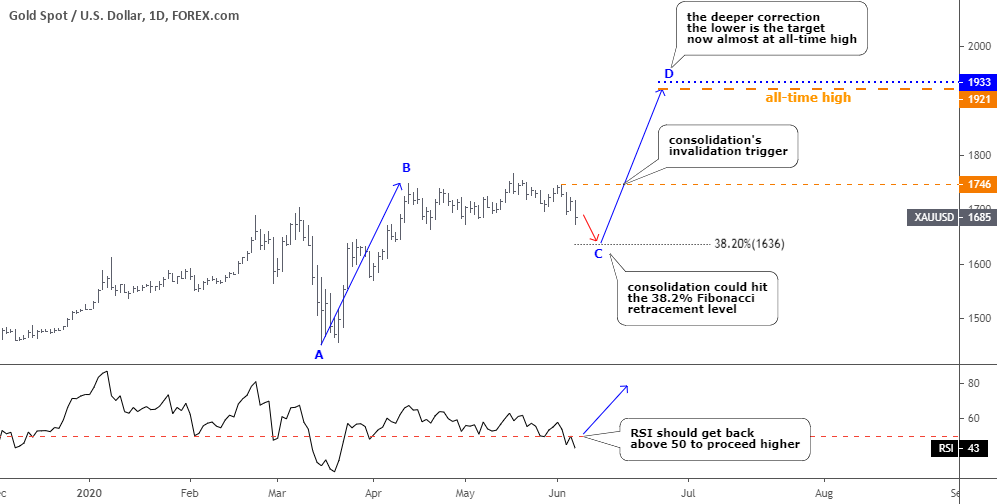
Gold is still consolidating as it couldn’t overcome not only the nearest peak of $1766 but it also failed right at the top of the AB segment of $1748. The RSI dipped into the bearish zone below the crucial 50 level. So, it’s the right time to put our classic instrument called Fibonacci retracement level as gold watches ground while both feet are in the air. The first important 38.2% Fibonacci retracement level could offer support at $1636. Continue reading "Gold Falls As Silver Misses Target"

Silver/Gold Ratio Hits Target

The NFTRH plan is and has been that the gold mining sector, due to the fundamentals implied by the handy graphic below, could eventually lead a world full of inflatables higher. The miners, leveraging gold’s outperformance to most everything else during liquidity crises and even deflation, move first and draw in the inflationist bugs later. If the macro goes inflationary the miners will likely continue to perform well (ref. the 2003-2008 period) but would no longer be the go-to sector.

Then the play theoretically spreads far afield into commodities, global stocks (e.g. EM, Asia, etc.) and US markets/sectors that tend to benefit from the rising long-term yields (e.g. banks, materials, etc.) resulting from inflationary macro signaling. These would be aspects of a sustainable inflation/reflation trade IF the signals are in order. So let’s take a look at some of them.

The Silver/Gold Ratio (SGR), a reflationary risk ‘on’ indicator has hit our upside target, which we have tracked in NFTRH updates over the last few weeks using the yellow box highlighting an area near the down-trending 200-day moving average that would at least temporarily halt the party. The SGR is pausing and pulling back a bit here. All normal so far. Continue reading "Silver/Gold Ratio Hits Target"

Indexes Trigger Monthly Trade Triangles

The DOW, S&P 500, NASDAQ, and Bitcoin all triggered new green monthly Trade Triangles signaling a move to a long-term uptrend. The move higher was on the back of a historic and surprising gain in U.S. jobs that raised hopes that the economy is starting to recover from the coronavirus pandemic.

U.S. employers added a shocking 2.5 million jobs last month, the largest gain on record, while the unemployment rate slid to 13.3%, the Labor Department said Friday. Economists polled by the Dow Jones expected a drop of more than 8 million jobs and the unemployment rate to nearly reach 20%, which would have been the highest since the 1930s. Continue reading "Indexes Trigger Monthly Trade Triangles"

BNY Mellon With Truly Fee-Free ETF

BNY Mellon has been a player in the ETF industry for years, however until just recently, it was always a 'behind the scenes' player. In early April, the Bank of New York Mellon changed that in a big way by not only introducing three brand new ETFs but offering one of them to clients for free.

Yes, you read that correctly, the BNY Mellon US Large Cap Core Equity ETF (BKLC) has an expense ratio of zero. The fund doesn't charge you anything to own it. Furthermore, the Bank's two other ETFs come with extremely low fees, 0.04% for each of them.

The BNY Mellon US Mid Cap Core Equity ETF (BKMC) and the BNY Mellon US Small Cap Core Equity ETF (BKSE). Both fall in the top 1% of lowest funds when based on expense ratio, and that's while the BNY Mellon US Large Cap Core Equity ETF was technically the first ETF to offer a zero-expense ratio. Since the launch of these three funds on April 9th, BNY Mello has also launched a few other ETFs, all of which have low fees but one other that doesn't have any, the BNY Mello Core Bond ETF (BKAG).

You may be wondering about another ETF that has been touted as a zero-fee ETF or the first free ETF, it's the SoFi Select 500 ETF (SFY) and the SoFi Next 500 ETF (SFYX) however while they don't currently have an expense ratio, they could in the future. The reason for that is because the SoFi products have a fee reducing waiver, which would need to be renewed for the fund to maintain its zero-fee long term. Continue reading "BNY Mellon With Truly Fee-Free ETF"

U.S. Crude Oil Production Peaked In November

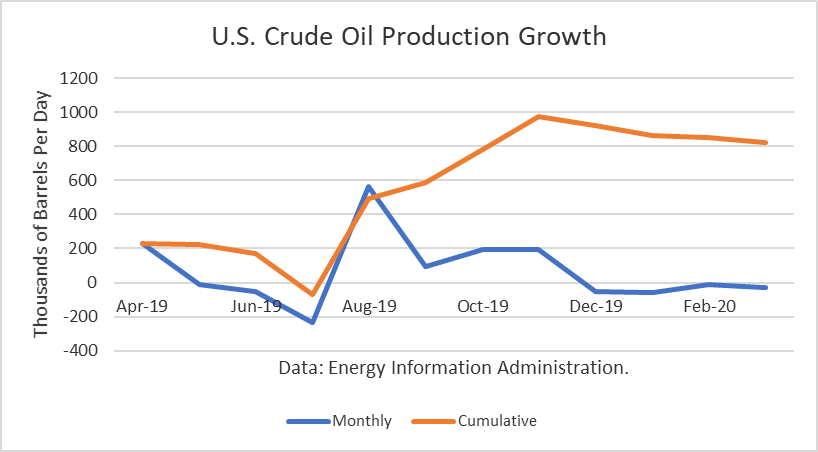
The Energy Information Administration reported that March crude oil production averaged 12.716 million barrels per day (mmbd), down 28,000 b/d from February. Reductions occurred in the Gulf of Mexico (41,000 b/d) North Dakota (19,000 b/d), and Colorado (13,000 b/d). Because of the oil price war and demand destruction, the collapse in oil prices likely undercut output in March, but the substantial drop in production started in April.

Texas production rose by 67,000 b/d to an all-time high of 5.422 mmbd.

Crude Oil

The gains from last April were still 824,000 b/d. And this number only includes crude oil. Other supplies (liquids) that are part of the petroleum supply fell 490,000 b/d from a year ago. Continue reading "U.S. Crude Oil Production Peaked In November"