Gold & Silver: The King Fights Back

The benchmark 10-year Treasury yield spiked to 1.61% last week for the first time in more than a year. The U.S. dollar, aka “King,” fought back to the upside on this growth of the yield. Investors ran out of other assets, including precious metals, and its price dropped.

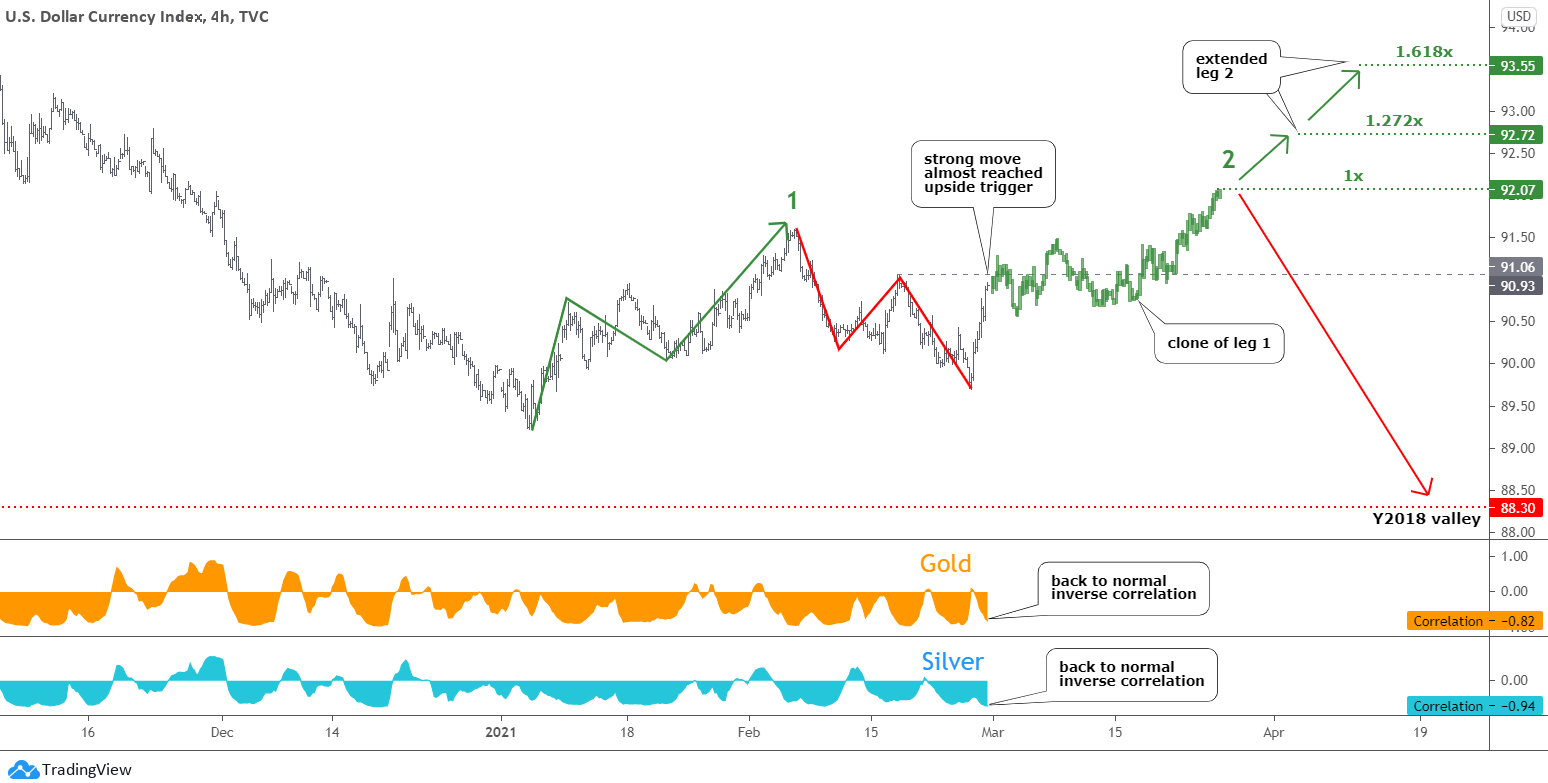
Let us see the updated structure of the U.S. dollar index (DXY) in the chart below.

dollar

It looks like the DXY moves according to your favorite orange path to the upside that was published last week. However, the sharp drop below the earlier valley eliminated both scenarios. Continue reading "Gold & Silver: The King Fights Back"

The Prospect Of Higher Rates Boost Big Banks

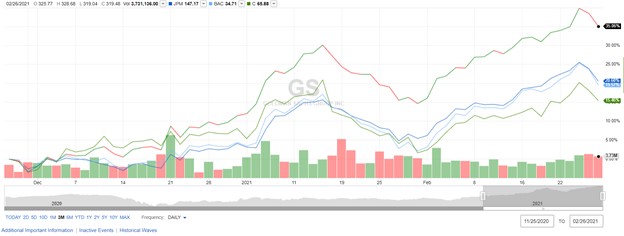
The prospect of rising interest rates has propelled bank stocks to all-high highs. Citigroup (C), JPMorgan (JPM), Bank of America (BAC), and Goldman Sachs (GS) have appreciated double digits over the past three months, breaking out to all-time highs. Rising interest rates combined with the highly disruptive COVID-19 backdrop abating has served as the foundation for this move higher. The big banks responded and evolved in the face of COVID-19 to the real possibility of widespread loan defaults, liquidity issues, ballooning credit card debt, and stressed mortgages. To exacerbate these COVID-19 impacts, interest rates, Federal Reserve actions, yield curve inversion, and liquidity heavily weighed on the sector.

Along with this turn higher, balance sheets have become even stronger now that share buybacks have been halted and dividend payouts were arrested. Large capital reserves have already been put aside for anticipated financial challenges. The big banks have demonstrated their ability to evolve in the face of COVID-19 and present compelling value. Now with the prospect of rising rates, this may serve as a long-term tailwind for banks to appreciate higher.

Bank

COVID-19 and Financial Crisis – Lessons Learned

The big banks are far stronger and more prepared than they were during the 2008 Financial Crisis. Lessons learned from the Financial Crisis yielded rigorous annual stress tests that forced banks to maintain a slew of fiscal discipline measures. With the Federal Reserve working in-hand with the banks, a financial bridge to those businesses and consumers negatively impacted by COVID-19 as a stop-gap measure has been afforded. As this pandemic subsides and economic activity rebounds the banks' present value. Add in the prospect of higher rates, and the banks are set-up for long-term appreciation. Their strong cash positions and healthy balance sheets are allowing dividends to continue as the economy transitions through the damage of the pandemic. Continue reading "The Prospect Of Higher Rates Boost Big Banks"

Bonds And Stimulus Are Driving Big Sector Trends

Falling Bonds and rising yields are creating a condition in the global markets where capital is shifting away from Technology, Communication Services and Discretionary stocks have suddenly fallen out of favor, and Financials, Energy, Real Estate, and Metals/Miners are gaining strength. The rise in yields presents an opportunity for Banks and Lenders to profit from increased yield rates. In addition, historically low-interest rates have pushed the Real Estate sector, including commodities towards new highs.

We also note Miners and Metals have shown strong support recently as the US Dollar and Bonds continue to collapse. The way the markets are shifting right now is suggesting that we may be close to a technology peak, similar to the DOT COM peak, where capital rushes away from recently high-flying technology firms into other sectors (such as Banks, Financials, Real Estate, and Energy).

The deep dive in Bonds and the US Dollar aligns with the research we conducted near the end of 2020, which suggested a market peak may set up in late February. We also suggested the markets may continue to trade in a sideways (rounded top) type of structure until late March or early April 2021. Our tools and research help us to make these predictions nearly 4 to 5+ months before the markets attempt to make these moves.

If our research is correct, we may have started a “capital shift” process in mid-February where declining Bonds, rising yields, and the declining US Dollar push traders to re-evaluate continued profit potential in the hottest sectors over the past 6 to 12+ months. This would mean that Technology, Healthcare, Comm Services, and Discretionary sectors may suddenly find themselves on the “not so hot” list soon. Continue reading "Bonds And Stimulus Are Driving Big Sector Trends"

Your ETFs Are At Risk If US Delist Chinese Stocks

At the beginning of January, the drama of delisting certain Chinese stocks controlled the headlines for a few days. Then, as we all know, other more newsworthy stories occurred, and we all forgot about the delisting of Chinese stocks due to 'national security' concerns.

Several different stocks were being thrown around as possibly being delisted in the future, which could affect you even if you don't own any individual Chinese stocks or Chinese-focused ETFs.

The delisting occurred as a way to 'protect' the national security of the United States against China. So, the main focus of the delisted stocks were those of military importance to the Chinese government. Most of the stocks on this list the average investors would have never heard of before. But, there were three telecommunications companies thrown on the list that some investors may have heard of. However, still very unlikely you would be holding them individually or through a non-Chinese-focused ETF.

However, two Chinese stocks, in particular, are a part of a vast number of popular ETFs in the US. The companies are JD.com (JD) and Alibaba Group Holding (BABA). For whatever reason, these two stocks were and still to an extent being considered as possible additions to the delisting list. Continue reading "Your ETFs Are At Risk If US Delist Chinese Stocks"

Watch Gold, Leave Silver Alone

It is time to update the charts as gold triggered the former valley of $1765 last Friday.

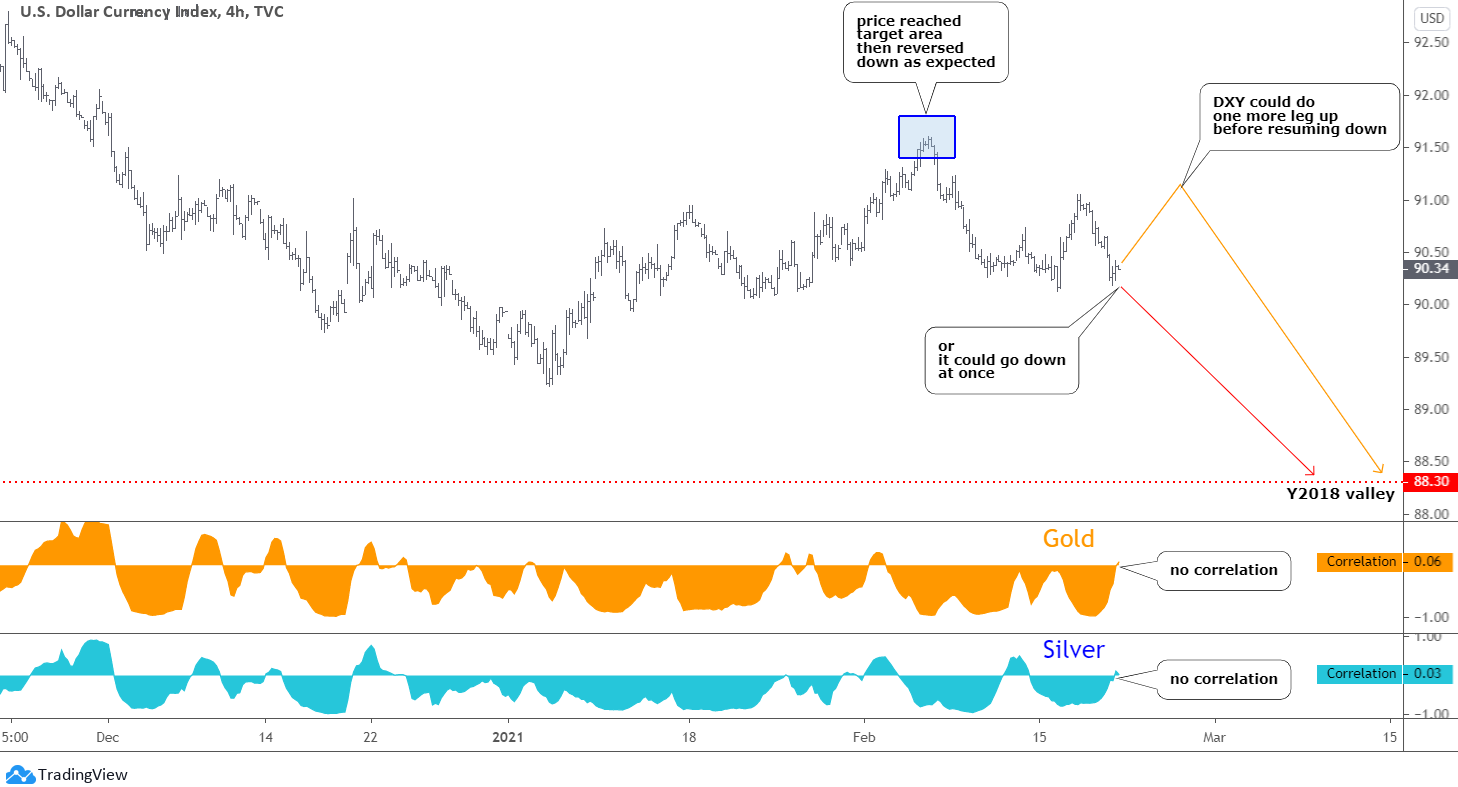
The U.S. dollar index (DXY) opens this post.

Dollar Index

Most of you agreed last month with the plan that the dollar index will extend its consolidation to the upside, making a zigzag first to the downside and then to the upside with the target area between 91.40 and 91.80 (blue box). The former was your favorite goal, and it was hit with a margin as the price reached 91.60 at the top of this month. Continue reading "Watch Gold, Leave Silver Alone"