Are Silver & Gold Mirroring 1999 To 2011 Again?

Today, we are writing about a pattern that our research team sees in the Gold/Silver ratio which is correlated to the price movement of Gold. What does this mean and how can we profit from this setup? Let’s get started trying to explain this chart pattern/setup.

Gold/Silver Ratio Chart From A New Angle

This first chart highlights the pattern we have identified and how we believe a similar pattern is setting up again in the current market. The setup of the pattern is explained in the text below, but quickly scroll down and look at the first chart and the pink shaded areas “A” to get an idea of what we are talking about.

Prior To “A” Pattern Setup

After a moderate price decline in Gold (1996 through 2001), a bottom sets up as the price of Gold begins to base near support.

The Gold/Silver ratio (BLUE), falls throughout this pattern setup as both Gold and Silver prices decline somewhat in unison. Continue reading "Are Silver & Gold Mirroring 1999 To 2011 Again?"

"Stay Home Save Lives" Drives Oil Futures Lower

Crude Oil Futures

Crude oil futures in the May contract is trading lower for the 2nd consecutive session after settling last Friday in New York at 22.63 a barrel while currently trading at 22.23 down about 40 cents for the trading week continuing its bearish momentum.

Fundamentally speaking, the energy complex sold off sharply, with oil prices sinking after the Trump administration canceled its plans to buy crude oil to replenish the Strategic Petroleum Reserve (SPR). Then the energy complex extended its losses Thursday on dire predictions from the International Energy Association (IEA).

I am not involved, but I do think prices will break the $20 level as I'm certainly not recommending any bullish position as weakening demand due to the Coronavirus causing millions of Americans to work from home while not driving.

Crude oil prices are trading far below their 20 and 100-day moving average as the trend is to the downside as unleaded gasoline is right near an all-time low as that is also putting pressure on oil in the short-term. If you are short a futures contract, I would place the stop loss at 28.50 as an exit strategy as I do think $15 a barrel is a realistic number that could happen in the coming weeks ahead.

TREND: LOWER
CHART STRUCTURE: POOR
VOLATILITY: HIGH

Silver Futures

Silver futures in the May contract is currently trading at 14.51 an ounce after settling last Friday in New York at 12.38 up over $2 for the trading week experiencing high volatility as prices hit an 11-year low last week. Silver has been mirroring the gold market, which is also having tremendous price swings daily. Continue reading ""Stay Home Save Lives" Drives Oil Futures Lower"

Seeing Beyond The Black Swan Event

Just before the COVID-19 pandemic struck the S&P 500, Nasdaq, and Dow, Ray Dalio was recklessly dismissive of cash positions, stating "cash is trash." Even Goldman Sachs proclaimed that the economy was recession-proof via "Great Moderation," characterized by low volatility, sustainable growth, and muted inflation. Not only were these assessments incorrect but they were ill-advised in what was an already frothy market with stretched valuations. I'm sure Ray Dalio quickly realized that his "cash is trash" mentality, and public statements were imprudent. The COVID-19 pandemic has been a truly back swan event that no one saw coming. This health crisis has crushed stocks and decimated entire industries such as airlines, casinos, travel, leisure, and retail with others in the crosshairs.

The S&P 500, Nasdaq, and Dow Jones have shed approximately a third of their market capitalization, with the sell-offs coming in at 33%, 29%, and 36%, respectively, through March 20, 2020. Some individual stocks have lost over 70% of their market capitalization. Other stocks have been hit due to the market-wide meltdown, and many opportunities have been presented as a result.

Investors have been presented with a unique opportunity to start buying stocks and take long positions in high-quality companies. Throughout this market sell-off, I have begun to take long positions in individual stocks, particularly in the technology sector and broad market ETFs that mirror the S&P 500, Nasdaq, and Dow Jones. It's important to put this black swan into perspective and see through this on a long term basis while viewing this as an opportunity that only comes along in decades.

Most Extreme and Rare Sell-Off Ever

The abrupt and drastic economic shutdown and velocity of the U.S. market's ~30% drop within a month bring parallels to the 1930s. This sell-off has been extreme and rare in its breadth, nearly evaporating entire market capitalizations of specific companies. The pace at which stocks have dropped from their peak just last month from all-time highs is the fastest in history. The major averages just posted their worst week since the financial crisis (Figures 1 and 2). The Dow is tracking for its worst month since 1931, the S&P since 1940. As of March 20, the S&P 500, Nasdaq and Dow Jones have sold off 33%, 29%, and 36%, respectively. Continue reading "Seeing Beyond The Black Swan Event"

Concerned About The Real Estate Market?

Our continuing research into the state of the real estate market suggests the Covid-19 virus event will likely put extreme pressure on many sectors within the US and global markets. This, Part III of a multi-part research article, will highlight many of the key economic data points that will soon be released and how these numbers may shock the markets. Additionally, as consumers and businesses prepare for an extended shutdown, it is important to understand the psychological process that takes place in the minds of people. PART I, PART II

Initially, people naturally hope for a quick and reasonable solution. As the process continues where an extended shutdown of the US economy persists, consumers and business managers change their expectations from optimism for a quick resumption of economic activity to “how do we survive this extended closure event”. This is when traders and investors really need to pay attention to what is happening in their local and national economies. One of the most important things to consider throughout an event like this is to watch how your local economy is operating and what is happening with local consumers. This will help you understand what is happening elsewhere.

Demand for certain items will continue almost as normal. We call this the Personal Consumer Essentials. These items are typically things like toilet paper, toothpaste, over the counter medications, underwear, food, and water. These are the types of purchases that must continue for average people to survive this type of event. Luxury items, vacations, extras, and other purchases may suffer throughout this process.

The first 30 days will likely be a transition period for many consumers. Remember, this is still the “hope” phase where Continue reading "Concerned About The Real Estate Market?"

World Oil Supply And Price Outlook, March 2020

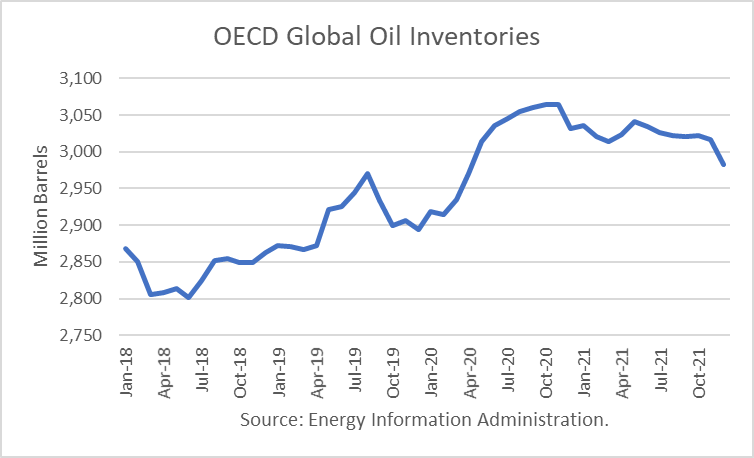
The Energy Information Administration released its Short-Term Energy Outlook for March, and it shows that OECD oil inventories likely bottomed last June 2018 at 2.802 billion barrels. It estimated stocks dipped by 5 million barrels in February to end at 2.914 billion, 44 million barrels higher than a year ago.

For 2020, OECD inventories are projected to build by 137 million barrels to 3.031 billion. For 2021 it forecasts that stocks will draw by 48 million barrels to end the year at 2.983 billion.

Oil

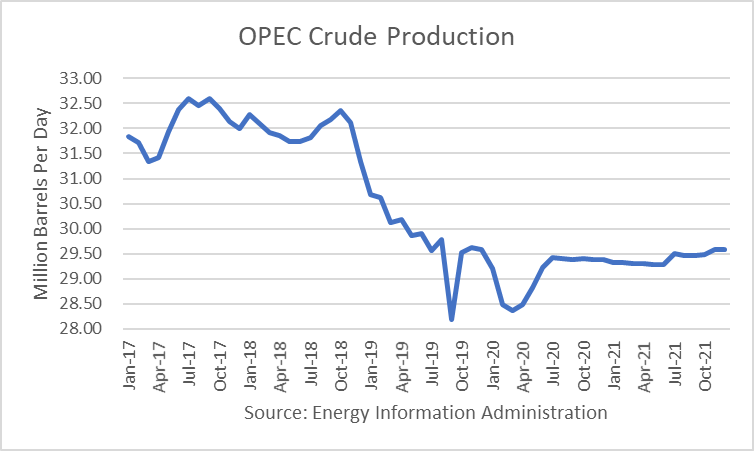
The EIA estimated that OPEC production dropped by 72,000 b/d in February to 28.49 million barrels per day. For 2020, it estimates that OPEC production will average about 29.08 million, about 720,000 b/d lower than in 2019. For 2021, it estimates OPEC production average 2.941 million. The EIA did not increase its estimates for OPEC despite the announcements by Saudi Arabia that it is pushing its production up to 12 million barrels per day and the UAE is increasing its production by 1 million barrels per day.

Oil

Oil Price Implications

I updated my linear regression between OECD oil inventories and WTI crude oil prices for the period 2010 through 2019. As expected, there are periods where the price deviates greatly from the regression model. But overall, the model provides a reasonably high r-square result of 79 percent. Continue reading "World Oil Supply And Price Outlook, March 2020"