January Market Rebound Provides 100% Options Win Rate

Previously, I authored a piece covering options trading and the mechanics behind long-term successful options trading to generate high probability win rates for consistent premium income. I provided empirical data via 100 options trades during the market wide sell-off in Q4 of 2018 where the Dow and S&P 500 erased all of its gains while turning negative for the year and posting their worse December since the Great Depression in 1931. Despite this negative backdrop, I was able to successfully close 80% of my trades at a profit, demonstrating the resiliency of high probability options trading regardless of market condition. These trading mechanics resulted in a total portfolio return of -5.9% against the S&P 500 return of -14.0% in Q4 of 2018, outperforming the broader index by a wide margin.

Since then, the month of January presented the polar opposite market scenario with the S&P closing out the best January in over 30 years. Maintaining the same trading mechanics deployed in Q4 of 2018 into January produced a portfolio return of 9.26% against the S&P 500 return of 7.87%, outperforming the index by a healthy margin. This seesaw from a negative to a positive market backdrop provided unique opportunities to capitalize on option trading via capturing a higher percentage of premium income, closing contracts early in the option lifecycle and relinquishing previously assigned contracts, which allowed the repurposing of capital for further options trading. In January, I was able to achieve a 100% options win rate by closing 30 out of 30 option contracts while maintaining capital liquidity.

Terse Overview

Options trading can be a fantastic avenue to mitigate risk; provide consistent income, lower cost basis of underlying stock positions and hedge against market movements while maintaining liquidity. Risk mitigation is particularly important given the market wide melt-down during Q4 of 2018. Maintaining liquidity via maintaining cash on hand to engage in covered put option selling is a great way to collect monthly income via premium selling. Heeding critical variables such as implied volatility, implied volatility percentile and probability, one can optimize option selling to yield a high probability win rate over the long term given enough trade occurrences. Continue reading "January Market Rebound Provides 100% Options Win Rate"
Blowin' In The Wind

Federal Reserve Chair Jerome Powell last week held sacred the Fed’s “precious” independence, but he apparently forgot how quickly and easily it’s been bullied into altering its monetary policy by both politicians and influential financial markets people.

Until just a couple of months ago, the Fed was determined to “normalize” interest rates and its enormous balance sheet. But after a relative – emphasis on that word – weak patch for the economy and howls of pain from investors during last year’s correction, the Powell Fed was lighting quick to reverse course and put a halt to more rate hikes and portfolio runoff until further notice.

Not surprisingly, the financial press hasn’t given President Trump any credit for this (if credit is the right word in this instance), even though he was clearly the first and loudest basher of tightening Fed policy. Wall Street then jumped on the bandwagon, and voila, we have a new “patient” Fed and an easier monetary policy – and the best January for stocks since the 1980s.
Powell and other members of the Fed have tried to justify their abrupt about-face by noting recent weak – again, relatively speaking – economic data. But January’s robust nonfarm payrolls report – nearly double the consensus forecast – calls that into serious question. Continue reading "Blowin' In The Wind"

Our May Stock Market Prediction - Part 1

As we enter the final stage of our stock market prediction from nearly 5 months ago, we thought it would be a good time to revisit these predictions and to update all of our followers with some timely and, apparently, accurate market data. We hope that many of you remember out predictions from September 2018 where we called for a 5~8% market decline, followed by a basing market headed into the November 2018 US elections, followed by a deep “Ultimate Low” price rotation before we called for an incredible upside price rally? The reason it is so important to watch for and understand all of our research is that we are attempting to provide great value and insight to our followers as well as help them protect their open positions from unknown risks.

As a bonus to all of this, we are going to include predictions made by our Adaptive Dynamic Learning (ADL) price modeling system that originated from December 2017 going all the way forward through to the end of May 2019. Can you imagine what it would be like to have a tool that could show you what is likely to happen going forward 6 months, 12 months or even 24 months into the future? Well, that is what we have with the ADL predictive price modeling system and we are going to show you how well it has been able to pick the future of the markets for the past 15+ months. Here we go.

At this point, we are going to highlight our earlier predictions (all of 2018 and into Q1/Q2 of 2019) and show you what the market has done since these calls were made back in September 2018. Pay attention to this Weekly ES (S&P 500 chart) and pay attention to the YELLOW ARROWS on this chart. We have highlighted key predictive price modeling points with these yellow arrows on the chart to show you what our ADL predictive modeling system suggested would happen back in December 2017. Continue reading "Our May Stock Market Prediction - Part 1"

Copper Gives Bears Another Chance

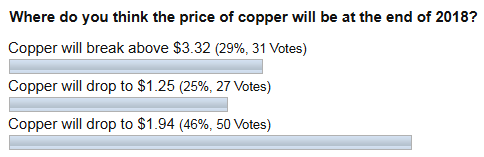
Last July I posted a monthly chart of copper futures to show you that the earlier move up had been completed when the price hit the accurately predicted $3.32 level and we have entered a bearish mode.

The big short game was set between the $3.32 and $1.94 extremes. The earlier post was calling for the price of copper to retest the former valley of $1.94. Below are the poll results with your expectations recorded in July of 2018. Again, I am very thankful for your stable activity!

Copper

The majority of you agreed with my opinion that the copper could revisit the former low of $1.94. 2018 finished at the $2.64 mark, which is far away from the target and below I will show you why and what could be the next for copper. Continue reading "Copper Gives Bears Another Chance"

Fed Chairman Powell Resuscitates Financial Cohort

The market-wide sell-off in the fourth quarter of 2018 was largely induced by the Federal Reserve and its alleged commitment to sequential interest rate increases into 2019. This was largely viewed as reckless and misguided while turning a blind eye to broader economic data-driven decision making about further interest rate hikes. The stock indices responded to the sequential interest rate hike stance with overwhelming negative sentiment, logging double-digit declines across the broader markets. Many market observers were questioning the Federal Reserve’s aggressive stance as companies issued weakness in ancillary economic metrics (slowing global growth, strong U.S. dollar, trade war, government shutdown, weak housing numbers, retail weakness, auto sluggishness, and oil decline) as an indication that cracks in the economic cycle were materializing. The strong labor market and record low unemployment served as a basis to rationalize increasing rates to tame inflation however these aforementioned economic headwinds appeared to cause the Federal Reserve to pivot in its aggressive stance. As Chairman Jerome Powell began to issue a softer stance on future interest rate hikes, January saw very healthy stock market gains after being decimated for months prior. On January 30th, Jerome Powell issued language that the markets were craving to levitate higher as he left interest rates unchanged and exercised caution and patience as a path forward. Using data-driven decision making as a path forward was cheered by market participants as the broader indices popped for healthy gains on top of the already robust gains throughout January.

Financial Cohort Squeezed

The financial cohort was stuck in a precarious situation in the latter half of 2018. On the one hand, a rising interest rate environment would provide boosts to bottom line revenue as a function of the increased rates on their deposit base. Banks had domestic and global economic expansion tailwinds at their back while posting accelerating revenue growth, increasing dividend payouts, engaging in a record number of share buybacks, benefiting from tax reform and deregulation. Augmenting this positive backdrop was a record number of IPOs, a record number of global merger and acquisitions along with consulting fees regarding mergers and acquisitions and trading around market volatility. All of these elements ostensibly provided an ideal confluence that boded well for the financial sector. JP Morgan (JPM), Citi (C), Wells Fargo (WFC), Goldman Sachs (GS) and Bank of America (BAC) seemed to be poised to continue to benefit from the favorable economic backdrop. Despite all these elements, 2018 was terrible for the financials which performed horribly, especially during the fourth quarter as rapid rate hikes were in the cards. Continue reading "Fed Chairman Powell Resuscitates Financial Cohort"