S&P 500: Any Juice Left?

Lior Alkalay - INO.com Contributor


The S&P 500 (CME:SP500) closed for the week at 2,472.10, after hitting an all-time record, after gaining 10.5% year-to-date. The S&P’s forward Price-to-Earnings ratio, a key ratio for investors, is 17.8 above the 10-year average of 14. And this brings up the inevitable pondering; is there any juice left in the S&P 500?

In searching for an answer, the intuitive starting point might be the S&P’s valuation. We’ve already pointed out that the S&P 500 is trading at a high valuation compared to its 10-year average. Furthermore, according to Factset research, earnings for the 500 companies which comprise the S&P 500 are expected to rise by 9.3% as compared to 9.26% in 2016. Now, while that is a solid figure, it also suggests earnings growth is not accelerating and may even suggest the acceleration in earnings growth is over. And if earnings growth is likely to decelerate in the coming years it cannot account for the S&P500’s 17.8 PE ratio. So, there’s no valid reason why the S&P’s valuation would be the catalyst for another surge. Why not? Simply because it's too high. In fact, the real catalyst isn’t within the S&P500 or even within the stock market; instead, the real reason lies within the Bond market. Continue reading "S&P 500: Any Juice Left?"

Upcoming Facebook Earnings - A Nonevent Long-Term

Noah Kiedrowski - INO.com Contributor - Biotech


Upcoming Earnings

Facebook Inc. (NASDAQ:FB) is due to announce earnings on July 26th after the market closes. Facebook tends to be volatile after earnings are announced and typically pop to the upside as Facebook’s earnings have continued to post robust growth. Back on June 2nd, 2017, I authored an article “Facebook Will Hit $175 By Year End” and with five more months to go before the end of the year, I think Facebook has a good chance of breaking through this number. Facebook has been on an uptrend heading into earnings and currently sits at $160 per share and while the stock is up 39% YTD. These numbers may seem staggering, and some would state that buying at these levels would be cashing the stock. Normally I would agree with this approach. However, I think Facebook is an exception to this situation. Even at these levels and YTD appreciation, factoring in Facebook’s projected growth with tech comparators such as Alphabet Inc. (NASDAQ:GOOG), Netflix Inc. (NASDAQ:NFLX) and Amazon.com (NASDAQ:AMZN), collectively known as the FANG stocks, Facebook is superior with a lower risk profile. Facebook’s projected growth is greater than Google’s and just shy of Amazon’s yet has a P/E ratio that’s lower than Google’s and a fraction of Amazon’s and Netflix’s. Regardless of the upcoming earnings announcement, this will be an immaterial event to the long term narrative for Facebook investors. I feel that Facebook represents value even after this massive run YTD and continue my long thesis. Continue reading "Upcoming Facebook Earnings - A Nonevent Long-Term"

Tech Stocks On a Run; ETFs To Buy 'IF' you Think It Will Soon Come to An End

Matt Thalman - INO.com Contributor - ETFs


The Bears have been referring to the current situation with technology stocks as the building up of the next dot com collapse. Price to earnings ratios are high, earnings expectation may be overinflated, and the unknown that surrounds all aspects of the current political landscape and how that could affect businesses are all reasons to be doubtful that technology stocks can continue on their massive run.

One analyst believes you should buy any of the technology stocks that garner a large portion of their revenue from advertisements. The analysts noted that companies like Facebook (NYSE:FB) and Alphabet (NASDAQ:GOOG) are likely to experience a revenue slowdown in the future because, at the end of the day, there is only so much money that can be thrown at web-based advertising.

Others think Amazon.com (NASDAQ:AMZN) may be getting too big and trying to do too much, and it could end up destroying itself. Sounds similar to what the bears say about Tesla (NASDAQ:TSLA).

At the end of the day, a negative case can be made about every single technology stock. If you agree with those cases and you want to start looking for some opportunities to make money when technology stocks start falling, then let's take a look at some or your options I have outlined below. Continue reading "Tech Stocks On a Run; ETFs To Buy 'IF' you Think It Will Soon Come to An End"

Gold & Silver: Gold Breaks Up As Silver Licks Wounds

Aibek Burabayev - INO.com Contributor - Metals


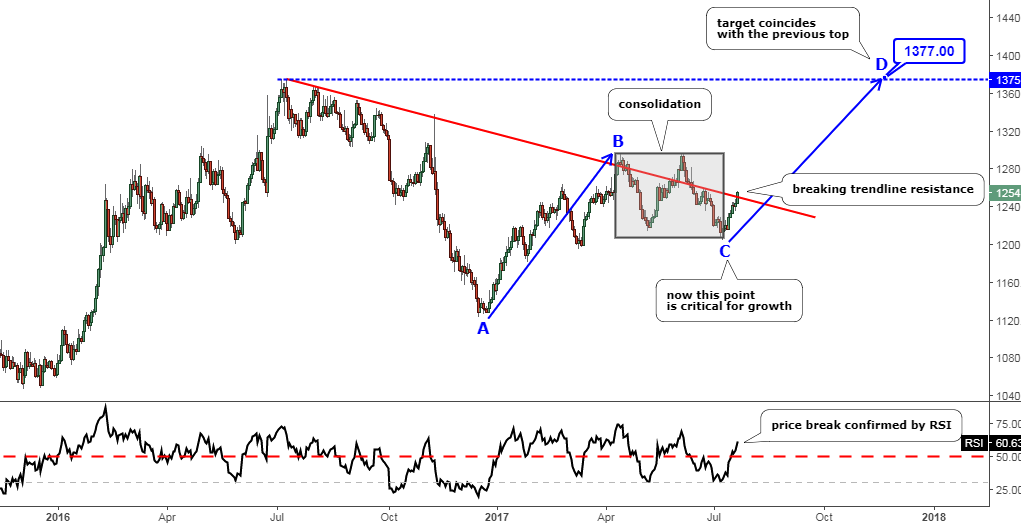
The broad weakness of the U.S. dollar supported precious metals and currencies. Gold has been saved from silver's Flash Crash destiny so far. Below are the updated charts for gold and silver.

Chart 1. Gold Daily: Breaking Upside

Daily Gold Chart
Chart courtesy of tradingview.com

The experimental clone chart for gold that I posted in April amazingly finished its move down as planned although later than expected. The anticipated reverse to the upside followed the end of the consolidation highlighted with the gray rectangle. Continue reading "Gold & Silver: Gold Breaks Up As Silver Licks Wounds"

Has Yellen Become A Dove Again?

George Yacik - INO.com Contributor - Fed & Interest Rates


Janet Yellen’s equivocal remarks at last week’s semi-annual Congressional testimony certainly might make you believe that a rate hike at the Federal Reserve’s July 25-26 meeting is hardly a sure thing. Indeed, the odds of that happening are a lot less than 50-50. A lot less.

In her testimony, Yellen remained confident in her previous declarations that inflation would gradually rise to the Fed’s 2% target. “It’s premature to reach the judgment that we’re not on the path to 2% inflation over the next couple of years,” she said. But then she quickly hedged her bets. “We’re watching this very closely and stand ready to adjust our policy if it appears that the inflation undershoot will be persistent,” she said.

Based on the past several months’ worth of inflation statistics, one would have a tough time arguing that lower-than-expected inflation hasn’t become “persistent.” Last month’s consumer price index was unchanged from May and up only 1.6% versus a year earlier, the fourth straight decline by that measurement. That followed May’s personal-consumption expenditures index, the Fed’s preferred inflation measure, which fell 0.1%. The core index, which excludes food and energy, rose 0.1%, but just 1.4% on a year-to-year basis, well below the Fed’s target rate and lower than at the beginning of the year. Continue reading "Has Yellen Become A Dove Again?"