Disney Continues To Deliver - Iger Extends Contract

Noah Kiedrowski - INO.com Contributor - Biotech


Introduction

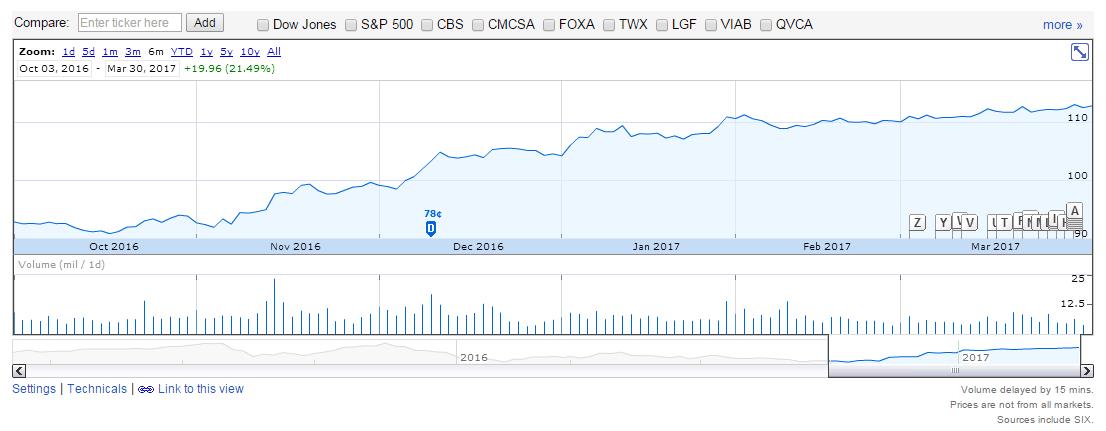
Over the previous six months, The Walt Disney Company (NYSE:DIS) has logged a solid 22% gain, moving from ~$92 to ~$113. I’ve been long Disney and wrote several pieces on how the strong fundamentals made a compelling case to buy shares when the stock traded down into the low $90s. The compelling long-term investment opportunity was drawn considering the growth drivers, pipeline, diversity of its portfolio, share repurchase program and dividend. As the first quarter of 2017 comes to an end, Disney continues to deliver strong fundamentals and catalysts moving into the future. At a high-level, Disney’s board has decided to extend Bob Iger’s contract to remain CEO, direct-to-consumer ESPN offerings are in the works, analyst upgrades continue to be issued and Beauty and Beast delivered record breaking numbers to start its film release slate on a strong note for 2017 (Figure 1).
NYSE:DIS
Figure 1 – Six-Month Chart For Disney

Bob Iger Extends Contract

Disney’s Board of Directors announced that it had extended Bob Iger’s contract as Chairman and Chief Executive Officer to July 2, 2019. Bob Iger had been the subject of increasing succession talk after the lead candidate to replace Iger as CEO, Tom Staggs went on to pursue other opportunities and left the company last year. Continue reading "Disney Continues To Deliver - Iger Extends Contract"

Gold & Silver: Gold Is Looking For Support As Silver Is Testing Resistance

Aibek Burabayev - INO.com Contributor - Metals


We've entered the period where patience is paid generously as it is too early to buy the gold now and too late to buy the flying silver. I don't recommend a countertrend sell as corrections are very tricky and require an extensive experience. It is good just to sit back and watch the price action.

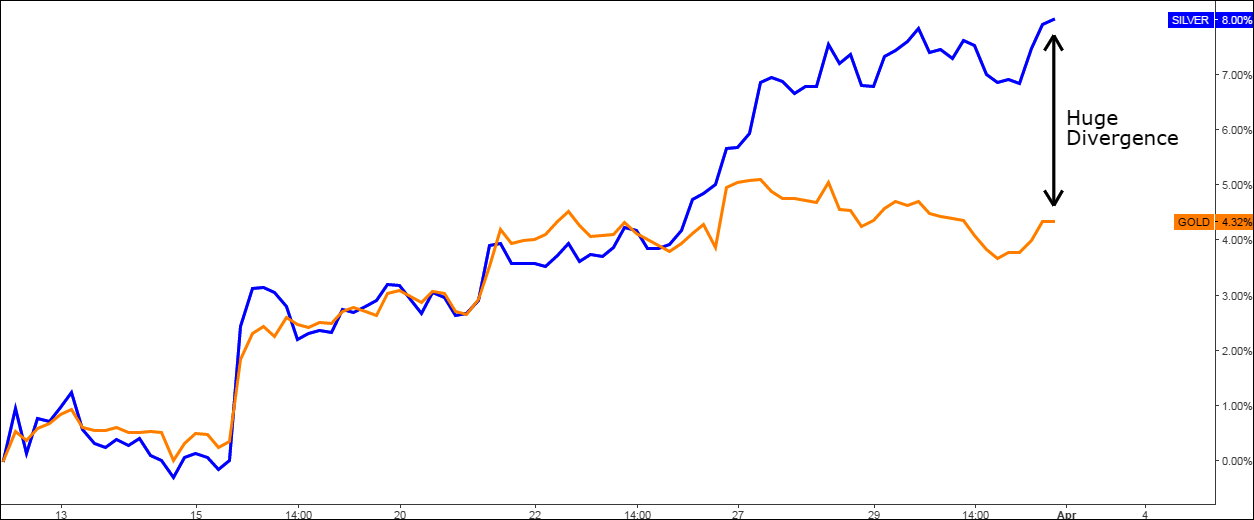
Chart 1. Gold Vs Silver 4H: Huge Divergence

4 Hour Chart Gold vs. Silver
Chart courtesy of tradingview.com

I refreshed the previous comparison chart, which starts from the low in the gold price established on the 10th of March.

Last week the gap between these top metals only widened with silver's gain almost exceeding two times that for the gold. The Gold/Silver ratio dropped severely from the 71.3 oz top (March, 23) to the 68.4 oz close last week losing almost all of the gains achieved in March. Continue reading "Gold & Silver: Gold Is Looking For Support As Silver Is Testing Resistance"

U.S. Crude Oil Exports Could Mean Stocks Are Dropping Elsewhere

Robert Boslego - INO.com Contributor - Energies


Crude stocks built by 0.9 million barrels in the week ending March 24th to end at 534 million barrels, 30.2 million larger than a year ago, setting a new record high. But crude oil exports also surged to 1.010 million barrels per day.

The stated objective of the OPEC production cut is to reduce OECD global inventories back to their five-year average. The U.S. has the largest excess inventories of any OECD country, and also publishes the most transparent, timely data, and so I had expected OPEC to target reductions in its exports to the U.S.

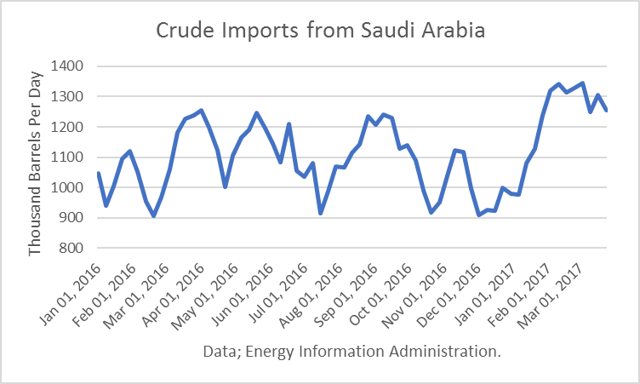
But based on Energy Department statistics for the weeks ending March 24, 2017, U.S. crude imports from Saudi Arabia averaged about 1.240 million barrels per day in the year-to-date. Saudi Arabia is the second largest source of imports behind Canada. That figure was about 30% higher than in the same weeks last year, and about 17% higher than during December, before its production cuts went into effect.

Crude Imports From Saudi Arabia

The Saudi energy minister claimed in December that he was reducing tanker nominations effective January 1, 2017, Saudi exports to the U.S. are 178,000 b/d higher than a year ago. Based on the import numbers for the 12 weeks off 2017, there is no evidence of any Saudi production cut. Continue reading "U.S. Crude Oil Exports Could Mean Stocks Are Dropping Elsewhere"

Why Is The Federal Reserve Not Selling?

Lior Alkalay - INO.com Contributor


On March 15th, the Federal Reserve Chairman, Janet Yellen, announced that the Fed would raise its target rate to 0.75-1.00% from 0.5-0.75%. Yellen also stressed, in a clear, hawkish tone, that the United States economy is doing well. After roughly three months of “hints” embedded in the Fed’s many statements, that news was hardly a surprise.

But in the same speech, Yellen stressed that the Fed was not ready to start selling the $4.5 trillion in the Treasury Notes, Treasury Bonds and mortgage papers that it holds on its balance sheet. Instead, Yellen stressed that the Fed sees rate hikes as the monetary tool. Further, rate hikes, as a tightening measure, must first be exhausted before the Fed would start selling those trillions. That was a clear retreat from the hints the Fed had dropped in the weeks which followed President Trump’s inauguration.

In fact, one could go so far as to say Yellen’s rhetoric, with respect to the Fed’s balance sheet, has been dovish; the way Yellen specifically emphasized how cautious the Fed is about the prospect of trimming its balance sheet singled that option out as some kind of a “bomb” that the Fed doesn't really want to drop and which could send markets into panic mode. If, indeed, the US economy doing so well, why then is the Fed not ready to roll back Quantitative Easing, a stimulus measure generally considered life support for the banking system? Continue reading "Why Is The Federal Reserve Not Selling?"

Issue #13: Icahn's Bristol-Myers Stake, Biotech Cohort Rallies and Eli Lilly's CEO Speaks

INO Health & Biotech Stock Guide

Issue #13

BIOTECH, HEALTH & PHARMA NEWS

Ever since President Trump met with a group of pharmaceutical executives at the White House, the entire biotech cohort has witnessed a resurgence as of late. This meeting was perceived as a positive interaction between the nascent government and the industry on a whole. This coincides with a consortium of big pharma companies joining forces to address transparency on drug price increases. Allergan (AGN), J&J (JNJ), Novo Nordisk (NVO), Merck (MRK) and AbbVie (ABBV) have committed to limiting any annual drug pricing increases to less than 10%. J&J, AbbVie and Merck all published annual reports regarding its portfolio and the price increases they’ve implemented. This transparency coalition is a step in the right direction to appease the general public and governmental officials that have been very critical of drug price increases. To add icing on the cake, Amgen’s CEO stated “We look forward to working collaboratively with the new administration.” Pharmaceutical executives are being proactive to be part of the conversation and be present at the table when it comes to working with Trump and his hardline stance regarding jobs and drug prices. The collaborative approach will hopefully bode well for the industry as a healthy relationship is fostered perceived on Wall Street.

Continue reading "Issue #13: Icahn's Bristol-Myers Stake, Biotech Cohort Rallies and Eli Lilly's CEO Speaks"