China 2017: More Boom Before the Bust

Lior Alkalay - INO.com Contributor - Forex


Despite the Yuan’s value recently plummeting to an eight-year low, the Chinese economy has been rather stable in the second half of 2016, manufacturing PMI held above 50 (above 50 signals expansion); exports reached $196.8 Bln in November(from $176.2 Bln in January); and in industrial production growth averaged 6.14% Year over Year.

Together, these changes all represent a strong indicator of growth - and of bounce-back - and all thanks to the Yuan. Or more accurately, to the Yuan meltdown. Even as the Chinese Yuan shed more than 7.1% this year, it allowed China’s exports to rebound and stabilize industrial and manufacturing production. But all that stability comes at a stiff price, down the line.

While a weaker Yuan helps exporting sectors, it causes problems in China’s domestic economy. In it, an exceptionally weak currency has the same impact as monetary easing, creating an inverse relationship where, when the Yuan’s value is eroded, China’s housing bubble swells.

The more China’s housing bubble swells, the more its debt problem becomes acute. And, ultimately, the more painful its bust will be. Continue reading "China 2017: More Boom Before the Bust"

Saudi Arabia Assumes $55 Oil Price in 2017

Robert Boslego - INO.com Contributor - Energies


Saudi Arabia's energy minister, Khalid Al-Falih, clarified his position on the cuts and oil price target. After the meeting with non-OPEC producers, there was a press conference, and the media reported that he had implied Saudi Arabia would make deeper cuts than agreed at the OPEC meeting. Also many commentators seem to think Saudi Arabia’s price objective is in the $60s or $70s.

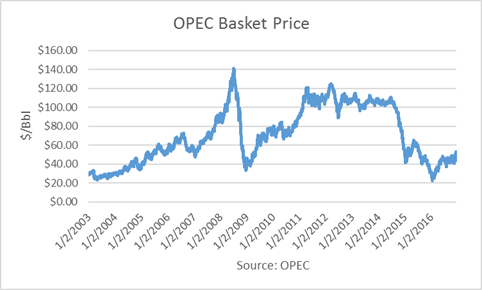
But in conjunction with announcing Saudi Arabia's 2017 budget, Mr. Al-Falih said that the kingdom sees no need for addition production cuts than the ones already pledged by the OPEC and some non-OPEC producers. He said the market intervention is intended only to "nudge along" the re-balancing of an oversupplied global oil market. He said he expects oil prices to rise "tangibly" from the 2016 average, and assumes oil will average $55 in 2017 and $61 in 2018. OPEC's Reference Basket (ORB) was $52.25 on December 21st, so it appears prices are close to where he expects them to average next year.

OPEC Basket Price Crude Oil

Economists have estimated that the new Saudi 2017 budget is based on oil prices in a range of $47 to $55/b. Al-Falih said that the budgeted oil price is a "conservative" scenario. Continue reading "Saudi Arabia Assumes $55 Oil Price in 2017"

High-Quality Secured Puts Yield 20% Return

Overview

I’ve written many articles highlighting the advantages options trading and how this technique, when deployed in opportunistic or conservative scenarios may augment overall portfolio returns while mitigating risk in a meaningful manner. Timing the market has proven to be very difficult if not altogether impossible. However creating opportunities to lock-in the downward movement in a given stock one is looking to own is possible. If a stock of interest has substantially fallen to near a 52-week low, then one has an option to “buy” the stock at an even lower price at a later date while collecting premium income in the process. Alternatively, it's also possible to make money on the option itself without owning any shares of the company via realizing options premium gains as the underlying stock appreciates in value off its lows. This is called a covered or secured put option, covered in the sense that one has cash to back the option contract. Leveraging covered or secured put options in opportunistic scenarios may augment overall portfolio returns while mitigating risk when looking to initiate a future position in an individual stock or looking to make money on the potential appreciation without owning the stock. In the event of a covered put, this is accomplished by leveraging the cash one currently has by selling a put contract against those funds for a premium. Why buy a stock now when you can purchase the stock in the future at a lower price while being paid to do so? Why buy stocks at all when you can make money on the underlying volatility without ever owning the shares? Continue reading "High-Quality Secured Puts Yield 20% Return"

So The Fed Raised Rates: Why Is the Market Acting Surprised?

George Yacik - INO.com Contributor - Fed & Interest Rates


It never ceases to amaze me how some people still react to and hang on to the words of former authoritative figures long after they’ve ceased to be relevant.

The other day 76-year-old Martin Sheen – Charlie’s father, for those under 40 – led a group of liberal has-beens and C-list “celebrities” urging Republican members of the Electoral College not to authenticate Donald Trump’s election. Does Sheen really believe people still care about what he thinks, if they ever did? Guess so.

While I admit that Janet Yellen and the other members of the Federal Reserve have hardly reached Martin Sheen status as irrelevant, I have to wonder about the market’s reaction to Wednesday’s decision by the Fed to raise interest rates an entire quarter point. Why did anyone care? Continue reading "So The Fed Raised Rates: Why Is the Market Acting Surprised?"

CVS - Overreaction or Justified Selloff?

Noah Kiedrowski - INO.com Contributor - Biotech


Introduction

CVS Health (NYSE:CVS) recently reported what was ostensibly another great quarter reporting a year-over-year increase of 28% and 16% in EPS and revenue, respectively. After reporting its Q3 earnings, CVS sold off 17%, moving down from $84 to $70 at market open. I’ve written several articles putting forth the case that CVS presents a compelling investment opportunity in the growing healthcare space. My investment thesis was based on the fact that CVS has been highly acquisitive, continues to deliver robust earnings growth, revenue growth, growing dividends and has an aggressive share buyback program in place. With its recent acquisitions of Target’s pharmacies and Omnicare, these proactive measures will significantly expand its presence and ability to dispense prescriptions to the general public and in long-term care facilities. As healthcare costs and prescription drug costs continue to rise and the population continues to age with the elderly comprising a larger segment of the overall population, CVS looked poised to benefit. Recent marketplace trends have forced CVS to cut guidance for Q4 2016 and the full-year 2017 numbers. Given this dichotomy between the company’s historically strong fundamentals and share price, was this an overreaction or was the selloff justified? Continue reading "CVS - Overreaction or Justified Selloff?"