Coming Soon: Uncle Sam's Credit Cards

George Yacik - INO.com Contributor - Fed & Interest Rates


If you were in the market for a new credit card or needed a loan to buy a car, would you think to go to some federal agency to get one?

Not right now, maybe, but we seem to be headed in that direction—and very quickly, too.

And the idea isn’t all that far-fetched when you come to think of it. The federal government is already heavily involved in consumer lending, either directly or indirectly. It’s the biggest player by far in the two biggest consumer loan businesses. Getting into new areas like credit cards and auto loans isn’t a terribly big leap.

It’s fairly safe to say that the residential mortgage market would barely exist were it not for the government-sponsored enterprises like Fannie Mae and Freddie Mac, plus other government agencies like the FHA, VA, and USDA. While these agencies don’t make loans themselves, they buy them from private lenders, stamping a federal guarantee on them in the process. Before the global financial crisis, there was a thriving market for private mortgages through a private secondary market, but since then that market has largely ceased to exist, except for a smattering of securities backed by jumbo loans, those too large for the federal agencies to buy. That leaves the government with about a 90% or more market share. Prior to the financial crisis, the government still commanded a market share of about 50%. Continue reading "Coming Soon: Uncle Sam's Credit Cards"

Brazilian Real May Face Another Spiral

Lior Alkalay - INO.com Contributor - Forex


A little more than a week ago, Brazil marked a historic milestone in its governance. After a lengthy process, and with a landslide vote, the Brazilian Parliament decided to impeach President Dilma Rousseff amid charges of corruption and breach of trust. For the record, Ms. Rousseff is widely held responsible for Brazil’s worst recession in a hundred years.

During the impeachment proceedings, which lasted some eight months, the Brazilian Vice President, Michel Temer, assumed the helm and took Rousseff’s place. Now, with the proceedings finally concluded, Michel Temer is officially Brazil’s president. Mr. Temer’s pro-business approach had been well rewarded with a period of grace from investors. Under Mr. Temer, the Brazilian Real rallied by 7% against the dollar, bond yields on Brazilian bonds fell and Credit Default Swaps, an important gauge for risk, fell as well. That made it easier for Mr. Temer to navigate and encouraged investors’ hopes for more pro-business reforms. But now, as Mr. Temer has turned from merely the acting president to the incumbent, the political climate is on the verge of change. The “grace period” afforded Mr. Temer during the impeachment proceedings has expired, and with the shift in sentiment the Brazilian economy and, consequently, the Brazilian Real, could fall into a tailspin.

The Brazilian economic crisis has three notable dimensions; a collapse in commodity prices, a weak monetary system, and an ugly fiscal picture. Continue reading "Brazilian Real May Face Another Spiral"

Copper Waits If Oil Keeps Upside; China Is In Focus

Aibek Burabayev - INO.com Contributor - Metals


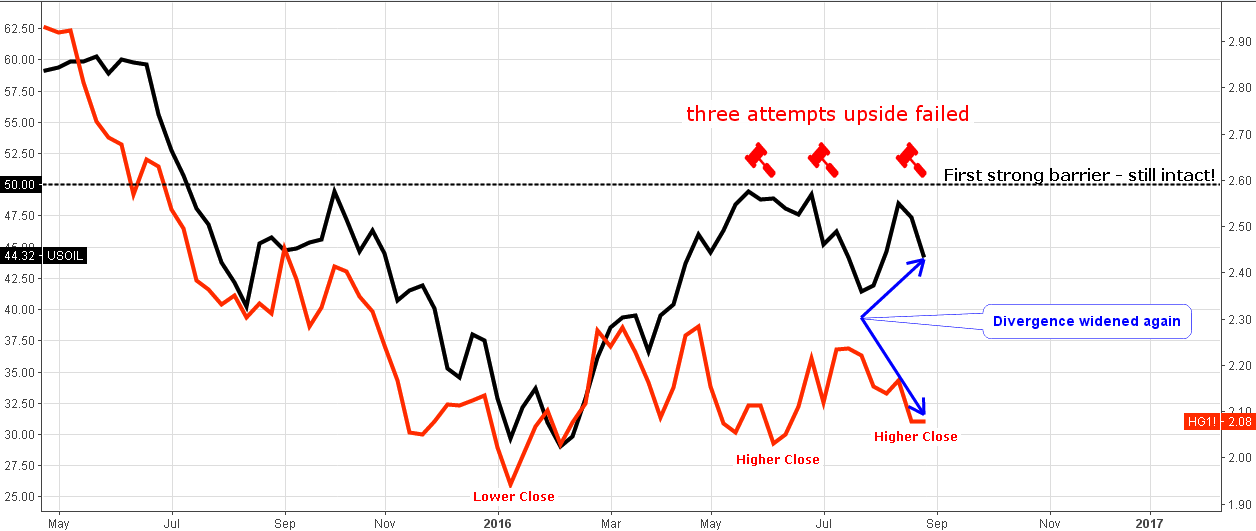
Chart 1. Crude Oil-Copper Correlation: Gap Widened

Crude Oil-Copper Correlation
Chart courtesy of tradingview.com

Another attempt by oil to close above the psychologically important $50 level (black dashed horizontal line) has failed. This was the third and a good try, and it was after a good correction in July, which makes bulls nervous as they lose their patience. Copper couldn’t keep the correlation gains achieved in July as it didn’t follow the rising crude last month and on the contrary, it moved the opposite way below the $2.2 level. The gap between them widened.

It’s not all bad news. There are at least two positive factors: Continue reading "Copper Waits If Oil Keeps Upside; China Is In Focus"

Energy-Focused Master Limited Partnerships (MLPs) Require Risk Management

Robert Boslego - INO.com Contributor - Energies


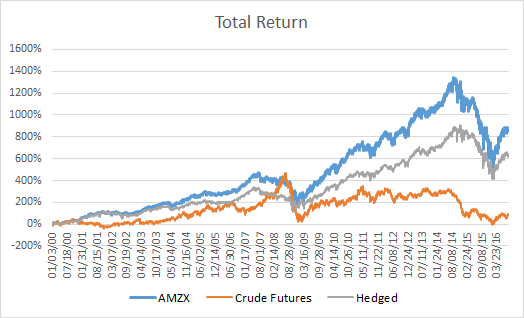
Energy-focused master limited partnerships (MLPs) have provided investors good returns over time, much better than owning crude oil futures. For example, from January 200 through July 2016, the Alerian Total Return Index (PACF:AMZX), a leading gauge of energy MLPs, provided a return of 867%, far exceeded the return from crude futures of about 63%.

However, there is reasonably strong correlation between AMZX and crude futures prices. As a result, AMZX has suffered some large drawdowns. It maximum drop from peak-to-valley (P2V) was 58% over the period mentioned above. I use P2V as my primary risk measurement because it shows how large a loss one may experience in a buy-and-hold strategy.

I tested hedging AMZX by maintaining a short position in crude futures. The risk-minimizing hedge ratio for crude futures was -17% but it only reduced the maximum P2V to 50% (see Hedged return in graph below).

Chart of AMZX, Crude Futures and Hedged

I therefore applied the risk management process I developed to determine when to be invested in AMZX and when to go to cash. I provide the citations for the mathematical formulae and back-tested results for anyone interested in utilizing this process below. Continue reading "Energy-Focused Master Limited Partnerships (MLPs) Require Risk Management"

Disney Can't Seem To Breakout

Noah Kiedrowski - INO.com Contributor - Biotech


Introduction

The Walt Disney Company (NYSE:DIS) can’t seem to get out of its own way when it comes to breaking out of this chronic stock slump after moving from the $120s in late 2015 to being stuck in the $90 range all throughout 2016. This perpetual slump is almost entirely attributable to the decrease in ESPN subscribers and thus revenue and profit from their Media Networks segment. Excluding ESPN, Disney has been executing well and reporting record numbers throughout its other business segments. Disney has a deep and diversified enough entertainment portfolio to make a compelling case that these ESPN fears are overblown. Disney’s portfolio consists of Marvel Entertainment, Lucasfilm, Pixar, ESPN, ABC, a 32% shareholder in Hulu and of course the core Disney franchise (Disney Studios, Disney consumer products, Parks and Resorts and Disney Cruise Line). The revenue stream from these assets is as diverse as the assets themselves. The ESPN franchise within the Media Networks segment generates revenue/operating income that is disproportionate to the amount of the company’s overall revenue and operating profit. Thus, one can see why investors were spooked after two consecutive significant declines in ESPN numbers in Q4 2015 and Q1 2016. The decreases in revenue within this segment have been arrested and on the rebound due to measures put in place at Disney. As this revenue stream slowly recovers and investors can rest assure, Disney will retrace the $120 level. In the meantime all other segments are performing well and coupled with dividends, share buybacks, a P/E ratio of ~17.0 and currently sitting at a 52-week low (excluding the flash crash in February), I’d be a buyer of the stock at these levels. Continue reading "Disney Can't Seem To Breakout"