REITs May Be Great Investment Moving Forward

Real estate has historically been a great investment during times of high inflation. And in certain ways, it’s also a good investment to be holding during times of high-interest rates. Just a month or so ago, the US saw inflation at over 7%. And during the Federal Reserve meeting in January, Jerome Powell made it very clear that interest rates would be rising in the near term. So, what are you waiting for?

Ok, before you go off buying, let me dig a little deeper into why real estate and REITs are good during times of inflation and high-interest rates. For the most part, REITs will perform well during periods of high inflation because while goods and services are increasing in price, so will real estate because the price to build new homes will have risen due to inflation.

Think about what we just saw over the last two years with residential real estate in the US. Lumber, metal, plastic, concrete prices all increased due to the pandemic supply chain issues. Thus, the cost to build a brand-new home also went higher. If the price to buy brand new goes higher, then the price of pre-owned homes can also go higher simply because of the laws of supply and demand. And if the price of building a new home or buying a pre-owned homes goes higher, rent prices can also go higher. Continue reading "REITs May Be Great Investment Moving Forward"
Downside Protection: Risk-Defined Put Spreads vs Cash Covered Puts

Option trading can provide a meaningful addition to one's overall portfolio strategy when used in a disciplined manner. When options are used as a component to a holistic portfolio approach, generating consistent monthly income while defining risk, leveraging a minimal amount of capital, and maximizing returns is achievable. An options-based portfolio can provide durability and resiliency to drive portfolio results with substantially less risk via a combination of options, long equity, and cash. When engaging in options trading, specific rules must be followed. One of the most important rules is to structure every option trade in a risk-defined (put spreads, call spreads, iron condors, diagonal spreads, etc.) manner.

The January 2022 meltdown in the overall markets is a harsh reminder of the trade-offs between risk-defined options and options that have undefined risk. The overall markets were in freefall, with a large percentage of stocks getting cut in half with indiscriminate selling across all sectors. The extreme market conditions throughout January resulted in all stocks auto-correlating in a downward spiral. During these periods of unrelentless selling across the markets, risk-defined options are essential to protect one's portfolio from massive losses while preserving cash-on-hand within the portfolio.

Put Spreads vs Cash Covered Puts

Risk-defined option spreads (i.e., put spreads) prevent any losses beyond a specific strike price, avoids the assignment of shares, does not require a significant amount of capital, and does not soak up capital with share assignments. Conversely, in the case of cash-covered options (i.e., cash-covered puts), large amounts of capital are dedicated to the trade, and share Continue reading "Downside Protection: Risk-Defined Put Spreads vs Cash Covered Puts"

Behind Goldman's Huge Bitcoin Prediction

I don't have to tell you that financial powerhouses are quickly realizing that Bitcoin (BTC) and blockchain technology are revolutionizing the way we do just about everything, from conducting business to making financial transactions.

In fact, we took a deep dive into Bank of America's bombshell crypto report that pointed out in no uncertain terms that crypto is simply "too large to ignore." The report also made clear the transformative power of blockchain, where use cases are seemingly endless.

We also broke down the details behind Deloitte's Blockchain Survey, where blockchain made compelling business cases across the board. The report also made it apparent that if businesses don't get into the blockchain game, they did so at their own peril.

So, I wasn't exactly surprised when I found out that financial powerhouse Goldman Sachs was making some bold predictions about where Bitcoin prices are headed. But when I did a deep dive into the numbers, I found their predictions could even be on the low side. Continue reading "Behind Goldman's Huge Bitcoin Prediction"

Dollar Fades After Hitting The Target

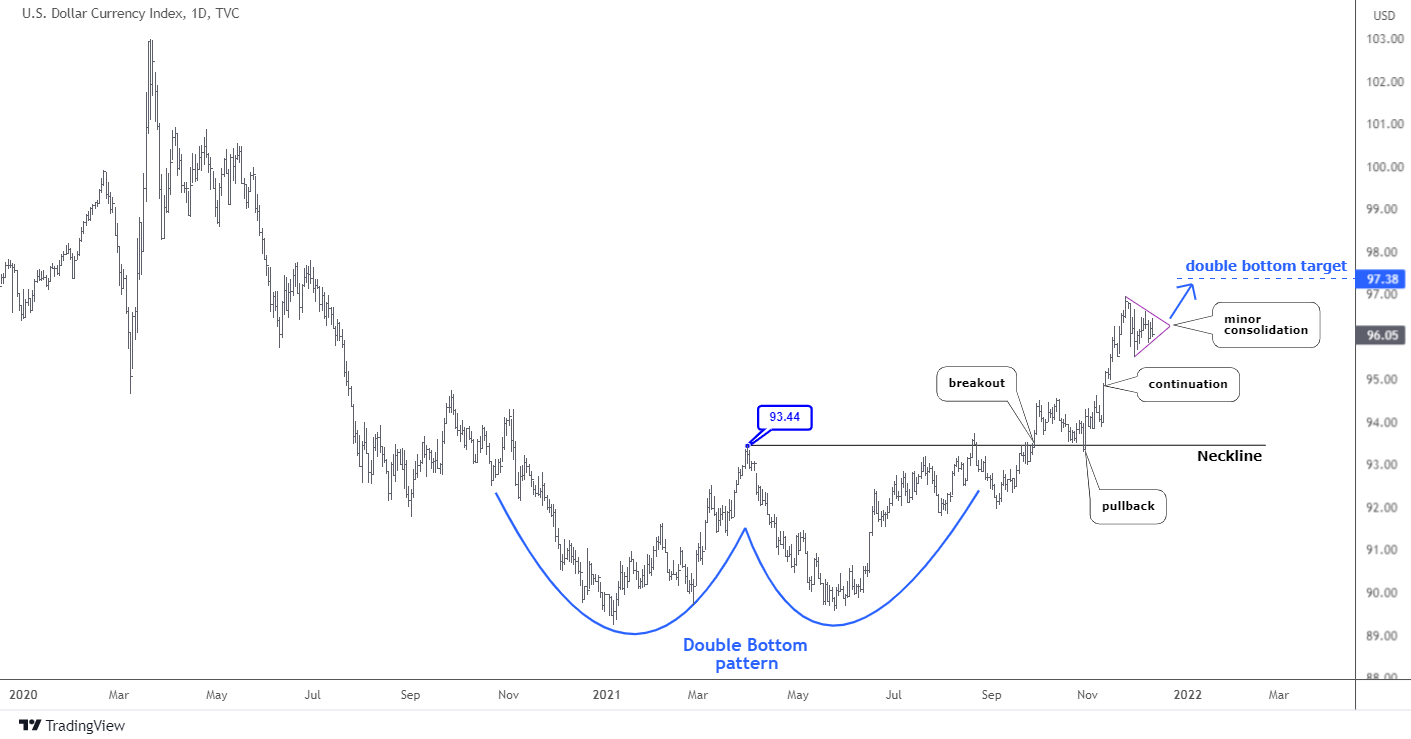
Last December, in the post titled "Is The Dollar Going To Steal The Santa Claus Rally?" I had shown you how a well-known “Double Bottom pattern” had been emerging in the daily chart. According to your voting, most of you have spotted that model as well.

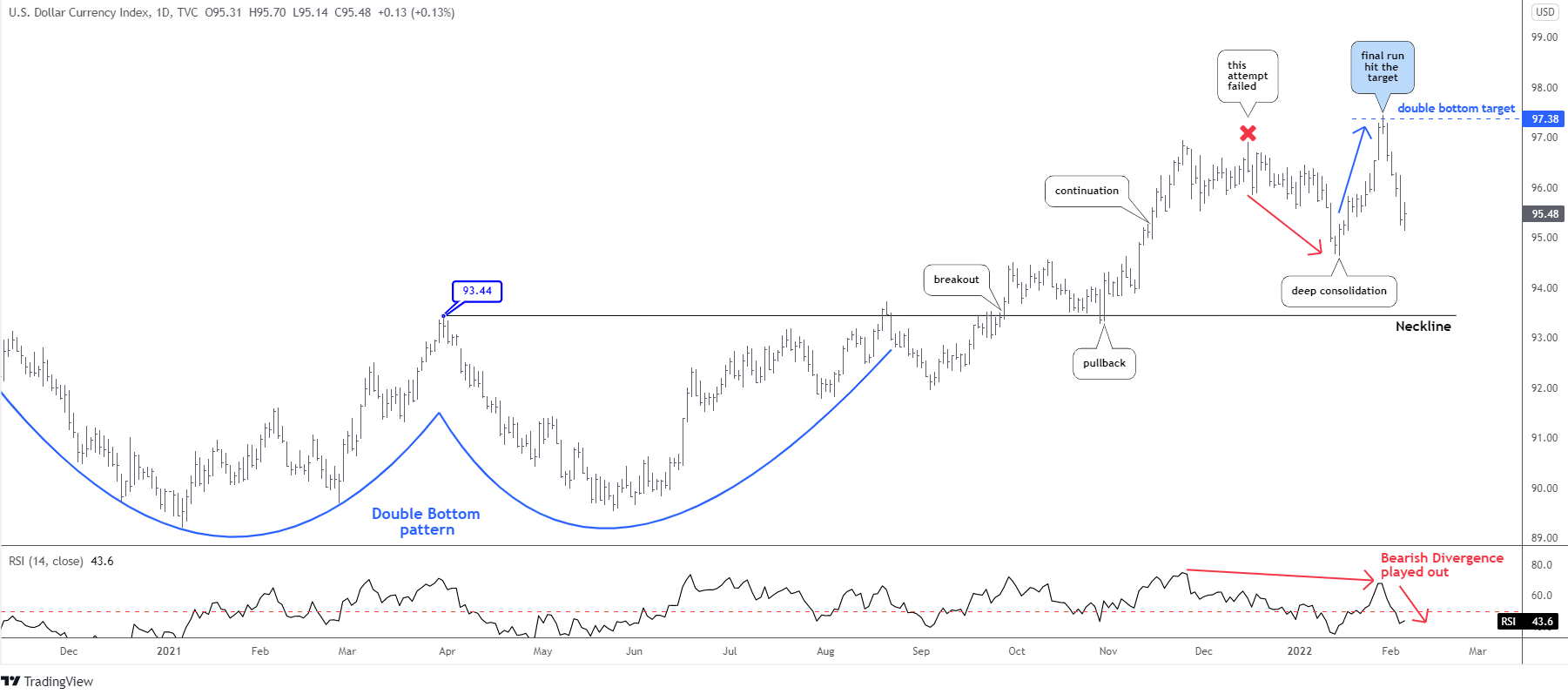
I put the updated chart below to show you the path of the price on its way to the target.

Dollar Chart

The dollar index (DX) has tried to climb over the previous top right after the post. This promising attempt has failed (red X), turning into the deeper complex consolidation (red down arrow). The good thing from a technical point of view was that the price has remained above the Neckline, although the depth of correction was scary. Continue reading "Dollar Fades After Hitting The Target"

This Is Not The Time To Panic

Almost the worst January in history! The streets are red, and everything looks like doom and gloom. Your account is off its highs, and nearly every day you log in to see what stock and ETF prices are doing, it only gets worse. The Federal Reserve is telling us they will raise interest rates all while inflation is higher than they expected it to be. It's hard to see what will stop the pain anytime soon, despite the occasional rally, green day.

However, this is not the time to panic.

Unless you started investing in the summer of 2020, you have seen this before. And unless you plan to stop investing, you will see this again in the future once this round of pain subsides.

First though, let me remind you where we came from and why in reality, this is not nearly as bad as it feels today. On February 10th, 2020, the S&P 500 was at 3,380; This was the top of the market before the Covid-19 pandemic started being felt by market participants. The bottom came about a month later, on March 16th, 2020, at 2,304. That is a 31% drop. Continue reading "This Is Not The Time To Panic"