Bitcoin: Digital Gold, Inflation Hedge Or Stock Market Gauge?

Bitcoin celebrated its 13th-anniversary last month. Which place in the financial universe does this "teenager" take over the time? Naturally, the judgment on this constantly changes with the growing acknowledgment of Bitcoin. It started as a revolutionary experiment, and nowadays, it is considered a financial asset with a growing acceptance from investors reflected in the market cap of over $700 billion.

Earlier, Bitcoin was called a "digital gold," which came to replace the ancient store of value. However, it better suits the lifestyle of the modern generation, as it is easier to handle and store compared to gold; moreover, it is digitally trendy.

After that, some analysts considered it as an inflation hedge as the emission of Bitcoin is limited with twenty-one million coins while fiat is not. The ninety percent of maximum supply has already been mined.

Recently, it's been acknowledged as the gauge of the stock market as they collapsed simultaneously.

Let's check on the daily chart below to determine which nickname suits Bitcoin best. Continue reading "Bitcoin: Digital Gold, Inflation Hedge Or Stock Market Gauge?"
Opportunities Abound - Building Out A Portfolio

The economy is going through a pivotal moment as the Federal Reserve withdrawals stimulus as economic tailwinds may be in jeopardy. The culmination of inflation, supply chain constraints, pandemic backdrop, rising rates, and easy money policies coming to an end has led to some individual stocks losing 30%-80% of their value in a matter of weeks. All the major indices have sold off in a meaningful way and are now in correction territory. Initially, there was a massive sea change in the market out of technology, specifically high beta/richly valued stocks and into value. As a result, the Nasdaq dropped over 15%, Russell 2000 dropped over 20%, S&P 500 dropped over 10%, and the Dow Jones dipped down over 8%.

With many high-quality companies selling at deep discounts, this correction offers an opportunity to build out a portfolio and engage in dollar-cost averaging. It's difficult, if not at all impossible, to time the market and buy at the exact bottom. However, one can initiate a position and add to the position as the stock becomes cheaper when and if the market-wide sell-off deepens. Any portfolio strategy should include a cash portion, and it's times like these where the cash portion should be deployed and put to work.

Earnings Disasters And Indiscriminate Selling

Disappointing earnings have been a linchpin for individual stocks to lose swaths of value while sending entire sectors into a downward spiral. The financials suffered massive selling pressure after JP Morgan (JPM) and Goldman Sachs (GS) reported earnings. Netflix (NFLX) saw its stock tank over 25% after reporting earnings, and this reverberated through the streaming space to sink Disney (DIS) too. Continue reading "Opportunities Abound - Building Out A Portfolio"

Weekly Stock Market Forecast

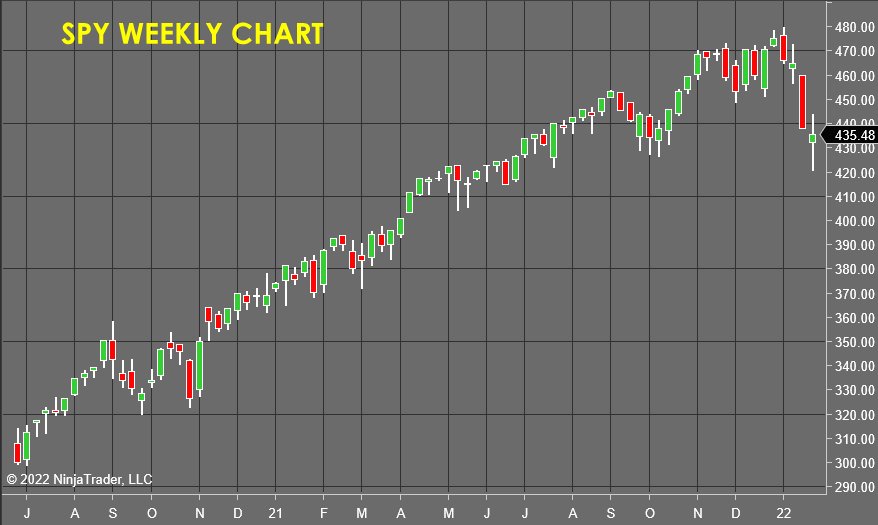
This week we have a stock market forecast for the week of 1/30/2022 from our friend Bo Yoder of the Market Forecasting Academy. Be sure to leave a comment and let us know what you think!

The S&P 500 (SPY)

SPY Weekly Chart - Stock Market Forecast

I'm putting my trading operations back together after a week plus away from my screens due to the good old-fashioned stomach flu that has marched its way through the family one by one, laying us out flat. This was a top 5 bug for sure; I haven't been that debilitated in many years. Continue reading "Weekly Stock Market Forecast"

A Macro View For Stocks, Commodities And Gold

Final rally for stocks, commodities to top, and a final down leg for gold?

This is one man asking one question among several I could be asking, given the volatility of macro indicators on a day-to-day, week-to-week basis. But as FOMC rides off into the sunset it is the scenario that I think is most probable, given the current state of some indicators we follow.

  • The yield curve is on a flattening trend that started signaling the beginning of the end of the inflation trades since the flattener began last April.
  • The Silver/Gold ratio has failed to establish any sort of firm signal to back the inflation trades since silver blew out with the ill-fated #silversqueeze promotion a year ago. That remains the case today.
  • Canada’s TSX-V index has gone bearish nominally and never did break its downtrend in relation to the senior TSX index. This is negative signaling for the more speculative inflation trades.
  • The Baltic Dry index of global shipping prices is in the tank, so to speak, having topped in October and dropped by 75% since.
  • Credit spreads are still intact, but bear watching as nominal junk bonds come under stress.
  • Industrial metals are still rising vs. the gold price, a still-intact macro positive, although Copper/Gold ratio continues to be undecided and a potential warning.
  • Gold had exploded upward vs. US (SPX/SPY) and global (ACWX) stocks. As we noted in an NFTRH update at the time, it would be subject to a potentially severe pullback whether or not the ratio has bottomed. The pullback started on Wednesday (FOMC day, and who is surprised?), and when gold bottoms vs. stocks the macro will be indicated to go quite bearish. For now, we’re neutral on the short-term.

With that macro backdrop in mind, let’s update three areas, US Stocks, Commodities, and Gold. Continue reading "A Macro View For Stocks, Commodities And Gold"

Failure To launch

Can everybody just chill a little? Yes, the Fed is “indicating” it’s moving to a less accommodative stance, no more government bond purchases, higher interest rates, maybe a decrease in its massive $9 trillion balance sheet, but it’s decidedly not going away. It simply can’t. Tightening? Hardly.

Indeed, as the results of its January 25-26 monetary policy meeting show, the Fed is basically being dragged kicking and screaming into stopping its asset purchases and raising interest rates to fight inflation, neither of which it actually announced at the conclusion of the meeting. Rather, it said it would buy “at least” another $20 billion of Treasury securities and $10 billion of mortgage-backed securities before ending the purchases “in early March.” It also didn’t raise interest rates, instead saying, “it will soon be appropriate to raise the target range for the federal funds rate.” Whenever that is, although everyone seems to believe it means its next meeting, which is set for March 15-16 (there’s no meeting in February). But again, the Fed didn’t say that.

If inflation is so darn dangerous to our nation’s economic health, why is the Fed willing to let it run another month or two before it starts acting instead of, to use Jerome Powell’s famous phrase, simply “talking about talking about” it? Continue reading "Failure To launch"