Worst Performing ETFs Of 2021

As we look back at yet another pandemic year and yet another tough 12 months for many reasons, overall, the markets have learned to deal with the pandemic and the headline news stories about new variants and new covid restrictions. This is proven by the fact that the major indexes all performed very well in terms of a historical perspective. The S&P 500 (SP500) ended the year up 26.89%, the Dow Jones Industrial Average (DJI) rose 18.73%, and the NASDAQ (COMP) increased by 21.39% in 2021.

Two of the three, the S&P 500 and the Dow Jones, outperformed their 2020 results in 2021, while the NASDAQ did well in 2021, but about half as well as it did in 2020. With those sorts of results, people may wonder how anyone could have lost money over the past 12 months, but depending on where and how you invested, you may be one of the unfortunate individuals who find yourself in that situation.

The start of a new year is a good time to review your investing thesis and try to pinpoint why some investments didn’t turn out the way you imagined they would. With that thinking in mind, let’s take a look at the top five worst performing ETFs of 2021 in a number of different categories that the average investor could have chosen from in 2021 to see if you owned any of them or if there was some sort of trend that we can learn from. Continue reading "Worst Performing ETFs Of 2021"
Extreme Volatility: Options-Based Portfolio Approach

Cash is a critical component to any portfolio strategy to reduce volatility, seize opportunities, lower cost basis of a long position and avoid full exposure to the equity markets. Controlling portfolio volatility is essential as the broader markets continue to undergo a sea change from high beta/richly valued technology stocks and into value names. The past four-month stretch from September 2021 - January 2022 serves as a prime example of extreme market volatility. The markets pushed to new all-time highs early in September 2021, then suffered a significant selloff in the same month where the Dow Jones was down as much as 6%. October 2021 saw a bounce back into positive territory with new all-time highs set. Then the November/December 2021 stretch saw a sharp dichotomy between the tech-heavy Nasdaq and the Dow Jones, with these indices experiencing relentless selling and heavy buying, respectively.

Amid the bifurcated market, entire sectors have been decimated, and some companies have lost swaths of market capitalizations. Even many well-established, profitable large-cap companies have seen their market capitalizations reduced in a meaningful way. Entire sectors of the market have been wiped out, specifically the fintech space and some pure stay-at-home plays. Given the market backdrop, the cash portion of the portfolio can come in handy to seize unique opportunities to bolster a portfolio. In addition to cash, a conservative options strategy can offer additional mitigation against these pockets of extreme volatility.

A Holistic Approach

Proper portfolio construction and optimal risk management is essential when engaging in options trading to drive portfolio results (Figure 1). Managing a long-term successful options-based portfolio requires a risk tolerance balance between cash, long equity, and options. Ideally, an options-based portfolio should be broken out into the below structure (This is an example breakdown, and percentages can be modified): Continue reading "Extreme Volatility: Options-Based Portfolio Approach"

Palladium Update: Contradiction

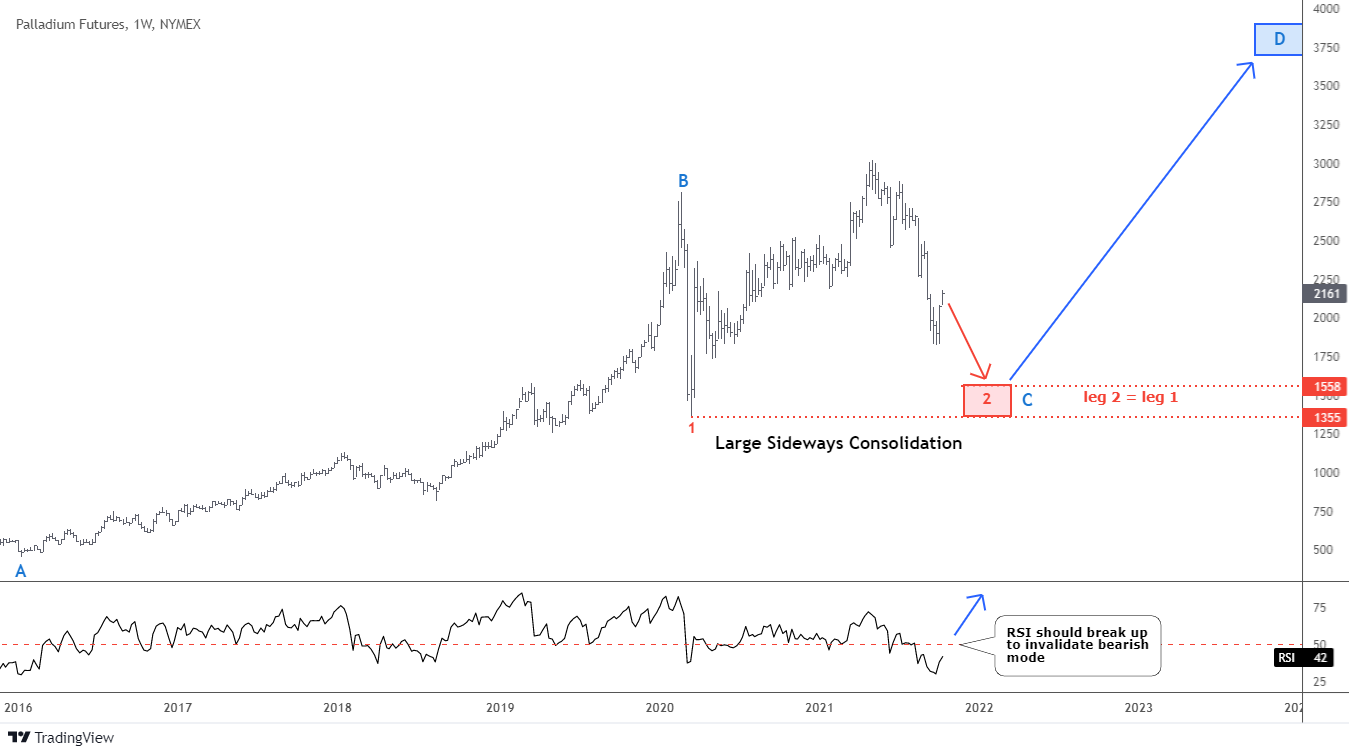
In October 2021, I shared with you my technical outlook for palladium futures.

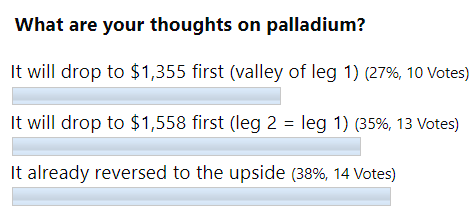
The chart structure was clear; therefore, I was confident of further collapse of palladium price. The results of your ballot are in the graph below.

Palladium

Most of you voted for a bullish trend to resume. The second popular bet turned out to be the most accurate as the price has pierced the upper side of the preset bearish target area at $1,558.

The next step after two-leg consolidation was going to be a huge growth of the metal’s price. However, the industry fundamentals do not support that bold plan. Continue reading "Palladium Update: Contradiction"

This Chart Pattern Spells Upside For BTC

If you've been reading my articles here at INO.com, I don't have to tell you that I lean on fundamental analysis when I talk about crypto.

You've also noticed that I don't hesitate to pull out a chart and do some technical analysis.

That's why today, we're going to use some technical analysis to explore a chart pattern that I've used for a long time and that all of a sudden popped up on my screen when I was in the midst of my routine studies of Bitcoin (BTC).

But before we get to that dynamite chart pattern, let's look at the difference between fundamental and technical analysis.

What's Fundamental And Technical Analysis?

Fundamental analysis looks at what an asset does, what its markets are, how it makes money. By looking at these features, fundamental analysis can provide opportunities for investors. And the assets that you can target with fundamental analysis can be pretty much anything, from a stock to a bond or a cryptocurrency. Continue reading "This Chart Pattern Spells Upside For BTC"

Apparently, Valuations Do Matter

2021 ended with a bang, with the S&P posting a 27% gain on the year. This appreciation occurred with the markets were facing a trifecta of rising interest rates, an unknown coronavirus variant backdrop, and the Federal Reserve tapering. The major indices reached unprecedented territory breaking through all-time high after all-time in what seemed like a daily occurrence throughout the year until the back third of the year rolled around. The September correction was a harbinger that valuations do matter, albeit October saw a huge reversal to the upside. Then came the November/December bifurcation in the markets, along with extreme bouts of volatility. Despite the back third of the year, the S&P 500 posted a 27% gain, placing the index in rarified air across many valuation metrics.

As interest rates, fed taper, and the pandemic gripped the markets, a sea change occurred. This sea change started to take hold back in November and December of 2021 while really accelerating in the first week of January 2022. As a result, technology names experienced heavy selling, specifically in stocks with high beta and/or rich valuations. This massive rotation came out of technology companies that are unprofitable with proof of concepts and into value-oriented companies that are well-capitalized, profitable, and pay dividends. As 2022 continues onward, this theme will lead the charge in the markets until the uncertainty surrounding the pandemic and the interest rate environment is settled out. Continue reading "Apparently, Valuations Do Matter"