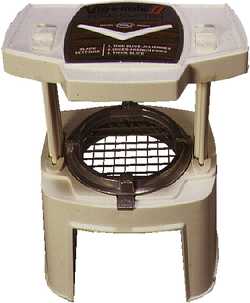
Get ready for the Veg-O-Matic Markets

"This is Veg-O-Matic, the world-famous food appliance! . . . the only appliance in the world that slices whole, firm tomatoes in one stroke, with every seed in place. . . . French fries? Make hundreds in one minute! . . . Isn't that amazing?!"

Let's face it, the really big money is made in the big trending markets. What happens after a big trend comes to an end? Well, that is when you enter into a period of uncertainty.
Continue reading "Get ready for the Veg-O-Matic Markets"

My favorite Indicator for inflation and it's not gold. (New Video)

One of my favorite indicators for large cyclic trends has accurately forecasted every inflationary and deflationary cycle since it was created in 1957.

Watch my February 6th video on this indicator here.

You may want to watch this index carefully should you want to invest in certain stocks and commodity related markets. Over the last half-century, this index has seen some remarkable moves both on the downside and in the last few months on the upside. I believe that this is the indicator that everyone should watch. If you trade stocks or futures and are interested in world trade trends, this is the indicator to track.

Video link to new video and forecast on next page.

Continue reading "My favorite Indicator for inflation and it's not gold. (New Video)"

Interview with a "Silver Man"

Earlier this week I had the chance to talk to David Morgan from Silver-Investor.com and ask him some questions about the futures markets and silver. Here's David's bio and below you'll see my mini interview!

==================================================================

Trader's Blog: David Good morning! How are things?

David: Things are well, just got back from vacation and am looking forward to getting my nose back into the silver that's for sure.

Trader's Blog: David let me get right to it here....Can you give us a brief overview of how the futures markets operate?

David: Until very recently the futures market has been operated the same way basically from the inception.  It’s what’s called an open outcry market.  Guys jam literally into a ring.  It’s a round section with tiers going up from the floor, like a cone.  The levels represent different months. This same layout is for different commodities; a wheat pit, a corn pit or ring as referred to in New York.  Now most futures contracts trade electronically.

What takes place is an auction method, and the futures price is set by this method.  This method actually sets the spot price.  The spot price is called the cash market.

Now, once that price is set, that doesn’t necessarily mean that you can buy silver or gold at that price that’s set in that pit.  You can buy it for that price plus a few other fees, such as a delivery charge and transportation, but basically you will pay the price set.

I want to be very clear; there are times that the silver market and other markets go into what is called backwardation, where you actually have to pay more for immediate delivery of the real product than you can purchase the same commodity for in a future delivery month. This is a sign of a tight supply situation and usually does not last for much more than a few days.

Conversely, in the past we have seen the opposite. If we go back to the 1980 high of January 21, 1980 – the peak in precious metals in real terms, not nominal terms the price of silver in the physical realm was less than the futures price. I was in Los Angeles at the time, and even though silver in the futures market was over $50.00 the ounce, in the futures exchange, on the spot market, closing that day, the actual price that you could sell your silver physically for all over Los Angeles, every dealer that I checked with  – was $35.00 the ounce.

So the dealer community bid it back $15.00 from the actual futures price.  I want people to be aware of the facts and this was at the high and a very fast moving market.  I’m really trying to be objective here.  Now, the way we’re going in the silver market and the gold market right now is that anyone that really understands these markets are willing to go to the futures markets and take physical delivery.

I do expect these premiums to close up, meaning, that what you have to pay your local coin dealer for silver being greater than the spot month is going to narrow so that if you have to pay, as an example, $14.00 for one ounce of silver at your coin dealer, and the futures price is 10, those two will come together at some point in the future.

I wrote an article about that recently; if you haven’t read my Web site, you might go there, Silver-Investor.com. It’s called Silver Arbitrage; where I explain these arbitrage opportunities, usually don’t last for a very long time.

Trader's Blog: Okay.   I guess what I’m driving at is reading the Internet that some say big interests are depressing the price through Comex.  I don’t understand how they succeed in that and why they don’t just lose money and go out of business and why the price doesn’t just reach its natural equilibrium due to supply and demand rather than this manipulation?

Continue reading interview

Golden Opportunities

Today I'd like to welcome John Rubino from DollarCollapse.com. Over the past few months I've come quite accustomed to checking out DollarCollapse.com to get the latest breaking news on the stuff that REALLY moves the markets. John focuses on metals, the economy as whole, and yes the Dollar. Great site, take a look. He's also written a book talking directly about the collapse of the dollar, check it out here. Today I've asked John to talk about some interesting ways to take advantage of the markets recent implosion!

====================================================================

Golden Opportunities

The gold bugs are about to be proven right in a very big way. Most of them have placed their bets on the general proposition that the U.S. economy would implode in four distinct stages. First, the three-decade flood of easy money would cause a "crack-up" boom in which banks gave loans to pretty much anyone with a pulse and turned the resulting bad debts into toxic bonds and derivatives. Then, in Stage Two, the sheer weight of this misallocated capital would cause everything to fall apart (which happened this past month). Then (Stage Three) the world’s governments would panic, flooding the system with liquidity by lowering interest rates, bailing out banks and buying up pretty much any asset that threatened voters’ jobs or nest eggs.

With the passage of the U.S. bank bailout and similar plans in Europe, we’re clearly entering Stage Three. Now it’s time to start considering Stage Four, the credit bubble’s grand finale. This is when a critical mass of people notice that with government printing presses running flat-out, paper money is about to return to its intrinsic value--zero. The result: a global run on fiat currency, in which the dollar, euro, and yen all plunge, and the dollar price of real things like gold, silver, and oil soar.

It’s crucial to understand the role that precious metals play in this kind of currency crisis. They aren’t commodities like oil and wheat. They’re alternative forms of money that have functioned as a medium of exchange and store of value since the beginning of recorded history. After each failed experiment with fiat (i.e. government created and controlled) currency, these "sound" forms of money come back into style. Why? Because gold and silver can’t be created on a printing press. The only way to get more is to mine it from the ground, and historically we’ve found only about 2% more each year. This constrained supply means unscrupulous and/or panicked governments can’t simply legislate more money to buy votes. So gold and silver tend to hold their value. It takes about the same amount of gold to buy a bushel of wheat as it did in the Middle Ages. Today an ounce of gold buys the same ten or so gallons of oil as in the 1950s.

So as the world’s paper currencies are shredded into so much confetti, investors will swap their increasingly worthless paper for real money as fast as possible, at whatever price the market requires. Gold and silver will soar in dollar terms, and the market value of the companies that mine these metals will rise even further. Today, in short, is a once-in-a-generation chance to load up on precious metals miners. And the junior miners--the smaller companies that most people have never heard of--are especially interesting. They’ve been absolutely crushed by the recent credit troubles, as investors assume that they’ll be unable to attract the funds necessary to bring their newly-discovered reserves to market.

This is a classic case of throwing the baby out with the bathwater. Some junior miners are indeed in financial trouble, running out of cash and unlikely to find more. But many others raised capital before the credit crunch and have adequate cash to build their mines and start producing. When gold and silver take off, these stocks will go parabolic, putting up double-digit gains on a daily basis and tripling or better in a good month. There will be lots of good months. Here are three that fit the profile: Small, obscure, but with properties that have the potential to become highly-profitable mines. And more than enough cash on hand to see them through to the beginning of Stage Four, when the markets will shower them with capital.
Detour Gold (DGC.TO) is developing the Detour Lake deposit in Ontario, which contains more than 11 million ounces of gold, a huge resource by new-mine standards. On June 30, Detour had $65 million of cash and short-term investments and no debt. So it won’t need outside capital for at least the next two years. Claude Cormier, publisher of the Ormetal Report and an expert on Canadian juniors, really likes this one, and expects it to find more gold and eventually to be taken over by a senior miner for a big multiple of today’s price.
Andina Minerals (ADM.V) has a mine in Chile that Louis James, senior metals analyst with junior miner specialist Casey Research describes as “a genuine monster that is getting much bigger.” In its last financial report it listed $25 million in cash and no debt. Back in July, James referred to Andina’s $3.50 share price as “not cheap.” Since then it has fallen to around a buck.
Rubicon Minerals (RBY) in 2002 bought some land from a bankrupt miner in Canada’s Red Lake district, home to industry giant Goldcorp’s most productive mine. Since then Rubicon has found gold all over this property, both near the surface and far underground. The find looks like a true blockbuster. Rubicon has $22 million in cash and no debt, and its stock is down from a year-ago $2.25 to $1.40.
I’ll go out on a limb and predict that all three of these, plus about twenty other junior miners with similar profiles, will be ten baggers in the next few years. Golden opportunities indeed.

John Rubino runs the DollarCollapse.com website and is co-author, with GoldMoney’s James Turk, of The Collapse of the Dollar and How to Profit From It (Doubleday, 2007). His previous books include How to Profit from the Coming Real Estate Bust (Rodale, 2003) and Main Street, Not Wall Street (Morrow, 1998).

The Biggest Mistake Silver Investors and Traders Make

Last month I invited David Morgan Silver-Investor.com to come and do a guest blog post. Well we received a huge email and comment response to bring him back for more analysis.

==================================================================

The Biggest Mistake Silver Investors and Traders Make!
Do you know what it is?

by David Morgan

To say that investors in the resource sector have been having a bumpy ride for the last six months would be the understatement of the year! Whether you hold mining stocks, buy physical precious metals, or play the futures market, it’s been hard to make dimes and easy to lose dollars. How is a trader supposed to keep his or her balance during these turbulent times, when gold and silver can make bigger up and down moves overnight than they normally do during the daytime session?

I’ve said many times that the market will seek to find and lay bare every weakness a trader has (both in personality and trading style). In order to survive and trade profitably, it is not enough just to become proficient in the mechanics of buying and selling. What is critical is to spend the time necessary to develop a thorough understanding of yourself.

An old Chinese saying that many of my readers have no doubt heard, but which in today’s market environment certainly bears repeating, goes:

If you know your opponent and yourself, you will be victorious in one hundred battles.
If you know only yourself, the odds are even.
If you know neither, there is great danger in one hundred battles.

Tony Burroughs of the Intenders tells us that, to a large extent, our reality is formed by the way we talk to ourselves. Almost always, the outcome of something we are doing will be more productive and positive if we “intend” rather than “try” or “hope.” When the markets are challenging, as they have been lately, “the novice buys into the doubt, but the ‘knower’ pushes the doubt aside and continues forward.”

Start by asking yourself if the reasons you initially invested in mining stocks and metals have changed. Do you believe the fundamentals are different now than they were a few months ago? Are your goals and how you plan to achieve them still aligned? Can you still focus on the larger, long-term picture and turn down the short-term noise?

If you believe, as I do, that this secular bull market for gold and silver has a long way to run, then you can more easily deal with current conditions, limit second-guessing, and make the trading decisions that will keep you in the game.

My friend Pat Gorman has spent much of his life helping others to develop the tools they need to succeed, as well as spending no small amount of time in the search for balance in walking his own path. He likes to speak of two important concepts that can help us stay centered and move forward professionally and personally. These concepts are discipline and gratitude.

Be disciplined in studying about the markets you choose to invest in, and then follow through on what you have learned. Just as important, take time on a regular basis to express your gratitude for what life has given you and the opportunities it presents. Sure the markets and the profit we hope to make from them are important. But doesn’t the real value in our lives rest with our relationships and the health of family, friends, and ourselves? Aren’t you privileged to live in a country that in spite of its many problems is still a beacon for millions of people from around the world?

Developing a thorough understanding about yourself and making sure your self-talk moves you in the direction of your personal and professional goals may not seem as exciting as pulling off a ten-bagger mining stock trade or catching a one-dollar move on a silver futures contract. But it really does offer the potential of helping your trading to become more consistent and enables it to flow with the market, regardless of what it is doing on a given day, week, or month.

Let’s face it. Not only is the market unaware that you exist, but it probably wouldn’t care, even if it knew. There are valid reasons for seeing the trading floors as battlefields, because that’s what they really are . . . titanic battles between bulls and bears.

When the day comes that you have developed a good understanding not only of the markets, but of yourself as well, you may then truly become “victorious in one hundred (trades) battles.” I’d say this is a very worthy endeavor. How about you?

Get Real, Buy Real,
David Morgan

Mr. Morgan is the founder of Silver-Investor.com and has followed the silver market daily for over thirty years. Much of this Web site is devoted to education about money, metals and mining.