Analysis Of The EIA Statistics

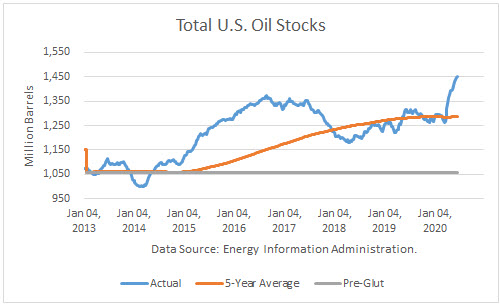
According to the Energy Information Administration (EIA), U.S. petroleum inventories (excluding SPR) built by 5.9 million barrels last week to 1.451 billion, whereas SPR stocks built by 1.4 million. Total stocks stand 163 mmb above the rising, rolling 5-year average and about 151 mmb higher than a year ago. Comparing total inventories to the pre-glut average (end-2014), stocks are 392 mmb above that average.

EIA

Crude Production

Production averaged 11.0 mmbd last week, up 500,000 b/d from the prior week, and 10.950 mmbd over the past 4 weeks, off 10.6 % v. a year ago. In the year-to-date, crude production averaged 12.311 mmbd, up 1.7 % v. last year, about 200,000 barrels per day higher than a year ago. Continue reading "Analysis Of The EIA Statistics"

Are We Ready For A Second Wave?

As we know well by now, the financial markets have recovered nicely from the initial wave of the coronavirus, at least until recently. After plunging by a third from its February 19 all-time high through its March 23 bottom, the S&P 500 has rebounded sharply, although it still remains about 10% below its record high. NASDAQ, however, has won back all of what it lost and now is solidly in the green for the year. Bond yields, meanwhile, have largely settled into a relatively narrow range, all of which signals that investors are fairly positive about the future.

Certainly, the most recent economic news has borne out that optimism. Retail sales jumped a record 17.7% in May after plunging 14.7% in April, the first increase in fourth months. Moreover, May sales in dollars were only 7.7% below where they were in February before the worst effects of the virus hit. In other words, after an extraordinary dip, spending is already close to where it was as more stores and restaurants reopen.

Elsewhere, the Conference Board’s index rose a better than expected 2.8% in May after falling 6.1% in April. Sales of newly-built homes jumped 16.6% while the National Association of Home Builders’ confidence index surged 21 points in June to 58. Sales of existing-home sales, by far the largest category, dropped nearly 10% in May, but that “reflected contract signings in March and April, during the strictest times of the pandemic lockdown,” the National Association of Realtors said, adding that “home sales will surely rise in the upcoming months with the economy reopening, and could even surpass one-year-ago figures in the second half of the year.”

While all of that is undoubtedly good news, is it sustainable? Right now, two main questions are facing the economy and the financial markets: How bad will a dreaded “second wave” of the virus be on both the nation’s health and economy and what happens now that the U.S. government’s stimulus programs have started to run out? Continue reading "Are We Ready For A Second Wave?"

Market Selloff To End Volatile Week

As we head into the close for the week, stocks are at or near session lows in a market selloff ending what was a volatile week. The reason for the selloff, spiking cases for Coronanvirus in several states.

The U.S. hit a new record for daily coronavirus cases. That has caused the governors of Texas and Florida to pause their reopening plans, with both states effectively closing bars to limit the spread of coronavirus. Coronavirus cases are trending upward in about half of U.S. states, and several have reported record-breaking daily new case counts this week, according to Johns Hopkins University. The U.S. reported 39,972 daily cases of the coronavirus on Thursday, a new daily record, according to Johns Hopkins.

Both the S&P 500 and DOW have now gone negative for the month, but the NASDAQ continues to trade in positive territory on a monthly level. However, on a weekly level, all three indexes will post weekly losses with the S&P 500 losing over -2%, the DOW will drop over -2.9% closing in on -3%, and the NASDAQ is looking at a weekly loss over -1%. Continue reading "Market Selloff To End Volatile Week"

COVID-19 - Capitalizing On Opportunities

Just before the COVID-19 pandemic struck the markets, Ray Dalio was recklessly dismissive of cash positions, stating "cash is trash." Even Goldman Sachs proclaimed that the economy was recession-proof via "Great Moderation," characterized by low volatility, sustainable growth, and muted inflation. Not only were these assessments incorrect, but they were ill-advised in what was an already frothy market with stretched valuations prior to COVID-19 hitting the markets. The COVID-19 pandemic was a true back swan event that no one saw coming as far as its abruptness, scale, and impact. This COVID-19 induced sell-off was the worst since the Great Depression in terms of breadth and velocity of the sell-off.

The S&P 500, Nasdaq, and Dow Jones shed a third or more of their market capitalization through late March 2020. Some individual stocks lost over 80% of their market capitalization. Other stocks were hit due to the market-wide meltdown, and many opportunities were presented as a result. Investors were presented with a unique opportunity to start buying stocks and take long positions in high-quality companies. Throughout this market sell-off, I took long positions in individual stocks, particularly in the technology sector and broad market ETFs that mirror the S&P 500, Nasdaq, and Dow Jones. It was important to put this black swan into perspective and see through this event on a long term basis. Viewing the COVID-19 sell-off as an opportunity to buy stocks that only comes along on the scale of decades has proven to be fruitful. When using past recessions as a barometer, I started buying stocks when the sell-off reached 15% and continued buying into further weakness to improve cost basis.

Most Extreme and Rare Sell-Off Ever

Out of the 12 recessions that have occurred since May of 1937, the average sell-off for the S&P 500 was -31.6% with a range of -57% (2008 Financial Crisis) to -14% (1960-1961). The COVID-19 pandemic has crushed stocks beyond the average recession sell-off of -31.6%. The markets didn't reach the most severe sell-off levels by historical standards despite the possibility for more downside potential. Regardless, at initial recession levels of 15% declines, I began putting cash to work as that was the prudent action for any long-term minded investor. Continue reading "COVID-19 - Capitalizing On Opportunities"

Is Gold Poised To Move Higher?

Polls show that you were optimistic about the probability of another rally for top metals. Both of them go well with the maps that I shared earlier this month. Let's see, in the updated charts below if they are going to justify your bold expectations.

Gold is the first as it has a stronger position now.

Gold
Chart courtesy of tradingview.com

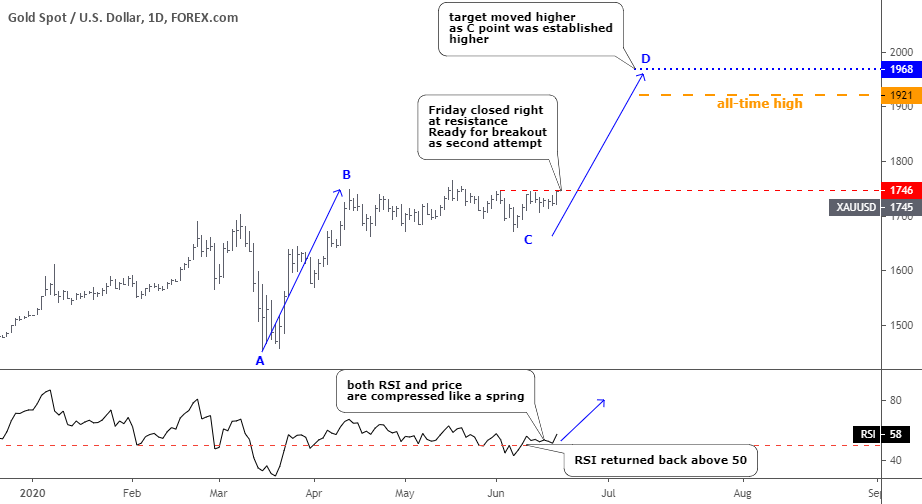
The top metal completed the sideways consolidation that I showed you two weeks ago. It didn't touch the 38.2% Fibonacci retracement level at $1636 as it stopped at $1671, which is even higher than the first leg of this corrective structure, which was established at $1661. It is an entirely natural outcome as the last leg down started at $1766, also higher than the top of the first leg did at $1748. The second leg down was longer ($95) than the first leg ($87). Continue reading "Is Gold Poised To Move Higher?"