IV Rank - Key To Successful Long-Term Options Trading

After posting my recent options article “High-Probability Options Trading Thrives” where I demonstrated an 87% options win rate throughout the bear and bull markets in Q4 2018 and Q1 of 2019, respectively, I received a lot of questions. I previously walked through how powerful options are and how you can be wrong about the direction of the stock and still make money. This is because options are a bet on where stocks won’t go, not where they will go. When coupled with IV Rank, options provide a high-probability win rate while generating income, mitigating risk and circumventing drastic market moves. Many questions that arose were centered on implied volatility rank (IVR) and how this can be leveraged appropriately when engaging in options trading. IVR is by far the most important and most essential concept to understand when it comes to long-term success in options trading. Here, I’ll discuss how implied volatility and IVR can impact options pricing and provide options traders with a statistical edge over the long term.

Purpose and Implied Volatility (IV)

The whole idea behind options trading is to sell options and collect premium income in a consistent and high-probability manner. Enabling your portfolio to appreciation steadily month after month without guessing which direction the market will move. The main key for options trading success is leveraging implied volatility and time premium decay to your advantage. Since options premium pricing is largely determined by implied volatility, it’s this implied volatility component when used appropriately that provides options traders with a statistical edge over the long term.

Implied volatility is the market’s prediction of how volatile the stock will be in the future or the expected volatility of a stock. Implied volatility has many implications and relationships that should be grasped. Continue reading "IV Rank - Key To Successful Long-Term Options Trading"
A Few New Retail ETF Investing Options

Recent data reports and economic indicators have been mixed when it comes to the health of the American consumer. This has led some investors to think retail stocks are undervalued, while other investors believe they are overvalued. So whether you fall into the camp that thinks the next recession is “just right around the corner” or that the poor retail sales figures reported in December were not a sign the economy is struggling, but simply a blip in the data caused because of the government shutdown; there are a few newer Retail ETFs which give you the option to invest regardless of the way you think the market is headed.

The first place to start looking if you want to be long retail is with the SPDR S&P Retail ETF (XRT). The XRT would be most investors first choice if you are looking for plain vanilla long Retail ETF investing. XRT has been around since 2006; it has a lower than average expense ratio, when compared to others on this list, at 0.35%. IT has $250 million in assets, 96 holdings and is equally-weighted and draws stocks from the S&P Total Market Index, not just the S&P 500. It also invests in both e-commerce retailers and brick-and-mortar retailers.

Since most people would agree retails future is more online, the most basic ‘online’ Retail ETF is the Amplify Online Retail ETF (IBUY). IBUY has an inception date of April 20th, 2016, and offers equally weighted, well-diversified exposure to global online retailers. Firms must derive 70% of their revenues from online sales and can be any size in terms of market-cap (subject to the standard typical minimum size and liquidity constraints). The fund has 75% of its assets in US-based companies and 25% in foreign stocks. IBUY has an expense ratio of 0.65%, which is on the ‘high’ side, but considering the exposure the fund offers, it is not unreasonable. IBUY currently has $275 million in assets spread out over its 42 different holdings, which have a weighted average market cap of $52 billion. Wayfair (W), Etsy (ETSY), eBay (EBAY) and PayPal (PYPL) are four of the funds top 10 holdings, with none representing more than 5% of the fund. Continue reading "A Few New Retail ETF Investing Options"

Keep An Eye On The Financial Sector

A very interesting price pattern is setting up in the financial sector that could lead to a very big move in the US and Global markets. Remember how in 2008-09, the Financial sector and Insurance sector were some of the biggest hit stock sectors to prompt a global market crisis? Well, the next few weeks and months for the financial sector are setting up to be critical for our future expectations of the US stock market and global economy.

Right now, many of the financial sector stocks are poised near an upper price channel that must be breached/broken before any further upside price advance can take place. The current trend has been bullish as prices have rallied off the December 2018 lows. Yet, we are acutely aware of the bigger price channels that could become critical to our future decision making. If there is any price weakness near these upper price channel levels and any downside price rotation, the downside potential for the price is massive and could lead to bigger concerns.

Let’s start off by taking a look at these Monthly charts… Continue reading "Keep An Eye On The Financial Sector"

U.S. Crude Production In January Displays A Seasonal Lull

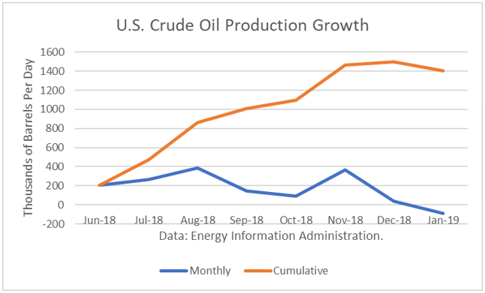
The Energy Information Administration reported that January crude oil production averaged 11.871 million barrels per day (mmbd), down 90,000 b/d from December. Despite the drop in January, crude production still rose by a spectacular 1.407 mmbd from June through January, a period when capacity takeaway constraints had been expected to slow down the growth in Texas.

crude production

The year-over-year gains have been especially impressive with the January figure being 1.876 mmbd. And this number only includes crude oil. Other supplies (liquids) that are part of the petroleum supply add to that. For January, that additional gain is about 6,950 b/d. Continue reading "U.S. Crude Production In January Displays A Seasonal Lull"

Crude Oil Hits The Target Early

Back in February, I wondered: “How Far Could Crude Oil Go?” As this commodity confirmed the upside reversal breaking above $54.6. We are still living in a “PetroWorld” therefore the price of oil is crucial, and it impacts all of us around the globe. So, we should watch it carefully.

I spotted a structural similarity on the weekly chart, which was cloned and applied to the current pullback of oil price on the lower time frame daily chart. The price target was set at the $63.7 and the time goal was set on the 6th of May, 2019.

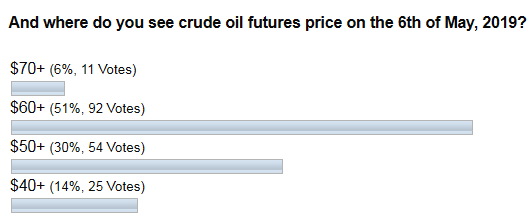
Before we move on to the updated daily chart, I would like to show you the results of your ballot on this topic.

oil price

I can’t express all my gratitude for your voting activity and support of my experiments. The results in the diagram above show that you also saw the area above $60 as a target for the current pullback. It is yet early to say if the price has topped already, but our initial target was achieved and even was passed over ahead of time.

In another ballot, you voted for the instruments you liked the most. Continue reading "Crude Oil Hits The Target Early"