Bear or Bull Market - Options Trading Provides Outperformance and 98% Win Rate

The broader market has whipsawed over the past five months. The S&P 500 posted one of its worst quarters and since the Great Depression with the index selling off 14% and erasing all of its gains from 2018. 2019 started on a high note for the S&P 500 with January posting a 7.9% gain, logging its best January in over 30 years. This was followed by continued strength in February, putting the index on its best footing since 1991 with a cumulative return of 11% year-to-date. In this article, I’ll be discussing how options trading can generate consistent premium income with a high-probability of success, regardless of the market backdrop. This is accomplished since options are a bet on where stocks won’t go, not where they will go. Following the options trading mechanics described in this article, my options-centric portfolio resulted in a total portfolio return of 4.2% against the S&P 500 return of -4.4% over the previous five months. This timeframe provided both bear and bull market conditions to demonstrate the effectiveness and resiliency of options trading while outperforming the broader index by a wide margin. This seesaw from a negative to a positive market backdrop provided unique opportunities to capitalize on options trading via capturing a higher percentage of premium income. In January and February, I was able to achieve a 98% options success rate by closing 46 out of 47 option contracts while leveraging cash-on-hand.

Options Crash Course

Options trading can be a fantastic avenue to mitigate risk, provide consistent income and hedge against market movements while maintaining cash-on-hand. Risk mitigation is particularly important given the market wide melt-down during Q4 of 2018 albeit the market has rebounded furiously thus far in 2019 through February. Maintaining liquidity via maintaining cash on hand to engage in covered put option selling is a great way to collect monthly income via premium selling. Heeding critical variables such as implied volatility, implied volatility percentile and probability, one can optimize option selling to yield a high probability win rate over the long term given enough trade occurrences. I demonstrated via empirical data how these critical elements translate from predictive high probability outcomes to reality. In the end, options are a bet on where the stock won’t go, not where it will go and collecting premium income throughout the process. These empirical data demonstrate that the probabilities play out given enough occurrences over time. Despite a small sample size (148 trades) in a period where the market seesawed from erasing all of its gains for 2018 to posting its best January/February since 1991, an 85% win rate was achieved while outperforming the broader market by a spread of 8 percentage points from October of 2018 through February of 2019 (S&P -4.4% vs. 4.2%).

Trading Mechanics

Continue reading "Bear or Bull Market - Options Trading Provides Outperformance and 98% Win Rate"
The Bank That Couldn't Shoot Straight

Other than President Donald J. Trump, Wells Fargo CEO Timothy Sloan has to be the most hated man in Washington, or at least he was this week.

On Monday, the New York Times published a story which said employees at the bank “remain under heavy pressure to squeeze extra money out of customers” despite “years [of] publicly apologizing for deceiving customers with fake bank accounts, unwarranted fees and unwanted products” and claims by top executives that they “have eliminated the aggressive sales targets that spurred bad behavior.” That was a reference to the 2016 scandal in which over a period of many years, thousands of bank employees opened millions of accounts without customers’ knowledge or consent.

But that proved to be only the beginning of the bank’s problems. Since then there has been a steady drip of one scandal after another, from forcing auto loan customers to buy insurance they didn’t need to allegedly overcharging military veterans for mortgage refinances.

Indeed, “each time a new scandal breaks, Wells Fargo promises to get to the bottom of it. It promises to make sure it doesn’t happen again, but then a few months later, we hear about another case of dishonest sales practices or gross mismanagement,” Rep. Patrick McHenry, R-N.C., told Sloan at a House Financial Services Committee hearing on Tuesday.

At the hearing, members of both parties lambasted Sloan and his bank. Continue reading "The Bank That Couldn't Shoot Straight"

Palladium Pushed Platinum To Record Low

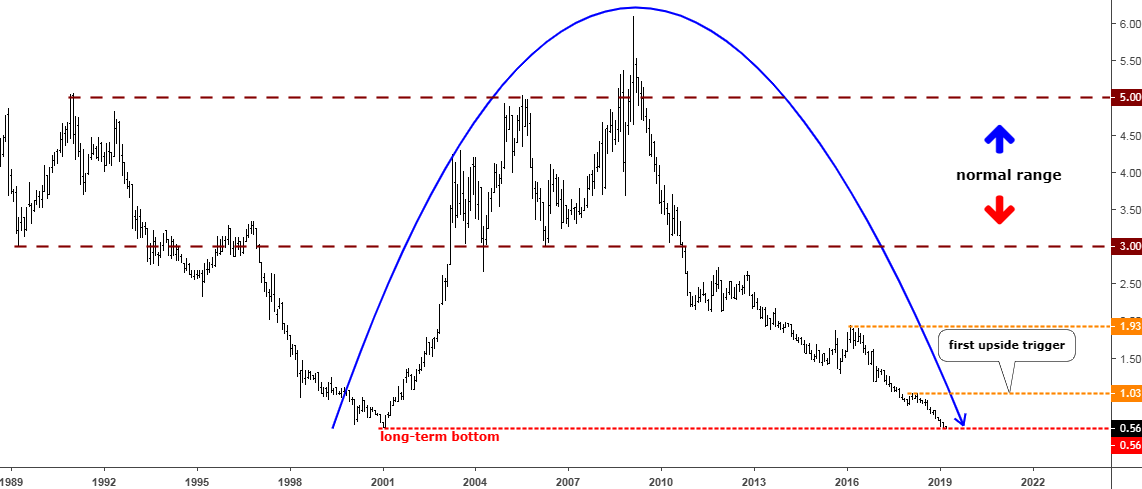
A year ago I wrote about the platinum/palladium ratio as it was on the edge, and there were two possible options, to restore the historically normal supremacy of platinum (target 1.93 oz) or to prolong the triumph of palladium (target 0.56 oz.).

This month the Platinum/Palladium ratio hit a new record low of 0.55 oz. amid the rocket move to the upside in the palladium market; the latter became the most precious metal beating gold. Let’s take a look at the big picture below.

Chart 1. Platinum/Palladium Ratio Monthly: New Record Low

platinum/palladium ratio
Chart courtesy of tradingview.com

The chart above starts with a robust growth to the upside from 3 to 5 oz. and this move had set the “normal” range for the fluctuations of the ratio within the next two decades. It was interrupted only once in 1997 when the ratio fell out of the range and quickly dropped to establish a previous record low of 0.56 oz. in 2001 amid rumors that Russia would ban palladium export. It was a textbook example of a “sell rumors - buy facts” market behavior, the ratio was down on rumors and then when the reality didn’t confirm it the ratio quickly returned to the normal range making a beautiful V-shape pattern. Then the ratio had spent another decade in that range. Continue reading "Palladium Pushed Platinum To Record Low"

Micro and Macro Investing Using ETFs

Most people wouldn’t think that investors could use Exchange Traded Funds to invest from both a macro standpoint and from a micro point of view, but due to the increasing number of ETFs now available to investors, this is possible.

First off, what is micro or macro investing?

Macro investing is when you take high-level data points and base your investment strategy on that information. A few examples of high-level data points would be gross domestic product, unemployment stats, US Home Sales stats, current interest rates, consumer confidence, business confidence, the purchasing manager's index, and so on. These data points highlight certain aspects of the economy from the ten-thousand-foot level. The macro picture will tell you how an economy is doing from a very general aspect.

The opposite side of that is micro investing or taking information from much smaller sample sizes and making investment decisions based on that information. A microdata point could be something as small as Apple’s (AAPL) revenue from their most recent earnings report or Amazon.com’s (AMZN) number of Prime Members subscribers. This very small, very direct and specific information will not tell you how the overall US economy is doing, but it would give you a better idea about how Apple or Amazon are faring as opposed to just knowing that the US GDP grew by 3.0% last quarter.

So how would you take macro investment data and put it to use with ETFs? Continue reading "Micro and Macro Investing Using ETFs"

CVS - Earnings Implosion And Opaque Near-Term

The pharmaceutical supply chain cohort is simply unable to obtain firm footing in the backdrop consolidation within the sector, legislative backdrop, drug pricing pressures, rising insurance costs and a market that has lost patience with these stocks. All of these factors culminate into sub-par growth with a level of uncertainty as this sector continues to face headwinds from multiple directions. Many of the stocks that comprised this cohort presented compelling valuations in a very frothy market. CVS Health (CVS) was one stock that stood out as compelling value sitting, near multi-year lows in December of 2018. During the market rebound in January and February, CVS began to appreciate to new highs moving from $63 in mid-January to $70 in mid-February or an 11% move to the upside. Upon the release of its Q4 earnings, the narrative quickly changed as the transition to growth and Aneta integration is proving to be much slower than investors had anticipated, yielding an opaque situation near term for the stock. CVS has a healthy balance sheet and growing its dividend while seizing partnerships and acquisitions to propel growth into the future. It’s no secret that these companies have been faced with several headwinds that have negatively impacted the growth and the changing marketplace conditions have plagued these stocks. Regardless, until growth is restored and Aneta is fully integrated to yield a fully functional bumper-to-bumper healthcare colossus, the stock remains range bound. However, the long-term picture looks rewarding for value investors as growth initiatives and acquisitions bear fruit.

Market Challenges

The political backdrop has been a major headwind for the entire pharmaceutical supply chain (i.e., drug manufacturers, pharmaceutical wholesalers, and pharmacies/pharmacy benefit managers). Exacerbating the political climate, the drug pricing debate continues to rage on throughout political and social media circles weighing on the sector. This backdrop erodes pricing power and margins of drugs that ultimately move from drug manufacturers to patients with insurers and other middlemen playing roles in the supply chain web. Continue reading "CVS - Earnings Implosion And Opaque Near-Term"