Copper On Big Time Frame Charts: $0.6 or $6?

There is an age-old question asking: How do you determine if a trader is biased? Show him a chart and ask where he thinks the market would go and then show him the same, but reversed chart and if the answer is the same, then this trader is indeed biased. We call such a trader a Perma-Bull or a Perma-Bear. The market sentiment is often split even as there are a lot of biased traders and market is then trapped within a range as there is no dominant opinion among the participants.

Every day I see how the trading community spreads opposite signals in any instrument creating an overwhelming sea of information where it’s hard for novice traders to focus and make a trading decision. Different levels of experience and fantasy generate the diversity of chart patterns and models. People change time frames and squeeze or expand charts; all of this affects the perception and therefore, the final decision.

Let’s perform an educational experiment with two patterns that I found on different time frames for the same instrument, copper. I will add two separate charts with those patterns followed by explanations. I am eager to see what you think about the outlook for this instrument after reading and voting on the pole at the end of the article. Continue reading "Copper On Big Time Frame Charts: $0.6 or $6?"
Disney: Fox Acquisition and Strong ESPN Numbers

Stock Trends Upward to New Highs

Disney (DIS) has finally broken out to new highs as the Fox (FOX) acquisition, and its streaming initiatives come into the fold. Now that the Fox acquisition is complete and its assets are being absorbed by Disney this once opaque situation now appears clear and definitive. Furthermore, Disney is divesting its 39% Sky ownership stake that it acquired via the Fox acquisition to Comcast (CMCSA). This divestiture enables Disney to reduce its debt that was required to purchase the Fox media assets and will allow more investment into its streaming services such as Hulu, ESPN Plus and its Disney branded streaming service that will directly compete with Netflix (NFLX) in 2019. The Fox acquisition brings a majority stake in Hulu (60% ownership) while its ESPN Plus launched earlier this year and has over 1 million subscribers in its early phases of being rolled out. Disney continues to dominate at the box office while posting great growth at its theme parks translating into robust and durable revenue streams. The company is evolving to meet the new age of media consumption demands of the consumer via streaming and on-demand content. To this end, shareholders are beginning to resonate with Disney’s vision for future growth and the stock has appreciated to a 52-week high as of late-breaking above the $118 level. Disney currently trades at a P/E of 14.5 while the average stock in the S&P 500 trades at ~25, representing a ~40% discount to the average stock in the index. Disney offers a compelling long-term investment opportunity given its backdrop.

ESPN Plus – Subscriber Numbers Released

ESPN Plus was launched earlier this year in April to a mixed skeptical reception among shareholders and consumers upon its debut. Due to precipitous declines in ESPN viewership via traditional cable, Disney was cornered to remediate its ESPN business and evolve to the cord cutting consumer. Recently, Disney announced a key milestone for its streaming platform, reaching over 1 million paid subscribers. ESPN is Disney’s first inroads into the streaming arena offering a package of sports which include Major League Baseball (MLB), National Hockey League (NHL), college football, soccer, boxing and UFC for $4.99 per month. Disney has kept its ESPN Plus subscriber numbers a secret and would only state that its paid subscriptions were "strong" and that growth was surpassing expectations. Continue reading "Disney: Fox Acquisition and Strong ESPN Numbers"

Emerging Market ETFs Could Offer Great Opportunities

Recent studies of emerging markets show their investment opportunities may be greater than most investors realize. One study believes that by 2020 the aggregate GDP of emerging markets will overtake that of developed economies around the world. Another one has the number of global consumers hitting 1.8 billion by 2025, with the majority of them living in emerging markets. Lastly, it is believed consumer spending in emerging markets will grow three times faster than that of developed markets in the coming years.

All three of these stats indicate there could soon be a huge growth opportunity in developing markets around the world. But there are a lot of emerging market ETFs that are down more than 9% year-to-date while the SPDR S&P 500 ETF (SPY) is up more than 10% and hitting new all-time highs. With that being said, many experts are beginning to grow weary of U.S. equities as we have now set a new record regarding the length of our current bull-market and valuations appear to be stretched.

When we take all of this into consideration, moving money to emerging market funds now may turn out to be a good long-term asset allocation play. So, let's take a look at a few funds which look appealing due to their rough 2018.

The first two are the Vanguard FTSE Emerging Markets ETF (VWO) and its direct competitor the Schwab Emerging Markets Equity ETF (SCHE). Both of these funds are large, liquid and have low fee’s; 0.14% and 0.13% respectively. They also both don’t consider South Korea an emerging market but hold positions based in Hong Kong, Taiwan, India, China, South Africa, Brazil, Russia, and Mexico to name the top 8 countries based on holdings. Both have an index weighting based on market cap and have a weighted market cap of around $80 billion, meaning you’re getting great foreign large-cap exposure. Continue reading "Emerging Market ETFs Could Offer Great Opportunities"

World Oil Supply, Demand And Price Outlook, October 2018

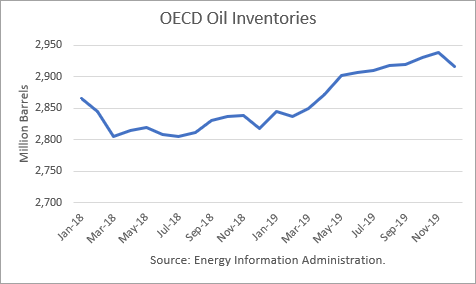
The Energy Information Administration (EIA) released its Short-Term Energy Outlook for October, and it shows that OECD oil inventories likely bottomed in July at 2.806 billion barrels. It shows inventories rising in the third quarter, contrary to the normal seasonal trend. However, it forecasts that stocks will drop in December to 2.817 billion after the Iranian sanctions are expected to go into effect.

Throughout 2019, OECD inventories are generally expected to rise, ending the year with 98 million barrels more than at the end of 2018. The expected drop in Iranian production, due to the U.S. sanctions, is forecast to be more-than-offset by increases from other producers, such as the U.S., Canada and the Gulf states of Saudi Arabia, Kuwait and the UAE.

oil inventories

Crown Prince Mohammed bin Salman of Saudi Arabia has recently stated that KSA can produce at least 12 million barrels per day. If it does increase output to that level, this would be a major “surprise” to world markets since its production has never exceeded 11 million. Continue reading "World Oil Supply, Demand And Price Outlook, October 2018"

Gold & Silver: Fly or Die

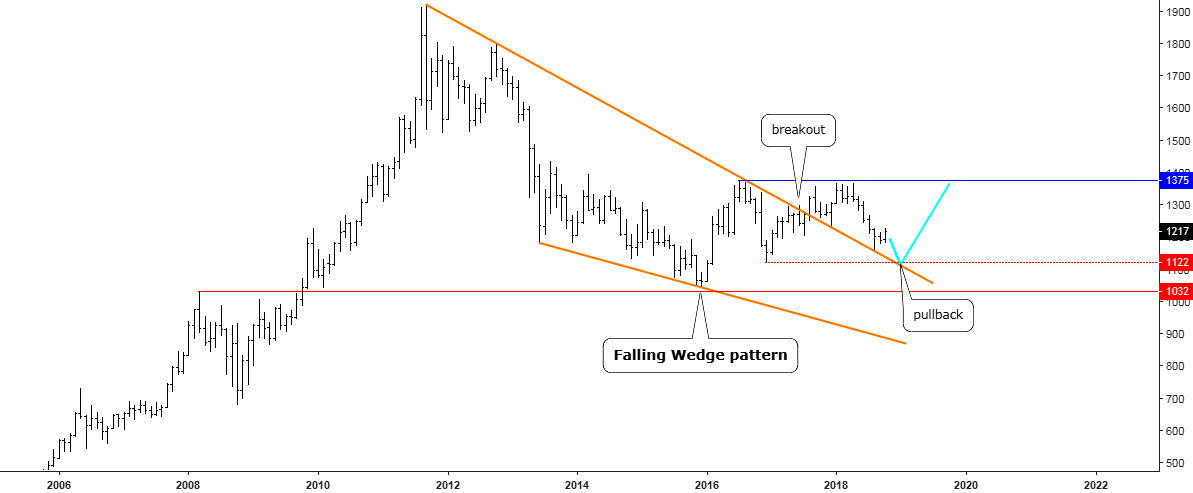
The precious metals are busy finishing the anticipated pullback to the former support, which is almost within our grasp on the short-term charts. So, let it go and in the meantime we can look into the bigger charts with higher time frames to update the outlook beyond the short-term horizon.

Chart 1. Gold Monthly: 1122/1375

Gold Shines
Chart courtesy of tradingview.com

The monthly gold chart above answers some critical questions. The first one, why gold reversed ahead of $1000? The answer is the red horizontal line, which was set at the 2008 top and acted as strong support and breakdown of it would unleash severe volatility into the market as the next level of serious technical support is located in the $700 area (2006 top/2008 bottom). Continue reading "Gold & Silver: Fly or Die"