Sometimes Keeping it Simple is the Best Way To Invest

Matt Thalman - INO.com Contributor - ETFs


Now that 2014 is officially over, it is a good time to review your portfolio's performance. Whether you are a stock picker, day trader, mutual fund investor, commodities or currency guru; understanding how much you made or lost in the markets during the year is extremely important. But, just knowing whether or not you made money isn't enough; you need to know whether or not you outperformed the market itself or else all the time and money you spent researching, buy and selling, or paying an advisor was simply a waste.

In order to determine whether your complicating things and throwing money away you should be comparing your total portfolio returns to that of a specific index such as the S&P 500 or more specifically the SPDR S&P 500 ETF (SPY). By using the SPDR S&P 500 ETF as a benchmark, you can determine whether you beat or were beaten by the market. This information will then allow you to make a better financial decision about how and with whom you invest your money moving forward.

Let's get started

First let's start with how your portfolio performed? To get total portfolio return you need to calculate if your investments increased or decreased. Take all the individual stocks, bonds, mutual funds ETF's you own, add up the total value of the investments at the start of 2014 and subtract that by what they were worth at the end of the year. (That figure should include all dividends, capital gains from investments sold.) For example, if you started with $90,000 in investable assets on January 1, 2014 and on December 31, 2014 those assets were worth $104,500. Therefore the return would have been $14,500 for the year or a 16.1%.

Now compare that number with the SPDR S&P 500 ETF which rose 11.4% in 2014 pre-dividend or 13.27% with dividends calculated into the total return. The example above certainly would have beaten the SPDR S&P 500 ETF, meaning you didn’t waste time or money during 2014. Continue reading "Sometimes Keeping it Simple is the Best Way To Invest"

Ready Or Not, Copper Could Halve Its Value!

Aibek Burabayev - INO.com Contributor - Metals


Dear INO.com readers,

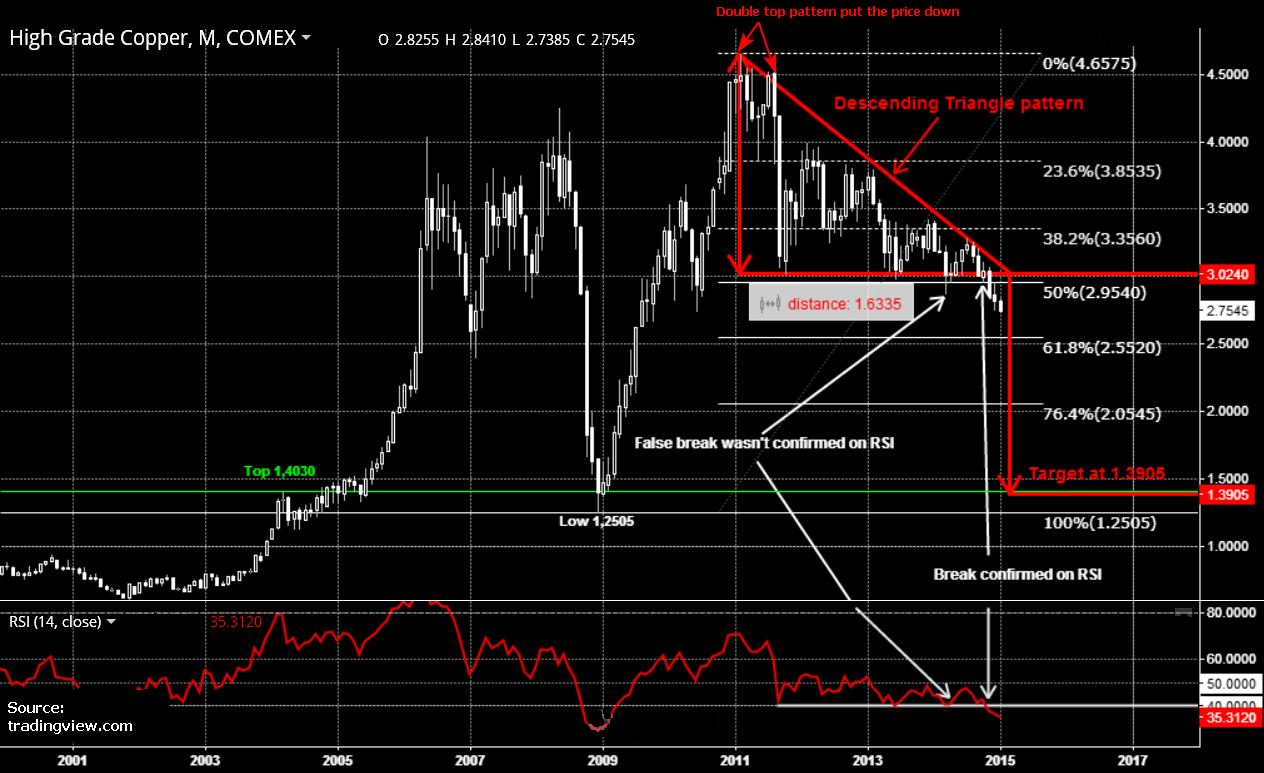
January turned out to be a harvest month for decent gain opportunities. This week, let's discuss copper which could lose half its weight this year. Impressive! Let's figure out how.

On the chart above, you'll see a monthly candle graph for COMEX high grade copper futures. As you can see, copper isn't phlegmatic at all, see-sawing up and down from below $1, up to almost $5 and again down for the past dozen years. And of course, that's why it is one of the best choices fo speculative traders.

2008 was a disastrous year for copper, free-falling from a $4.26 high to the $1.25 level and losing 70% of its value. Bad news for miners and brilliant for bear traders!

This reddish metal started 2009 as a rocket. Not to overload the graph, I didn't put Elliot waves on the bullish run. Two cycles completed on the way up from $1.25 to $4.55, where the fifth wave stalled with the top done at the $4.65 level at the start of 2011. 2.5 years of total growth thanks to QE. You should have noticed that fall is very short lived compared to unhurried growth, as fear is stronger than greed everywhere in the markets. Continue reading "Ready Or Not, Copper Could Halve Its Value!"

Can The ECB Learn From Its Own Mistakes?

Lior Alkalay - INO.com Contributor - Forex


This week, investors believe that they may have finally gotten the green light for ECB easing. With Eurozone inflation officially turning to deflation, investors believe that Mario Draghi and the ECB have been backed up into a corner with no escape, thus they will be forced to initiate a Quantitative Easing program that will balloon its balance sheet. In fact, the buildup towards this move started a few months back with Mario Draghi sending ever clearer signals of the ECB’s intent toward a full blown QE that will probably involve purchases of government bonds in a Federal Reserve-like manner.

If you will recall, Mario Draghi had also outlined the ECB’s intent to balloon its balance sheet back to its 2012 record of roughly €3.1 trillion. With the ECB’s current balance sheet at €2.216 trillion that means an estimated €884 billion in additional liquidity coming to the markets. As would be expected, the Euro has been in utter meltdown over the past few months, sliding to a low not seen in more than 9 years; of course, all this comes on the back of the impending liquidity injection and especially now as deflationary fears were confirmed with the Eurozone’s CPI at -0.2%. So far, this is par for the course, yet for me, this dredges up old memories of 2012.

The Big Mistake

Just by stating the obvious, that the ECB has to increase its balance sheet by a jaw-dropping €884 billion in order to increase its balance to the size it was a little more than two years ago, shows just how big a mistake the ECB has made in its policy since then. Across the “pond,” the Federal Reserve’s balance sheet has been growing since 2012 and its size has only now stabilized, as the US enjoys above-trend growth, a hair’s breadth of full employment and core inflation at a decent 1.7%. In the meanwhile, as the ECB was aggressively shrinking its own balance sheet, Eurozone growth came to a virtual standstill, unemployment remained stubbornly high, exports slowed, manufacturing weakened and, of course, the Eurozone moved into deflation. Continue reading "Can The ECB Learn From Its Own Mistakes?"

Chart For Profit: Buy Gold, Sell Euro

Aibek Burabayev - INO.com Contributor - Metals


Dear INO.com readers,

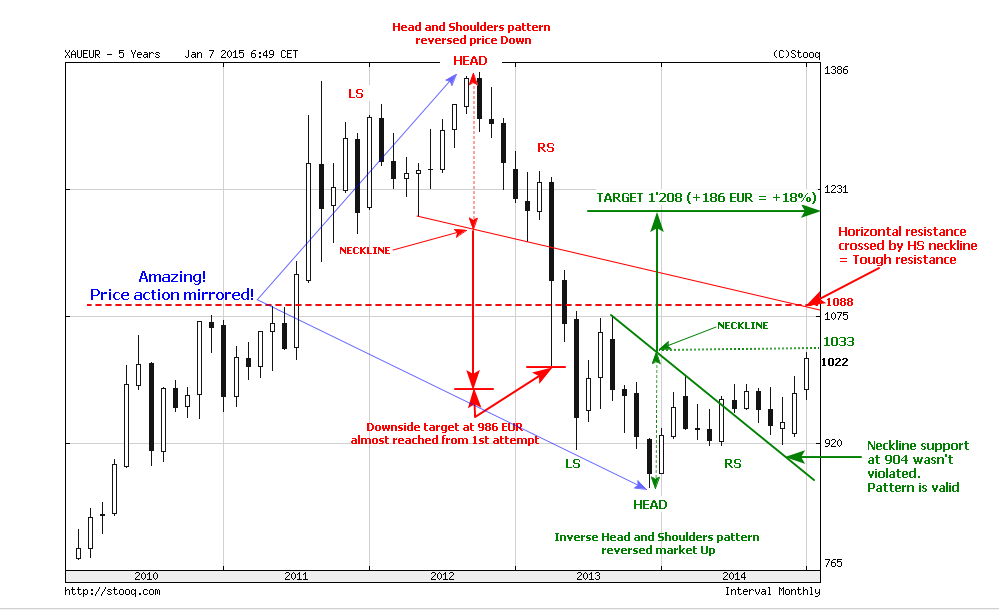
This week I prepared for you an analysis of gold versus the euro and why it might be profitable choice.

My last post was also dedicated to the European cross of gold versus the Swedish krona and, for the time being, it managed to gain more than 200 SEK per troy ounce (already or more than 2%). The target is set for a 14% gain, so please be patient.

Today I am going to tell you about a chance to score a nice 18%. The chart above is a monthly candle graph of XAUEUR for the last 5 years. It was me who wrongly forgot about such a liquid metal cross with such an interesting chart pattern being shaped. But fortunately, today we still have a chance to buy gold versus euro. Continue reading "Chart For Profit: Buy Gold, Sell Euro"

Best 2015 Bond Bet: Long U.S. Treasuries

George Yacik - INO.com Contributor - Fed & Interest Rates


Readers of my most recent columns know that I’ve been very critical of the Federal Reserve’s sluggishness – if not actual lack of resolve – to start raising short-term interest rates now that the economy has finally started to show some staying power. The earliest projections, both from Fed officials and market prognosticators, is that the first rate hike won’t come until well after the end of the first quarter of this year, if not sometime in the second half.

But even if the Fed should start taking my advice and start raising rates sooner – it looks like the March 17-18 FOMC meeting would be the earliest – don’t draw the conclusion that I also think long-term interest rates are headed any higher anytime soon.

If anything, I think long-term rates are headed lower in 2015, meaning I think this year will be another good year for bonds, U.S. Treasuries specifically.

That makes me a bit of a contrarian, which is usually where I feel most comfortable anyway. Continue reading "Best 2015 Bond Bet: Long U.S. Treasuries"