Hasbro Stock Struggling To Find Footing

The retail cohort reported a mixed bag during the most recent earnings season with Target (TGT), Khol’s (KSS), Gap (GPS), WalMart (WMT), Best Buy (BBY) and the Retail ETF (XRT) all experiencing downward pressure. This pressure has been exacerbated by the market wide sell-off in the broader indices. Hasbro (HAS) has struggled to find its footing moving into its historically biggest quarter. Hasbro is setting the post Toys R Us bankruptcy narrative and laying out a business roadmap for long-term profitable growth across its brands. The headwinds attributable to the bankruptcy of Toy R Us appear to be subsiding. This sentiment has been further bolstered by positive commentary from its CEO that the company will absolve itself of this Toy R Us related bankruptcy headwind come 2019. As Hasbro realigns and effectively manages the Toy R Us liquidation, this challenging backdrop is beginning to resolve itself to Hasbro's benefit. There are many current and future growth catalysts for Hasbro in movie franchises such as Marvel, Star Wars and other Disney (DIS) properties (Hasbro is the exclusive toy maker). Potential e-sports with Dungeons and Dragons and Magic: The Gathering, newly acquired Power Rangers franchise which will emulate Hasbro’s My Little Pony and Transformers’ Bumblebee within Hasbro Studios and its legacy games such as Monopoly and Nerf. Hasbro may benefit from a strong consumer, record low unemployment, a strong and growing dividend yield, clear skies post Toy R Us liquidation and putting forth initiatives within Hasbro Studios to further propel growth thus presenting a compelling long-term buy.

E-Commerce Channels Mitigating Toys R Us Bankruptcy

Analysts are predicting e-commerce toy orders to balloon to 40% of overall sales this year, up from 28% last year. Since Toys R Us has gone bankrupt, this puts a void of ~14% of last year’s U.S. toy sales that needs to be bridged, translating into $2.5 billion in revenue. This void will likely be filled by Target, Walmart and Amazon (AMZN) which recently, for the first time it will offer free shipping to everyone through the day before Christmas with no minimum purchase required. Per Jefferies analyst Stephanie Wissink, 70% of toy sales occur during the holiday season. Target and Walmart have announced expanded free-shipping programs of their own to drive online sales. Wissink sees Hasbro’s stock hitting $120 within a year and notes that the overall set-up for 2019 looks better than 2018. As other retail chains close the gap with the Toys R Us vacancy, Hasbro will likely return to form and growth across its brands. Hasbro has one more quarter to report earnings in which the Toys R Us issues will be impacting its numbers. 2019 will be free of this headwind, and all numbers will come full circle and be compared to post Toys R Us landscape. Continue reading "Hasbro Stock Struggling To Find Footing"
December OPEC Meeting Preview

When the OPEC-Non-OPEC Joint Ministerial Monitoring Committee (JMMC) convened in Abu Dhabi, United Arab Emirates in mid-November, it reported in a press release:

The Committee reviewed current oil supply and demand fundamentals and noted that 2019 prospects point to higher supply growth than global requirements, taking into account current uncertainties. “The Committee also noted that the dampening of global economic growth prospects, in addition to associated uncertainties, could have repercussions for global oil demand in 2019 – and could lead to widening the gap between supply and demand.”

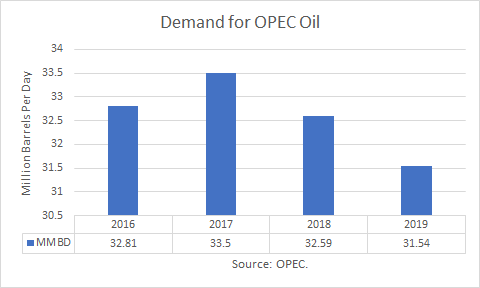
The figures they were reviewing were later released by OPEC in its November Monthly Oil Market Report. For 2019, they are projecting a decline in the demand for OPEC crude oil of about 1.04 million barrels per day to 31.54 mmbd. OPEC’s October production was estimated at 32.9 mmbd.

saudi energy minister khalid
Continue reading "December OPEC Meeting Preview"

Is The Housing Market About To Turn Positive?

One of the anomalies of the current economic rebound compared to past recoveries is the virtual absence of the housing market in the upturn. Not only has the housing industry – and its symbiotic partner, the mortgage market – failed to lead or even participate in the recovery, as it usually does, it’s been a laggard most of the way.

The main reason, of course, is the huge change in perception among young Americans about the attractiveness of home ownership. Most of them grew up during the housing boom of the early 2000s and the subsequent bust following the financial crisis – indeed, the housing bust was the root cause of the crisis – so homeownership for many of them has mostly negative connotations, as opposed to a symbol of the American Dream.

Then there’s the burden of student loan debt, which has made homeownership unaffordable for many, so it’s not hard to see why the U.S. homeownership rate has dropped to 64.3% most recently, down from the peak of 69.2% at the end of 2004.

Making matters even worse is the relative lack of homes for sale, which has created a huge supply-and-demand imbalance pushing prices in most areas of the country higher. The reason for the lack of supply is threefold: Older homeowners don’t want to give up the 3.5% mortgage they’ve refinanced into over the past several years. And many of them still can’t sell their homes at the price they want because the value is still below where it was 10 years ago. They’re also reluctant to sell their homes only to have to find a new home at an inflated price. Continue reading "Is The Housing Market About To Turn Positive?"

Gold Extends Consolidation Giving Silver Another Chance

Gold and silver exchange leading roles in the market quite often, especially on the short-term charts. Last time I wrote about it silver saved gold from collapse at the start of this month. The white metal unexpectedly bounced off the earlier low reversing the drop of the yellow metal.

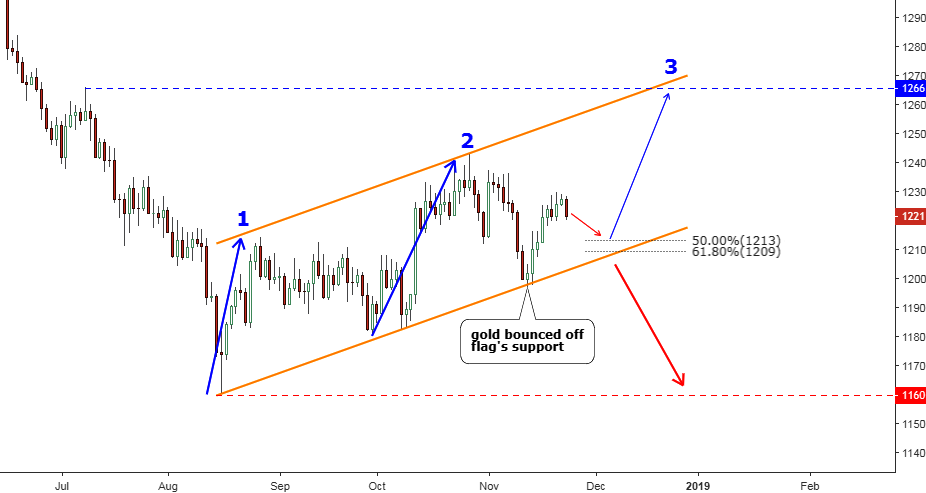
This time gold took the lead as its failure to break below the Bear Flag let silver lick its wounds and return above the $14 handle.

Both metals are still trapped in the middle of the range set by the earlier heavy drop, which first occurred in gold and then it was repeated in the silver market. In this post, I have focused on the local structure as the bigger picture remains unchanged.

Chart 1. Gold Daily: 3rd Leg Up Is Uncommon But Possible

consolidation
Chart courtesy of tradingview.com

The top metal couldn’t break below the trendline support of a Bear Flag (orange) and then quickly restored most of its losses coming back above $1200. It is interesting that the forecasted drop unfolded quite differently in each metal. Silver tagged the earlier trough, but gold failed even to breach the vertically sloped trendline. It looks like strong demand appeared right at the round number of the gold price in the $1200 area. Continue reading "Gold Extends Consolidation Giving Silver Another Chance"

CVS: Successfully Fighting Back to 52-Week Highs

Back in August, I had written an article highlighting the pharmaceutical supply chain cohort, presenting the case that these stocks were inexpensive in a very frothy market. Specifically, I profiled McKesson (MCK), Cardinal Health (CAH), CVS Health (CVS) and Walgreens Boots Alliance (WBA) and made the case that these stocks presented compelling value investments as all were near multi-year lows. The four companies above have healthy balance sheets and growing dividends while seizing partnerships and acquisitions to propel growth into the future. It’s no secret that these companies have been faced with several headwinds that have negatively impacted the growth and the changing marketplace conditions have plagued these stocks. The political backdrop has been a major headwind for the entire pharmaceutical supply chain (i.e., drug manufacturers, pharmaceutical wholesalers, and pharmacies/pharmacy benefit managers). Exacerbating the political climate, the drug pricing debate continues to rage on throughout political and social media circles weighing on the overarching sector. This backdrop erodes pricing power and margins of drugs that ultimately move from drug manufacturers to patients with insurers and other middlemen playing roles in the supply chain web. In an effort to address these headwinds and restore growth, companies within this cohort have made bold moves such as CVS acquiring Aetna (AET) to form a colossus bumper-to-bumper healthcare company and Cardinal Health shelling out $6.1 billion to acquire Medtronic's Patient Care, Deep Vein Thrombosis and Nutritional Insufficiency business. The overall cohort has been making bold acquisitions, heeding the competitive threats from the likes of Amazon (AMZN), possess great balance sheets, growing dividends, share buyback programs and more often than not posting growth albeit slower growth. These stocks presented value that provided a margin of safety that were largely de-risked considering the multi-year lows. Relative to the frothy market, these stocks were very inexpensive and witnessed a nice resurgence since proposing these stocks as value plays. CVS and Walgreens have retraced their 52-week highs as of late moving from their August lows and posting a 25% ($64 to $80) and 24% ($66 to $82), respectively. Specifically, I’ll be highlighting CVS Health as a continued value play for a long-term investment.

CVS and Aetna Combination

To further boost long-term growth prospects and fend off potential competition, CVS made a move to acquire Aetna and creates the first through-in-through healthcare company, combining CVS's pharmacies and PBM platform with Aetna's insurance business. Collectively, the acquisition is valued at $78 billion between stock and cash. This new CVS will combine its existing pharmacy benefits manager (PBM) and retail pharmacies with the second largest diversified healthcare company. This is a bold and hefty price tag to pay yet may be necessary to compete in the increasingly competitive healthcare space in the face of drug pricing pressures. CVS is making a defensive yet necessary acquisition moving into the future. Continue reading "CVS: Successfully Fighting Back to 52-Week Highs"