CVS Posts Robust Earnings - Compelling Long-Term Buy

Noah Kiedrowski - INO.com Contributor - Biotech


Introduction

CVS Health Corporation (NYSE:CVS) is fresh off reporting earnings for FYQ2 with beats on both the top and bottom line. EPS came in at $1.33 with revenue coming in at $45.69 billion, beating by $0.02 and $320 million, respectively. Since reporting earnings, the stock hasn’t moved as much of the pessimistic narrative was priced into the stock. Since its high of $112 in 2015, a slew of issues negatively impacting its growth and marketplace have plagued the stock. Firstly, the political backdrop was a significant headwind for the entire pharmaceutical supply chain from drug manufacturers to pharmacies/pharmacy benefit managers (i.e., CVS and Walgreens (WBA)) and the drug wholesalers in-between (i.e., McKesson (MCK), Cardinal Health (CAH) and AmerisourceBergen (ABC)). Secondly, marketplace trends forced CVS to cut guidance for Q4 2016 and the full-year 2017 numbers. CVS stated that “unexpected marketplace actions that will have a negative impact on our Q4 2016 results and a more meaningful impact on our outlook for 2017”. Thirdly, CVS lost a contract with the Department of Defense which carries tens of millions of prescriptions on an annual basis. A new restricted network relationship between Prime Therapeutics and Walgreens impacts CVS Pharmacy’s participation in selected fully-insured networks in several key states, and many cases make CVS Pharmacy a nonpreferred provider for Medicare Part D as well. These prescriptions tend to be the most profitable prescriptions as well. Lastly, Amazon’s purchase of Whole Foods and behind the scenes moves in the healthcare space has incited rumors that Amazon is looking to gain entry into the pharmacy area via leveraging the Whole Foods physical foot print of store fronts. I’ve written several articles contending that CVS presents a compelling investment opportunity in the ever expanding healthcare space. My investment thesis was based on an aging population and growth in long-term care facilities and the pharmacy benefit management segment. All of this in a backdrop of CVS being highly acquisitive, continuing to deliver robust earnings growth, revenue growth, growing dividends and has an aggressive share buyback program in place. It’s a matter of time before CVS will trend higher and in the meantime, investors will be paid to wait via dividends and share buybacks. The wildcard may be the Amazon threat with its first real pivot after acquiring Whole Foods with subsequent potential in entering the pharmacy space as well. Continue reading "CVS Posts Robust Earnings - Compelling Long-Term Buy"

Peak Oil Demand Season is Coming To A Close

Robert Boslego - INO.com Contributor - Energies


Peak demand for crude at refineries and for products to consumers is drawing to a close this season. Together, they caused total U.S. oil inventories to drop by 49 million barrels from their peak in the week ending June 9th. Total U.S. oil inventories stand at 1.304 billion barrels in the week ending August 11th, 58 million barrels lower than a year ago.

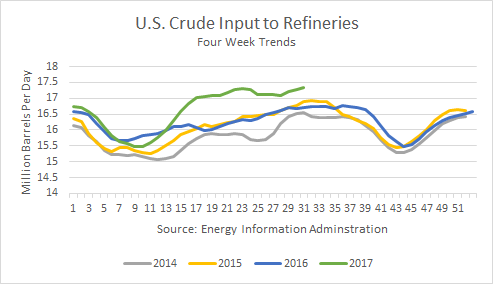
Refinery demand for crude oil set a new record high this summer, as the 4-week trend reached 17.458 million barrels per day, 4.4% higher than last year. As depicted in the graph below, refiners will soon be dialing back their operations for maintenance, and this will reduce the demand for crude at U.S. refineries by about 1.5 mmbd.

U.S. Crude Input to Refineries

Domestic demand was relatively strong this summer, up about 2.0% from last year. Gasoline demand was somewhat disappointing, but distillate demand spiked. As shown in the graph below, seasonal demand has likely peaked and will be headed lower in the weeks and months ahead. Continue reading "Peak Oil Demand Season is Coming To A Close"

How You Can Make Money From Market Volatility

Matt Thalman - INO.com Contributor - ETFs


Based on a number of recent reports indicating the major indexes could end the year flat from where they sit today, I offered a few ideas on how investors could still profit during the last four months of 2017.

One of those ways was using Exchange Traded Funds that invest in the futures of the Volatility Index. For most investors, the CBOE Volatility Index or VIX or even the 'fear gauge,' is a rather complicated and confusing market measuring stick. So, today we are going to go through the 'ins' and 'outs' of the VIX and go into a little more detail on how the average investor can use the VIX ETF's to turn a little profit from time to time.

The CBOE Volatility Index (VIX) was designed to put a number on market volatility so investors could trade and make money based on the volatility of the stock market. This is achieved through the use of the futures market and options prices. The VIX tells investors the square root of the risk-neutral expectation of the S&P 500 variance during the following 30 calendar days.

The VIX is often quoted as a number, say 10, 20, 25. That number represents the expected annualized change, with a 68% probability of being true, of the S&P 500. So for example if the VIX is at 20, it would be predicting the S&P 500 will change up or down by 20% over the next 12 months. Continue reading "How You Can Make Money From Market Volatility"

The Madness of Crowds

George Yacik - INO.com Contributor - Fed & Interest Rates


What a difference a week makes. Two weeks ago we were in a nuclear standoff with North Korea’s mad dictator. Then just a week later the nation was plunged into a “crisis” over a few thousand – or is it a couple of hundred? – Klansmen and Nazis, which had the smartest people in government, business and politics refighting the Civil War. Kim Jong-Un and his sycophants in Pyongyang must be laughing themselves silly, or kicking themselves for backing down.

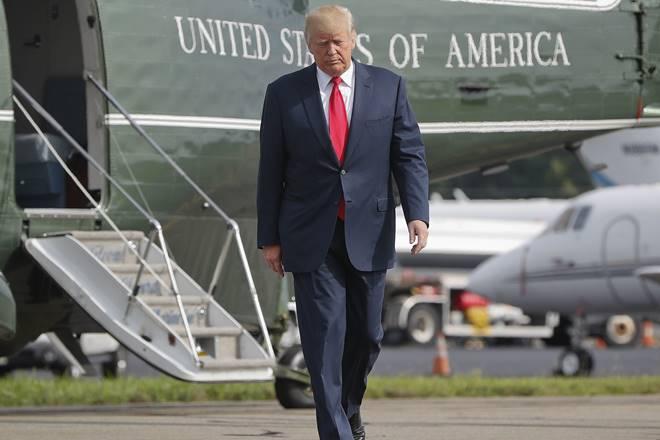
President Donald Trump
Image Courtesy of AP

If all we have to worry about is a bunch of Klansmen and Nazis parading in the streets, things must be pretty darn good in the United States. So intelligent investors shouldn’t be overly alarmed and go about their business, as they seemed to be doing by the end of last week.

Then again, this phony outrage has nothing to do with racism or hate or statues of Confederate generals. It has everything to do with President Donald Trump’s enemies trying to remove him from office.

Whether they will be successful or not remains to be determined. But last week’s events certainly should leave us a little concerned, since we learned a little bit more about who Trump’s friends are, and who he can count on for support if things get worse. Continue reading "The Madness of Crowds"

Market May End The Year Where It Is Today, But You Can Still Make Money

Matt Thalman - INO.com Contributor - ETFs


A number of market participants have begun making year end predictions about where they believe stocks will finish. The predictions have the market finishing higher, lower, a lot higher, a lot lower, and right where it is today. Basically, no one really knows how the stock market will finish 2017 because no one can accurately predict the future.

But, when we look at the past, predictions have been made which aren’t as optimistic. Based on historical data a Goldman Sachs analyst has noted that when stock valuations have been where they are today, the market returns have been in single digits or negative.

Year-to-date the S&P 500 is already up 10.5%, which again compared to historical averages is an above average return. Furthermore, history tells us that we have market pull backs of 5%, 10%, and 15% rather often; about every 3 months, 8 months, and 14 months. We have not seen a 10% or 15% pullback in 2017. Continue reading "Market May End The Year Where It Is Today, But You Can Still Make Money"