An Industry That Could Be A "Savior"

A few years ago, the investing world was enthralled with the idea that the marijuana industry was going to be the ‘next big investing trend.’ Unfortunately, for most who bought into the hype, the investments in the industry have not lived up to their promises. However, that may soon be changing.

The big marijuana players and their investors have all suffered over the years for several reasons. First, the industry is simply too fragmented for a single or handful of players to dominate the landscape. This is an issue because while competition is good, too much competition doesn’t allow individual companies in the industry to experience the power of ‘scale.’

What that means is, let’s say a marijuana company opens a farm. The farm may be large enough to produce 100 pounds, which is enough to cover the costs of the farm and the farmer. However, that 100 pounds aren’t enough to cover the cost of the transportation of the product from the farm, the distribution center, the security for the farm and distribution center, or the research and development so that the farmer can become more efficient and offer different strains. The fragmentation of the industry also hurts pricing power. The more competition means people trying to push product, perhaps simply to cover costs, means prices hit near rock bottom.

Another reason the industry has suffered is the very slow progress of legalizing marijuana both in most US States and the vast majority of countries around the world. With only a handful of states in the US having legalized the plant and the Federal Government still considering it a controlled substance, adoption rates around the country have been sluggish. When the industry was expecting to grow due to increasing numbers of legalized States rapidly, investors were pouring money into them. However, that money has begun drying up, which is now causing problems on balance sheets and debt levels. Continue reading "An Industry That Could Be A "Savior""
World Oil Supply And Price Outlook, July 2020

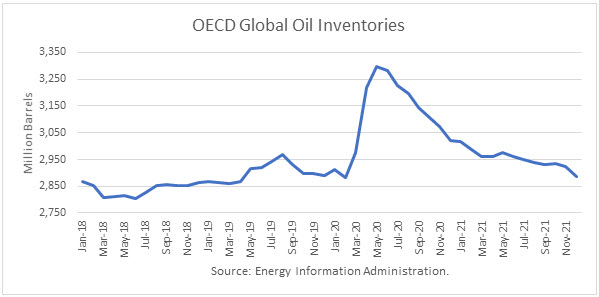
The Energy Information Administration released its Short-Term Energy Outlook for July, and it shows that OECD oil inventories likely bottomed in this cycle in June 2018 at 2.804 billion barrels. It estimated stocks dropped by 14 million barrels in June to end at 3.283 billion, 362 million barrels higher than a year ago. It estimates that inventories peaked in May 2020 at 3.297 billion.

The EIA estimated global oil production at 87.59 million barrels per day (mmbd) for June, compared to global oil consumption of 89.47 mmbd. That implies an undersupply of 1.87 mmbd or 56 million barrels for the month. However, that is still a small figure compared to the size of the build from February, which was 399 million barrels.

For 2020, OECD inventories are projected to build by 132 million barrels to 3.022 billion. For 2021 it forecasts that stocks will draw by 137 million barrels to end the year at 2.855 billion.

Oil

The EIA forecast was made to incorporate the OPEC+ decision to cut production and exports. According to OPEC’s press release: Continue reading "World Oil Supply And Price Outlook, July 2020"

The Financial Cohort and COVID-19 Dynamics

COVID-19 ushered in the real possibility of widespread loan defaults, liquidity issues, ballooning credit card debt (as banks hold the liability), and stressed mortgages. To exacerbate these COVID-19 impacts, a delicate balance between interest rates, Federal Reserve actions, potential yield curve inversion, and liquidity must be reached. The customer side of the business continues to be worrisome as the duration of this crisis continues to drag on with no signs of slowing. A segment of the consumer base is faced with lost wages and the real possibility of not being able to meet their financial obligations (i.e., car payments, mortgage payments, etc.), which will unquestionably have a negative impact on revenue and earnings for banks. The financial cohort is in a difficult space as the broader economic backdrop continues to dictate whether these stocks can appreciate higher. The initial shock of the COVID-19 pandemic resulted in the market capitalizations of many large banks to be cut by ~50%. Some of the largest banking institutions such as Citi (C), Goldman Sachs (GS), JPMorgan (JPM), and Bank of America (BAC) were sold off in the most aggressive manner since the Financial Crisis a decade earlier. As COVID-19 continues to drag in both spread and duration, share buybacks have now been halted, and dividend payouts arrested. The stability of dividend payouts is now in question as uncertainty continues to cloud this sector. Moving forward, how durable are the major financial names at these depressed levels, are the banks investable in light of the COVID-19 backdrop?

Recent Federal Reserve Stress Tests

The Federal Reserve put new restrictions on the banking sector after the results from the annual stress test found that several banks could get too close to minimum capital levels in potential scenarios tied to the COVID-19 pandemic. The largest banking institutions will be required to suspend share buybacks and arrest dividend payments at their current level for Q3 of 2020. For the first time in the 10 year history of these stress tests, banks are now required to resubmit their payout plans again later this year. This move is indicative of the unique and unprecedented landscape of the COVID-19 pandemic. Continue reading "The Financial Cohort and COVID-19 Dynamics"

Summer Weather Impacts Futures

Corn Futures

Corn futures in the December contract settled last Friday in Chicago at 3.53 a bushel while currently trading at 3.54 unchanged as traders are awaiting the WASDE crop report with estimates around 2.683 billion bushels as the carryover level. Any number below that number will be construed as bullish. In contrast, any amount higher than that number would be construed as bearish as the weather will now be the short-term dictator of price action. The 7-10 day weather forecast still has above-average temperatures. However, the crop at the current time has estimates around 71% good/excellent condition.

I am not involved as I do have a bullish soybean recommendation.
However, if you are long a futures contract, I would place the stop loss under the contract low standing at 3.22 as an exit strategy. I'm keeping a close eye on this market for a bullish position as I want the chart structure to improve, and that will take another couple of days or a replacement in price.

Corn prices are still trading above their 20 and 100 a moving average as the trend is higher as prices are still hovering right near a 3 month high with the next major level of resistance at the 3.60 area and if that is broken, I think we can head up to the $4 level as I see no reason to be short.

TREND: HIGHER
CHART STRUCTURE: IMPROVING
VOLATILITY: HIGH

Soybean Futures

Soybean futures in the November contract settled last Friday in Chicago at 8.96 a bushel while currently trading at 9.01, basically unchanged for the week. I have been recommending a bullish position from around the 8.97 level. If you took that trade, continue to place the stop loss at 8.56 as an exit strategy as the chart structure will improve early in next week's trade, therefore lowering the monetary risk. Traders are awaiting this afternoon's WASDE crop report with estimates around 414 million bushel carryover as that report will certainly send volatility back into this market. Continue reading "Summer Weather Impacts Futures"

"Diamond" Pattern Pushed Gold To Sky Vs. Silver

I appreciate active readers of the Blog for leaving valuable comments on Gold and Silver posts. Recently, there have been a lot of thoughts shared not only about the metals itself but also about its relationship reflected in the dynamics of the Gold/Silver ratio. I think it’s time to talk about it in this post. Please feel free to enrich this piece with your valuable thoughts in the comments section.

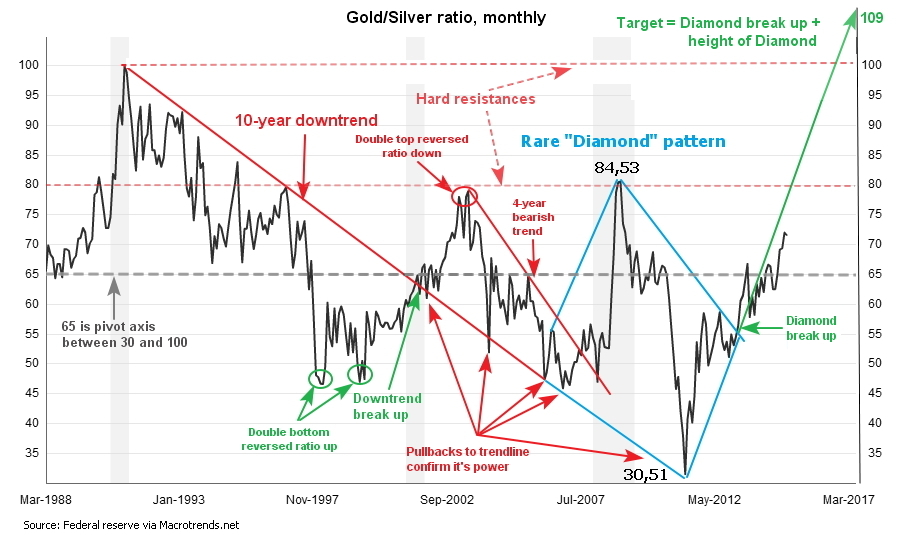
Back in December 2014, I shared only the third post here on the Blog. The title was more appropriate for a science fiction novel as it promised the “journey to the Moon” for the Gold/Silver ratio as it was going to hit the 109 ounces. Below is that very chart from the distant 2014 to refresh the memory.

gold silver

The idea was based on the “Diamond” pattern spotted on the monthly chart (blue). The target was reached more than five years later on the 16th of March this year. The total gain is equal to 109 - 72 = 37 troy ounces of silver per troy ounce of gold or 51% in five years.

Let’s see in the weekly chart below the ratio dynamics after that post. Continue reading ""Diamond" Pattern Pushed Gold To Sky Vs. Silver"