Coronavirus - ETFs You Should Avoid

With the deadly Coronavirus outbreak continuing to spread and countless US companies let alone Chinese firms suspend business in China, even though the true extent of that effect is yet to be known, it’s clear there is going to be some economic effect from this disease.

Like it or not, we all live in a world that is becoming increasingly more interconnected and interdependent. This is the same reason a disease like Coronavirus is so quick to spread around the world and why the impact on stocks is not going to be limited to those firms based solely in China.

This makes it even more difficult for investors to truly determine what is safe and what isn’t in the stock market right now. However, we do have some low hanging fruit in terms of what you should not own at this time.

The first Exchange Traded Funds you should be avoiding right now are going to be the pure-play Chinese equity ETFs. The iShares MSCI China ETF (MCHI) or the SPDR S&P China ETF (GXC) should be on your sell list or high on the list of what not to buy. These funds invest in Chinese equities and don’t favor one sector more than others. The longer the ‘quarantine’ periods last in the different provinces in China, the more these ETFs are going to be hurt, end of story. However, these could be two outstanding options if you are looking to buy back into the Chinese markets once the Coronavirus scare dies off.

Furthermore, ETFs such as the Continue reading "Coronavirus - ETFs You Should Avoid"
Coronavirus Puts Pressure On Futures

Gold Futures

Gold futures in the April contract is trading higher for the 3rd consecutive session after settling last Friday in New York at 1,578 an ounce while currently trading at 1,591 as prices are right near a 7 year high.

At the current time, I'm not involved, but I do believe higher prices are ahead as there is so much uncertainty about the Coronavirus. If that situation becomes worse, you will see massive money flows continue to enter the bond and gold market. If you are long a futures contract, I would place the stop loss under the 10-day low standing at 1,552 as an exit strategy as prices are trading above their 20 and 100-day moving average telling you that the trend is to the upside.

In my opinion, I believe prices will test the January 8th high of 1,619, possibly in next week's trade. I see no reason to be short gold at this time. Volatility is average, and I think it could start to expand tremendously to the upside, especially if the Coronavirus continues to spread as quickly as it has as. Nobody understands how bad this situation can become, as that will continue to support gold prices in the short-term.

TREND: HIGHER
CHART STRUCTURE: IMPROVING
VOLATILITY: AVERAGE

Platinum Futures

Platinum futures in the April contract settled last Friday in New York at 1,010 an ounce while currently trading at 963. I had been recommending a bullish position over the last month from around the 974 level as it is time to exit as prices are right near a three week low. Continue reading "Coronavirus Puts Pressure On Futures"

Put Spread Options - Defining Risk and Maximizing Returns

As 2020 unfolds and the markets continue to break through record highs, investors should heed these lofty levels. We’re in the longest bull market in history and the U.S. has started and ended a decade without a recession for the first time in history. By nearly all measures, these markets are overvalued with stretched valuations.

Deploying a put spread strategy is a great way to define your risk while leveraging a minimal amount of capital to maximize returns. Whether you have a small account or a large account, a put spread strategy is an effective way to limit risk with a high probability of success. Trading options on stocks like Expedia (EXPE), Tesla (TSLA), Ulta Beauty (ULTA), Apple (AAPL), Disney (DIS), Facebook (FB), etc., that possess such a high price per share when account balances are limited are no longer an issue with put spreads. Put spreads enable you to leverage a minimal amount of capital, which opens the door to trading virtually any stock all while defining your risk.

Over the past 13 months, ~315 trades have been made with a win rate of 86% and a premium capture of 57% across 69 different tickers. When stacked up against the S&P 500, an options strategy generated a return of 9.1% compared to the S&P 500 index which returned 3.7% over the same period. These returns demonstrate the resilience of this high probability options trading in both bear and bull markets. These results can be replicated irrespective of account size when following the fundamentals outlined below.

Put Spread and Defining Risk

Options can be used in a leveraged manner hence using small amounts of capital to trade what otherwise would require much greater capital requirements. A put spread is a type of options trade that risk-defines your trades and involves selling and buying an option. Let’s review a put spread below.

The Put Spread: Continue reading "Put Spread Options - Defining Risk and Maximizing Returns"

Worst Performing ETFs in 2019

Earlier in the month, we discussed the Top Performing ETFs of 2019. In this post, we'll discuss the worst performing ETFs of 2019.

After a down year in 2018, the stock market roared back in 2019 despite a number of political headwinds and many market participants calling for a recession to commence during the second half of the year. Fortunately, that never happened and the market shrugged off most of the negative headlines throughout the year since for the most part, economic numbers remained strong and while corporate earnings and revenue growth may be slowing, they are still in positive territory, which is undoubtedly a good sign.

With the S&P 500 (SP500) ending the year up 28.9%, the Dow Jones Industrial Average (DJI) rose 22.3%, and the NASDAQ (COMP) increased by 35.2% in 2019, one may wonder how anyone could have lost money in 2019, but unfortunately, some Exchange Traded Funds and therefore investor, did actually see negative returns during a year when the major indexes all crushed it.

Most investors who ended the year negative may want to forget about what happened. But those investors who focus on understanding why their investments went south are the ones who will learn from their mistakes and hopefully avoid making them in the future. The start of a new year is an excellent time to review your investing thesis and try to pinpoint why some investments didn’t turn out the way you imagined they would. So let’s take a look at the top five worst performing ETFs of 2019 in a number of different categories the average investor had to choose from in 2019 to see if you owned one or more of them.

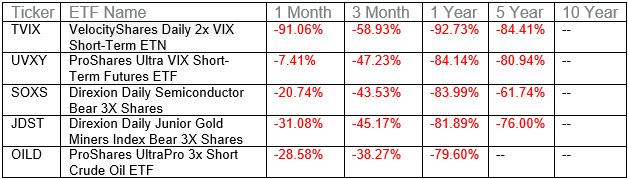
The following table shows the performance of the worst five ETFs in 2019, as well as their performance over the last month, the previous three months, the last five and ten years.

ETFs

The following table shows the performance of the worst five Non-Leveraged ETFs in 2019, as well as their performance over the last month, the previous three months, the last five and ten years. Continue reading "Worst Performing ETFs in 2019"

Visualizing Correlation: Gold Vs. Other Instruments

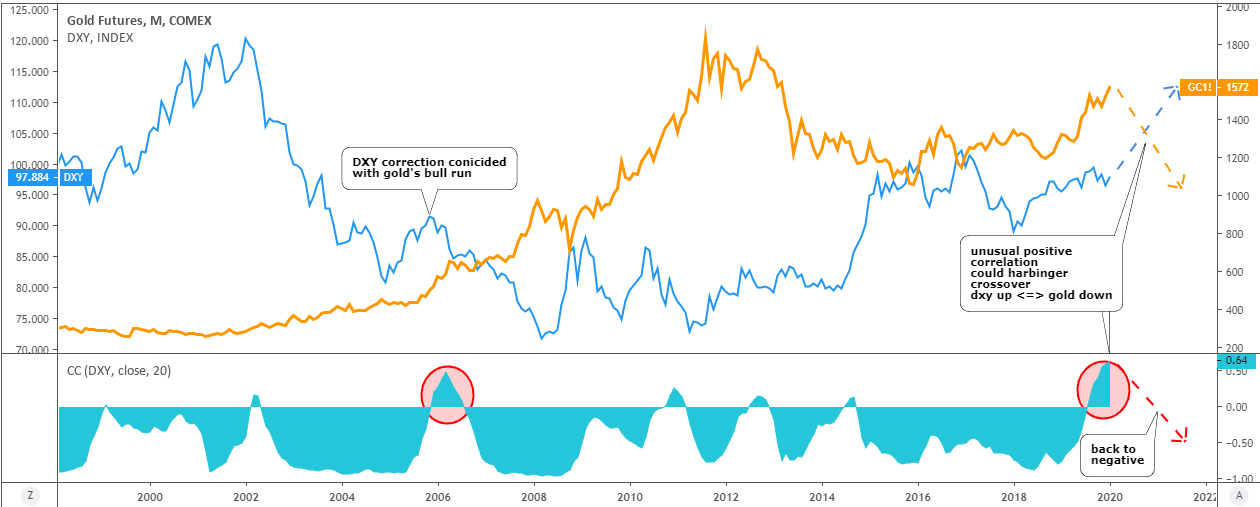
Some of our regular readers kindly shared their opinion about the gold market correlation with other instruments in the comments section under my previous post. I think it could be interesting for all of us to see what is going on there if we check the correlation between gold and other instruments.

I prepared the visualization of it for you below. The dollar index and the 5-year TIPS (Treasury Inflation-Protected Securities) were named in the comments, and I will add two other top instruments, so please stay tuned.

Let’s start with the Dollar Index (DXY).

Correlation
DXY: blue, left scale / Gold: orange, right scale / Correlation coefficient: turquoise, sub-chart - Chart courtesy of tradingview.com

For more than 20 years, these two instruments were mostly in a negative/mirrored correlation. It just changes from extremely negative to zero correlation with rare spikes into positive territory. Continue reading "Visualizing Correlation: Gold Vs. Other Instruments"